


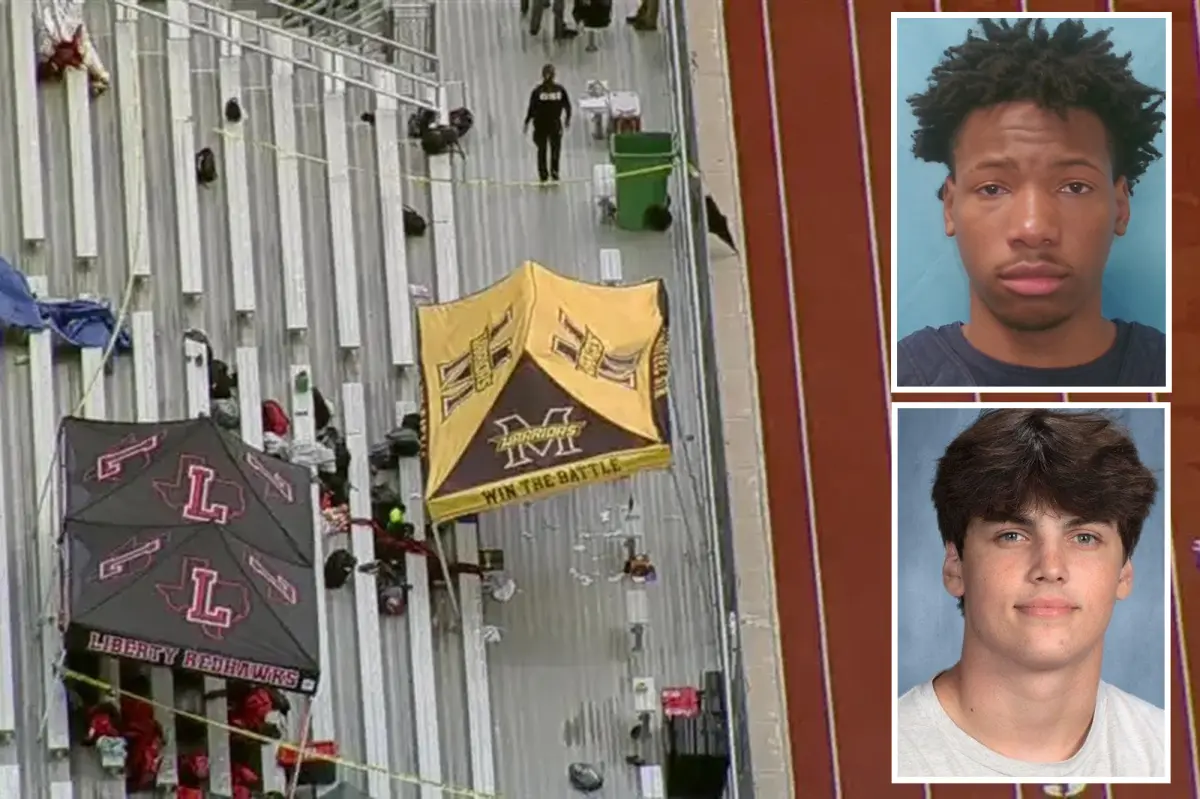
It began as a senseless tragedy on a cool spring evening in the affluent suburb of Frisco, Texas—a high school track meet, a sudden confrontation under a medical tent, and a knife being drawn with lethal finality. On April 2, 2025, 17-year-old Austin Metcalf’s life was brutally extinguished, and 19-year-old Karmelo Anthony was swiftly arrested, charged, tried, and convicted of murder. To the outside world, the case initially seemed almost disturbingly open-and-shut: a young man brought a deadly blade to school grounds and used it with devastating consequences, leaving a family shattered and a community reeling in shock. Yet, behind the sterile glass walls of the Collin County courthouse, a far more complicated and insidious story was quietly unfolding—one that has now thrown the entire integrity of the verdict into profound doubt. Last month, startling court documents surfaced, revealing that Anthony’s original defense team and the Texas prosecutors had brokered a clandestine, unwritten “gentleman’s agreement” designed to sanitize the entire trial. This secret pact, now the centerpiece of a desperate and high-stakes appeal, radically restricted what the jury was allowed to hear, stripping away the messy, brutal context of both boys’ lives. It was an agreement intended to steer the proceedings toward one narrow, sterile question—what exactly happened under the tent—thereby ignoring the explosive personal histories that might have swayed a jury to see the tragedy in a profoundly different light. As Anthony’s new, high-profile civil rights lawyers gear up to dismantle both the verdict and the judge who presided over it, the very integrity of the American legal system itself is now standing trial alongside the convicted teen.
The terms of this “gentleman’s agreement,” detailed in filings submitted by Anthony’s new appellate counsel, paint a stark picture of a trial deliberately stripped of all mitigating factors, a calculated gamble that has now backfired spectacularly. On one side, the defense, led by attorney Mike Howard, pledged to refrain from introducing any evidence pertaining to the Metcalf twins’ character, reputation, or any prior acts of violence, bullying, or racism. This was a staggering concession, effectively silencing any suggestion that Austin Metcalf might have had a history of antagonism that could have provoked the fatal altercation. On the other side, the prosecution agreed to bury Anthony’s own school disciplinary history and to forgo using his cellphone records, which potentially could have painted a picture of premeditation or prior threats. However, the most damning aspect of the agreement, according to the recent court filing, is what it did to Anthony’s own defense. In direct reliance on this secret pact, attorney Howard chose not to delve into the substantial family violence that Anthony had both witnessed and personally endured within his own home. This omission stripped him of a powerful narrative of a young trauma victim whose fight-or-flight response might have been dangerously distorted by a chaotic, abusive environment. The agreement also placed tight shackles on who could testify as character witnesses for Anthony, ensuring the jury saw only a two-dimensional portrait of a cold-blooded killer rather than a complex young man shaped by pain and fear. The intention was to keep the trial efficient, clean, and focused solely on the forensic details of the stabbing, but Anthony’s new lawyers argue it was a catastrophic miscarriage of justice, denying the jury the full, humanizing picture required to render a truly informed and just verdict.
Facing the weight of this startling revelation, the Collin County District Attorney’s Office has pushed back with defiant confidence, insisting that no ethical lines were crossed. First Assistant District Attorney Bill Wirskye publicly stated that he and his team “conducted this trial ethically and in full compliance with the Court’s rulings and any agreements with defense counsel.” From the prosecution’s perspective, the agreement was a mutual strategic choice, not an act of concealment—both sides voluntarily gave up powerful ammunition to focus on the immediate facts of the lethal stabbing. Yet, the optics of the pact are undeniably toxic, particularly now that Anthony has enlisted a legal dream team to overturn his conviction and breathe life into his case. The new defense is spearheaded by veteran appellate attorney Russell Wilson and civil rights lawyer Brooke Cluse from the nationally renowned Ben Crump Law firm—attorneys who have built their formidable careers on exposing systemic inequities, prosecutorial overreach, and the hidden biases that taint the justice system. For them, this “gentleman’s agreement” is not a legal nuance or a tactical savvy; it is a smoking gun proving that Anthony was denied a fundamentally fair trial. By willingly blinding the original defense to Anthony’s horrific history of abuse—evidence that undoubtedly would have humanized him in the eyes of the jury—and by barring the prosecution from exposing his disciplinary past, the trial became a sterilized theatrical performance. The critical legal question now is whether the courts will view this pact as a fatal procedural violation warranting a new trial, or as a legitimate, though perhaps foolish, trial strategy. The answer will likely determine whether Anthony spends the rest of his life behind bars or gets a second, more equitable shot at freedom.
The battle over Anthony’s fate has now shifted to a perilous new front: the very bench of the judge who oversaw his conviction, the Honorable John Roach. On Wednesday, in a McKinney, Texas courtroom, Anthony’s lawyers will make a direct attempt to have Judge Roach recused, arguing forcefully that his public comments following the trial demonstrate unforgivable judicial bias and a closed mind. Roach, an elected judge who is set to retire on December 31st, has been unapologetic and outspoken about his handling of the case, particularly his steadfast refusal to allow cameras into the courtroom during the proceedings. Just two days after sentencing Anthony, Roach defended his decision with emphatic vigor, telling local media, “Yes, it was an easy decision. I’ll tell you why, my primary goal in every case is to make sure the defendant and the prosecution get a fair trial. Period.” He elaborated that he has observed from other high-profile cases across the country how cameras can alter the behavior of judges, lawyers, and witnesses, inducing theatrical performances incompatible with sober justice. Furthermore, Roach expressed absolute confidence in the jury’s verdict, asserting that they were selected according to the law, listened carefully to the facts presented within his courtroom, and reached the “correct conclusion” through their deliberations. While these statements read on the surface as a judge defending his process, Anthony’s attorneys interpret them as clear evidence of a prejudiced jurist—one who has already pre-judged the merits of the case and is unwilling to entertain the possibility of an unfair trial. This, they argue, fundamentally undermines the very impartiality that constitutional law demands.
The legal chess match is now set to move at a dizzying pace, dictated by the unforgiving constraints of Texas procedural law, leaving little room for error. If Judge Roach is successfully recused from the case, Anthony’s defense team has announced they will immediately file a motion for a new trial, likely as early as the very next day. This motion will then be subject to a ruling by August 24th, a hard deadline imposed by Texas statutes which allow a court exactly 75 days from the date of sentencing to adjudicate such a motion. Crucially, if the judge fails to act within that specific window, the motion is automatically denied by operation of law, slamming the door on a retrial without any formal judicial acknowledgment. This procedural cliffhanger places immense pressure on the upcoming recusal hearing. Anthony’s lawyers are banking not only on the explosive nature of the “gentleman’s agreement” but also on the argument that Roach’s post-trial remarks indicate he cannot be trusted to objectively review the request for a new trial, having already gone on record to publicly legitimize the jury’s outcome. It is a high-stakes gamble fraught with tension; should they succeed in removing Roach, they gain an impartial arbiter who might look upon the suppressed family violence evidence and the secret pact with fresh, skeptical eyes. Should they fail, they face a judge who has already signaled his ironclad confidence in the trial’s fairness, drastically reducing their chances of ever reopening the case. The clock is ticking, and every day brings the Anthony family closer to either a glimmer of hope or a crushing finality.
Beneath the legal jargon, the secret agreements, and the procedural maneuvering, there lies a devastating human tragedy that is often lost in the fray of gavel banging and appellate filings. The Metcalf family is enduring an unfathomable loss—the brutal murder of a beloved son and brother at a place meant for youthful competition, growth, and community spirit. Their grief is compounded by the public airing of allegations about Austin’s “character” and “bullying” history, which his father, Jeff Metcalf, has refused to comment on, citing ongoing court proceedings. Conversely, the Anthony family watches their 19-year-old son face a lifetime behind bars, holding onto the bitter revelation that crucial, mitigating details about his own traumatic upbringing were knowingly withheld from the jury by a strategy brokered in a backroom. This case forces a chilling, uncomfortable question upon the American public: can a trial that deliberately ignores the context of domestic violence, systemic abuse, and a young man’s psychological state truly be considered fair? The “gentleman’s agreement” was crafted to create a clean, simple narrative of guilt, but life is never clean or simple; it is messy, complicated, and rooted in histories we often want to ignore. As the defense cries foul and the prosecution touts ethics, the only certainty is that one family is in mourning, and another is in sheer terror. In the end, the battle over Karmelo Anthony’s conviction is not just about a legal technicality; it is about whether our justice system can truly handle the full, uncomfortable spectrum of human experience, or if it will continue to rely on sanitized narratives that serve expediency over truth. The gavel falls on Wednesday, and with it, the fates of two families hang precariously in the balance, waiting to see if the scales of justice can be rebalanced or if they will remain forever weighted against a young man whose story was never fully told.