





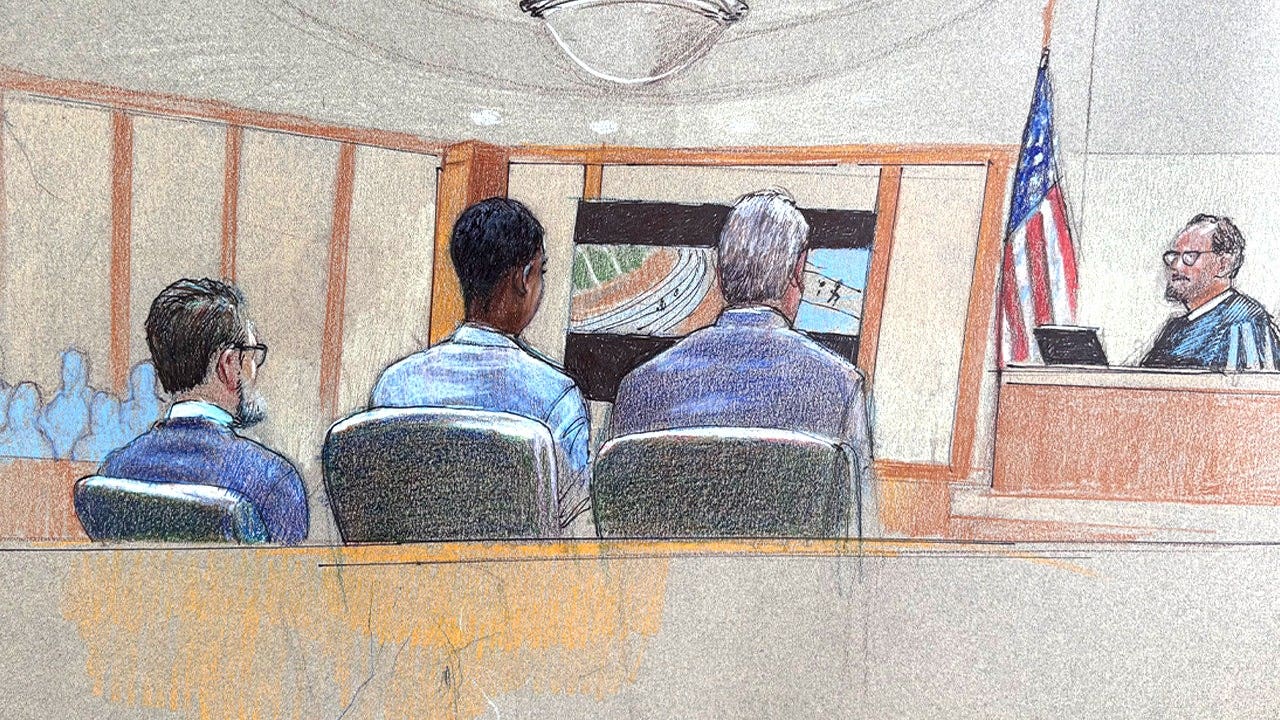
The heavy oak doors of the Texas courtroom swing open this Monday morning, signaling the resumption of a trial that has laid bare the raw nerves, grief, and anxieties of an entire community. At the absolute center of this legal storm is Karmelo Anthony, a young high school student whose life was irrevocably altered last year during what should have been a peaceful, celebratory track meet. Instead, that sporting event became the backdrop for a sudden, fatal confrontation that claimed the life of his peer, Austin Metcalf. Anthony has entered a plea of not guilty, relying on the deeply human and legally complex claim of self-defense—a position that forces a jury to look beyond the cold autopsy reports and into the chaotic, terrifying seconds of the physical altercation. Over the course of the trial’s opening week, the prosecution meticulously constructed its narrative, presenting twenty-one witnesses over several grueling days before resting their case on Saturday. Though Anthony’s defense team immediately made a standard motion for a directed verdict, arguing that the state had failed to prove its case, the presiding judge promptly denied the request, moving the trial squarely into the hands of the defense. As the defense begins to present its counter-narrative, starting with three witnesses who took the stand late Saturday, the atmosphere remains thick with tension. This is not merely a clinical evaluation of a crime; it is a deeply painful human drama, watched closely by two devastated families whose lives have been permanently fractured by a single moment of violence. For experienced legal minds like Larry Taylor, a seasoned criminal defense attorney and former Texas prosecutor, this trial is a powerful reminder that justice is rarely simple. It is a complex puzzle where jurors must look past the physical evidence to evaluate the fragile, subjective nature of human fear, survival instincts, and the tragic intersection of youthful paths on a sunny Texas afternoon.
To understand how this trial will ultimately be decided, one must look deep into the heart of Texas self-defense jurisprudence, a legal landscape that heavily prioritizes individual protection but is notoriously difficult to navigate in practice. Larry Taylor explains that the twelve citizens sitting in the jury box will be tasked with performing a profound act of psychological projection: they must attempt to recreate, in their own minds, the exact mental and emotional state of Karmelo Anthony at the moment he drew his knife. Texas operates under “Stand Your Ground” principles, which dictate that an individual who is being unlawfully attacked is under no legal obligation to retreat before using force to protect themselves. Yet, this legal standard places a massive burden of interpretation on the jury. They must ask themselves if Anthony was experiencing a genuine, terrifying fear for his physical safety, or if his actions were driven by anger, escalating teenage pride, or a reckless disregard for human life. The defense will undoubtedly argue that a sudden rush of physical intimidation robbed the teenager of any reasonable alternative, making the use of force feel like his only means of survival. Conversely, prosecutors will challenge this perception of imminent danger, asking why Anthony did not simply turn around, walk away, or seek help from the dozens of adults, coaches, and security personnel patrolling the track meet. This tension highlights the classic legal paradox of self-defense: it demands that a modern jury judge a split-second, panic-fueled decision with the benefit of hindsight, endless slow-motion video replays, and calm, clinical analysis. It forces us to confront the reality of how human beings react when cornered, raising uncomfortable questions about when fear becomes reasonable and how the law defines the boundary between a justified act of self-preservation and a criminal act of violence.
Running beneath the sophisticated legal arguments and forensic cross-examinations is an unspoken, yet incredibly powerful, undercurrent of race that threatens to polarize the trial and its broader public reception. In a case where a Black teenager is accused of taking the life of a peer, the racial dynamics of the community, the courthouse, and the justice system itself cannot be easily ignored. Larry Taylor points out that the social and cultural geography of Texas means that different communities often perceive threat, violence, and justice through vastly different lenses. This systemic divide is further highlighted by the composition of the jury, which contains no Black members—a demographic reality that has already drawn intense public scrutiny and raised concerns about the fairness and impartiality of the proceeding. A jury that lacks shared cultural or racial experiences with the defendant may struggle to fully comprehend the subtle nuances of his perspective, the fear he claimed to feel, or the social pressures inherent in his daily life. Taylor warns that if the defense believes Black jurors were systematically or improperly excluded from the panel during the selection process, it could establish a critical foundation for future appellate challenges, casting a long shadow of legal uncertainty over whatever verdict is ultimately reached. This dynamic humanizes the trial by placing it within the larger, ongoing struggle for racial equity in the American legal system. It forces observers to reckon with the uncomfortable truth that justice is not blind; it is interpreted by human beings whose worldviews are shaped by their own racial, cultural, and socioeconomic backgrounds, making the quest for a truly unbiased trial one of the ultimate challenges of our modern society.
Beyond the legal definitions of self-defense and the systemic questions of race, the jury will need a crash course in a unique environment that most of them have likely never experienced: the vibrant, high-energy subculture of Texas high school track meets. Larry Taylor, who ran track in college and has spent three decades coaching the sport, rejects the prosecution’s implication that rival athletes would have had no prior connection or reason to interact with one another. Unlike sports played in secluded, time-bound stadiums, track meets are sprawling, day-long events where hundreds of competitors from dozens of different schools share the same physical spaces, warm-up zones, and resting areas for hours on end. Under the hot Texas sun, athletes naturally mingle, chat, form friendships, and occasionally carry over long-standing personal, neighborhood, or athletic rivalries that simmer just beneath the surface. This environmental context is crucial because it directly addresses whether Karmelo Anthony and the Metcalf brothers had a history of prior interactions before their fatal encounter on the track field. If the jurors view a track meet as a rigid, highly controlled environment where athletes only interact during their specific races, they may completely misjudge the social dynamics that led to the confrontation. Understanding this social ecosystem humanizes both the defendant and the victim, showing them not as isolated actors in a vacuum, but as teenagers navigating a complex, highly charged social arena where athletic adrenaline, peer pressure, and personal histories can easily collide. By demystifying the reality of these athletic events, the defense hopes to show that the interaction was not a random, inexplicable act of targetless violence, but a tragic escalation of pre-existing tensions within a shared social space.
Perhaps the most difficult, emotionally charged question that Karmelo Anthony’s defense must answer is why a high school student was carrying a knife at a school-sanctioned sporting event in the first place. For many jurors, the simple possession of a weapon in an educational setting is an immediate indication of violent intent, suggesting that Anthony arrived at the track meet looking for a fight or prepared to do harm. To humanize this critical point, the defense must shift the narrative from one of criminal premeditation to one of functional, everyday athletic utility. Larry Taylor notes that in the world of competitive track and field, it is surprisingly common for athletes to carry small utility knives, multi-tools, or specialized instruments to perform a variety of routine, non-violent tasks. These tools are frequently used to cut thick athletic tape, adjust and replace metal spikes on running shoes, trim loose threads on uniforms, or repair faulty gear on the fly. By illustrating this practical reality, the defense aims to de-escalate the jury’s natural suspicion, explaining that what the prosecution frames as a weapon of murder was, in Anthony’s mind, just another piece of standard athletic equipment that he carried without a second thought. This distinction is vital to humanizing the case because it gets to the heart of teenage mindset and the casual normalization of carrying utility tools in athletic environments. If the jury can accept that the knife was not carried with malice, they can begin to view the subsequent stabbing not as a premeditated ambush, but as a spontaneous, panic-driven reaction where a tool of convenience was tragically transformed into a tool of survival during a moment of intense terror.
Finally, this case highlights the brutal, often hidden financial and human costs of mounting a defense in the American judicial system, a reality that can tear families apart just as easily as the crime itself. Over $624,000 has been raised through online fundraising platforms to support Anthony’s legal defense, a massive sum that has drawn both intense public support and sharp criticism from those who feel it glorifies a tragedy. However, as Larry Taylor points out, Anthony is quite literally fighting for his freedom and his life, and navigating a capital murder charge requires an extraordinary amount of financial resources. Retaining experienced defense attorneys, hiring private investigators to track down teenage witnesses, employing forensic experts to reconstruct the struggle, and preparing for weeks of high-stakes trial presentation can quickly bankrupt even a comfortable family, proving that access to a vigorous defense is often inextricably linked to financial capacity. As the trial enters its second critical week, the emotional stakes remain unbelievably high for everyone involved: the family of Austin Metcalf, who are left with a permanent, agonizing void; the family of Karmelo Anthony, who watch their son’s future hang in the balance; and the jurors, who carry the immense moral weight of deciding a young man’s fate. As Larry Taylor aptly observes, a jury trial of this nature is ultimately like a “box of chocolates,” where human emotion, unpredictable testimonies, and the subjective interpretations of twelve different minds make the final outcome completely impossible to predict, leaving a community holding its breath as they wait to see how this tragic story will end.