


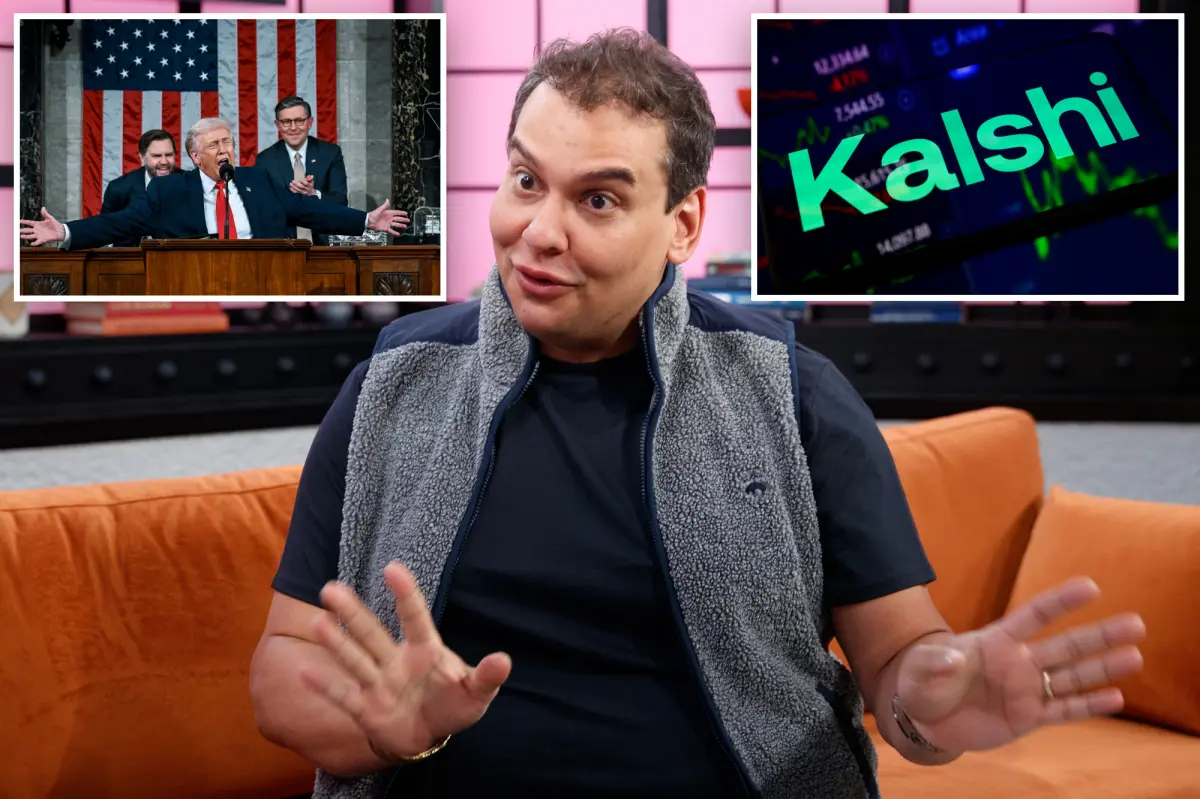
In a twist that feels ripped from a satirical political thriller, the disgraced former congressman George Santos has managed to make history once again—not for his legislative achievements, but for becoming the first person to receive a lifetime ban from the prediction market Kalshi. The platform, which allows users to bet on real-world events ranging from election outcomes to celebrity antics, announced the unprecedented punishment on Monday. But this wasn’t just a routine expulsion for bad behavior; it was the culmination of a bizarre, audacious scheme where Santos decided to gamble on his own public appearancesholistically, treating his political career as if it were a personal casino. Between February 2nd and February 25th of this year, Santos placed a series of hefty wagers on whether he would actually show up to President Trump’s State of the Union address. In a display of either incredible confidence in his own whereabouts or a stunning streak of self-serving chicanery, he managed to net a tidy $17,839.57 from these bets.
The scandal is a quintessential Santos moment—a perfect storm of narcissism, legal recklessness, and an almost theatrical disregard for consequences. The underlying bet was on a question that almost perfectly encapsulates his chaotic public life: would a disgraced, expelled congressman attend the most high-profile political event of the year? For most people, this would be a simple yes-or-no inquiry. For Santos, it was an opportunity to monetize his own infamy, effectively turning his potential presence at a presidential address into a financial windfall. He wagered heavily on his own attendance, essentially betting that he would show up and make a spectacle. It’s a level of self-objectification that borders on performance art—treating his own political existence as a stock ticker that he could manipulate and profit from. The fact that he won nearly eighteen thousand dollars suggests he had no doubt he’d be on the floor for the speech. But the real drama wasn’t in his winnings; it was in what happened after Kalshi realized they had a fraudster in their midst.
Kalshi, which prides itself on offering a transparent and legal marketplace for predicting the future, did not take kindly to being used as a personal ATM by a man with a documented history of fabricating his entire identity. When they initiated an internal investigation into his betting patterns, Santos didn’t cooperate. According to Kalshi, he actively obstructed their inquiries, failing to provide the necessary documentation and answers they demanded. This stonewalling triggered an additional layer of penalties, slapping him with a staggering $71,356 in fines on top of the permanent expulsion. This is a fascinating dynamic: Santos walked away with roughly $17,800 in winnings, yet he now owes Kalshi more than $71,000. In the cold arithmetic of consequence, this was a colossal failed gamble. He traded a fleeting profit for a permanent scarlet letter on his financial and betting record, while simultaneously confirming that he can’t help but treat every interaction with institutions—whether congressional ethics committees or startup tech platforms—as a game of high-stakes chicken.
The deeper rot here, however, lies in the nature of the violation itself. This wasn’t merely a case of a guy having a hunch about his own schedule. According to the Commodity Futures Trading Commission (CFTC), Santos actively misrepresented his intentions online, making posts and statements that influenced the market before he placed his wagers. Essentially, he was playing both sides of the coin—manipulating public perception to move the odds in his favor, then betting on the outcome he was secretly orchestrating. It’s a textbook case of market manipulation, but applied to the grotesque world of political theater. He had inside information (whether he planned to attend), and he used that information to profit off gullible bettors who thought they were trading on public signals. The CFTC alleged that he made misrepresentations and omissions online that influenced the market, violating the fundamental rule that a person cannot bet on an event they have the power to control, especially while simultaneously feeding false data to the public to skew the odds.
What makes this situation even more fascinating is the sheer scale of the penalty assessed by Kalshi, which watches over its domain with a severity that would make a casino security team blush. On top of the permanent ban—a distinction that had never been handed out before—Santos is staring down a staggering $71,356 fine specifically for refusing to cooperate with Kalshi’s internal investigation. This financial penalty eclipses his illicit winnings by a factor of four, meaning his ill-fated gamble ultimately left him deeply in the red. The lack of cooperation suggests a pattern of behavior that goes beyond simple opportunism. It implies that when he was caught, Santos doubled down on the obstruction, likely giving contradictory statements, wavering on the timeline of events, or simply refusing to hand over the digital breadcrumbs of his scheme. This intransigence mirrors his approach to his congressional ethics hearings, where he presented a moving target of lies and half-truths, frustrating investigators at every turn. He treated the platform’s compliance team the same way he treated the House Ethics Committee: as an annoyace to be outlasted rather than an authority to be respected.
This isn’t the first time Santos has faced regulatory heat over his extracurricular activities. In July, he agreed to pay a hefty fine of over $35,000 to settle an earlier investigation by the CFTC regarding the same underlying conduct. His attorney, Joseph Murray, issued a carefully worded statement at the time, insisting that the payout was merely a pragmatic decision to avoid a “lengthy and expensive legal battle,” and that it “should not be mistaken for an admission of any wrongdoing.” This language is standard legal boilerplate, but in the context of Santos’s career, it rings hollow. He is a man who has built his entire public persona on the denial of undeniable facts. Whether it was lying about his Jewish heritage, claiming to have worked on Wall Street, or inventing a gruesome backstory for his mother’s death, Santos has consistently chosen the path of spiteful denial over contrition. The CFTC settlement was merely the opening shot in a battle that would eventually lead to his complete banishment from the platform, reinforcing a public image that is less about politics and more about deciphering a pathological liar’s latest scheme.
So why didn’t he just cooperate? Why fight the investigation? The answer lies deep in the psyche of a man who has built a new career on the ashes of his old one. Since his expulsion from the House in December 2023, Santos has refused to follow the quiet path of a disgraced politician. Instead, he has reincarnated as a professional provocateur, selling personalized Cameo videos, starting a podcast, and leaning hard into the persona of “the gay, steal-from-your-mom MAGA Republican who did fraud.” This behavior is entirely on brand. The lifetime ban is just another trophy to him—a badge of honor that proves he’s still a thorn in the side of the establishment. His response on X (formerly Twitter) was the perfect distillation of his defiant, unrepentant soul: “Hey @Kalshi thanks for the lifetime ban from your gambling platform,” he wrote, dripping with sarcasmcars. “Let’s see how much longer you guys are around for.” It’s the taunt of a man who has weathered indictments, expulsion, and public humiliation, emerging with a Teflon-coated ego that simply absorbs the blows and bounces back swinging.
But to truly understand the significance of this ban, one must look at the broader context of who George Santos is. He is arguably the most infamous serial fabulist in modern American political history. During his brief tenure in the House, he fabricated his entire biography—claiming his mother died in 9/11, that he worked for Wall Street titans like Goldman Sachs and Citigroup, and that he attended Baruch College. When the lies crumbled, he was expelled from Congress, only to pivot to a lucrative career as a grifter and internet personality, selling personalized video messages on Cameo and leaning into his status as a walking punchline. This latest gambling scandal is just another chapter in that sagaholistic. In a strange way, this ban is a validation of his unique ability to seep into every corner of American life. He has now gone from the halls of power to the regulatory filings of a tech company. His defiant response on X, where he sarcastically thanked Kalshi and taunted them about their own longevity, shows a man who has lost the capacity for shame. He is not embarrassed; he is amused. He views the lifetime ban not as a punishment, but as a badge of honor, proof that he can still irritate institutional gatekeepers from his new perch on the political fringe.
The broader implications of this drama extend far beyond the absurdity of one disgraced politician’s betting habits. Prediction markets like Kalshi have emerged as the Wild West of the financial world, allowing everyday people to stake money on everything from interest rates to celebrity custody battles. They promise a futuristic utopia of crowd-sourced intelligence. But the Santos affair highlights a grotesque flaw in their design: these markets are only as honest as the participants within them. When a player has inside information—especially information about their own actions—the market ceases to be a reflection of reality and becomes a tool for personal enrichment through deception. Santos, by betting on his own attendance while simultaneously manipulating the public narrative, effectively weaponized the platform. Kalshi’s swift and brutal response—the lifetime ban and the heavy fines—is a desperate attempt to enforce a code of ethics that the platform was never designed to handle. They are trying to assure their user base that they will not allow a gambler to rig the casino.
In the end, George Santos walks away having lost over $50,000 in net fines and gained a permanent scarlet letter in the financial technology world. But we should not expect this to be the end of his saga. In fact, it is likely the opposite. For a man who built his political career on lies, who fabricated a resume, a family history, and even a fake dog charity, a lifetime ban from a prediction market is just another story for him to tell, another bit of viral content to fuel his social media presence. He will likely appeal, or simply ignore the fine, daring Kalshi to chase him through the courts. The true tragedy of the Santos story is that it highlights a cultural obsession with fame at any cost. We watch these scandals unfold with a mix of horror and glee, feeding the very attion that men like Santos crave. While Kalshi has lawfully addressed the violation, the fact remains that a man who was once seconds away from the levers of American power is now reduced to betting on his own public appearances—and that is a commentary on the state of modern politics that speaks for itself. It is a reminder that some people will always find a way to turn chaos into currency, and that the only guarantee in the world of George Santos is that there will always be another scam waiting in the wings.