



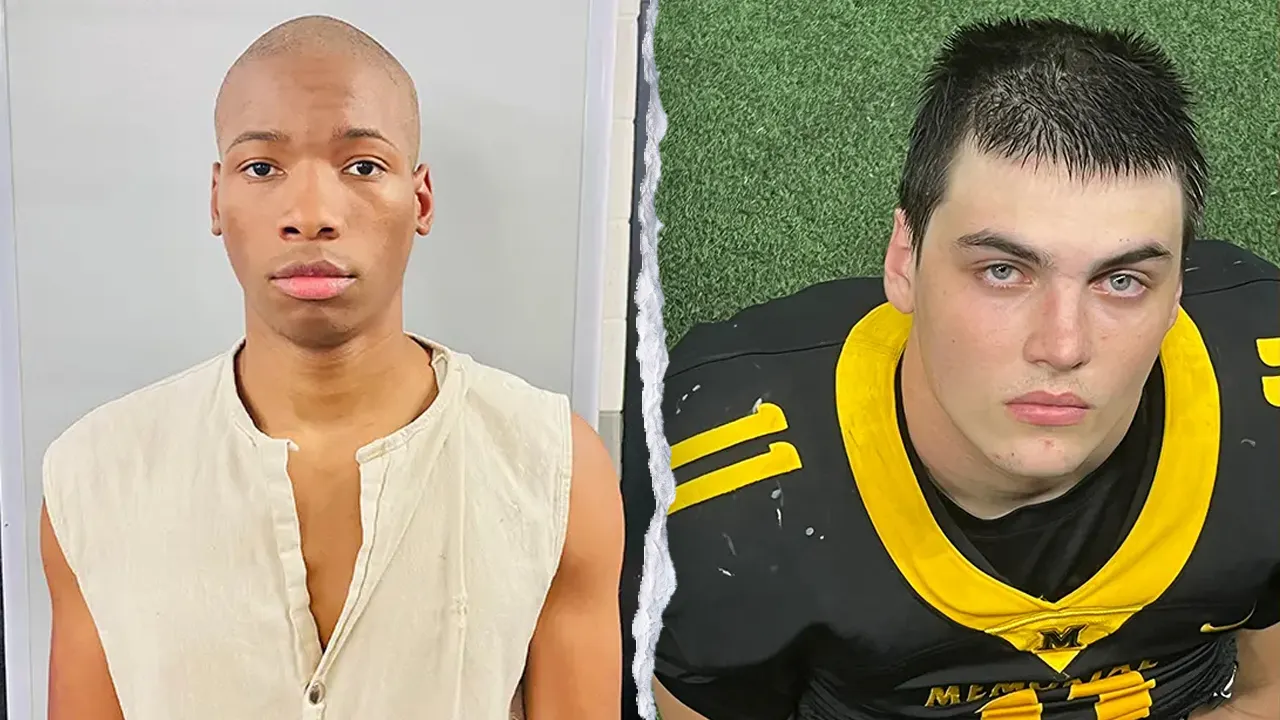
The quiet suburb of Frisco, Texas, was forever changed when a routine high school track meet at Memorial High School transformed from an energetic celebration of youth into a scene of unspeakable tragedy. In one sudden, violent moment, seventeen-year-old Austin Metcalf lost his life to a fatal stabbing—a young athlete with his entire future ahead of him, snatched away in an instant of chaotic friction. The teenager accused of taking that life, Karmelo Anthony, was immediately thrust into the center of a swirling legal storm, forced to face the reality of his actions under the heavy gaze of a grieving community. As the high-profile murder trial unfolded in the 296th District Court of Collin County, the emotional weight in the courtroom was nearly suffocating, serving as a stark reminder of the two young lives effectively shattered in a single afternoon. When the jury finally emerged with their verdict, finding Anthony guilty of murder and sentencing him to thirty-five years in prison, a solemn silence fell over the gallery. This sentence did not represent a triumph for anyone involved, but rather a tragic, legally binding acknowledgment of a devastating loss; it left one family to mourn a beloved son who will never grow up, and another to contemplate a son who will spend his youth behind concrete walls.
The intense public interest surrounding the trial quickly sparked a fierce debate over media transparency, race, and systemic justice, fueled in large part by the decision of presiding Judge John Roach to completely ban cameras and livestreams from the courtroom. In an era where high-profile court cases are routinely transformed into viral entertainment for the internet, Judge Roach stood firm against what defense attorneys and critics have increasingly labeled a “content tornado.” The public and various media outlets argued vehemently that barring cameras restricted the community’s right to witness justice being served, drawing parallels to televised trials of the past that polarized the nation along racial lines. However, Roach defended his decision as a necessary shield designed to protect the integrity of the judicial process from being swept away by sensationalism. By keeping the blinking lenses, flashing cameras, and live feeds out of his court room, the judge sought to preserve a quiet space for truth, ensuring that the gravity of a young man’s death would not be cheapened by the theatricality of social media commentary or the rush for digital clicks.
For Judge Roach, the choice to restrict media access was not born out of a desire for institutional secrecy, but from an unwavering, deeply personal commitment to his constitutional oath. In his post-verdict reflections, he emphasized that a judge’s primary and sacred duty is to guarantee that both the defendant and the prosecution receive a fair trial, entirely insulated from external clamor and public opinion. Acknowledging that his decision had angered many reporters and citizens who demanded total access, Roach calmly asserted that popularity is never the metric by which justice should be measured, stating simply that he is not there to make people happy. He explained that a trial must remain a highly focused, intellectual, and moral search for the truth, requiring a delicate balance between the media’s right to report and the defendant’s right to an unbiased proceeding. This philosophical stance highlights the profound, often lonely responsibility of the judiciary; to sleep well at night, a judge must find solace not in public approval, but in the strict, quiet application of the law.
In the vacuum created by the absence of a live broadcast, the internet’s speculation mill began to churn, generating unfounded conspiracy theories, including rumors that Judge Roach harbored a personal relationship with the Metcalf family. Such accusations strike at the very heart of judicial integrity, threatening to undermine public trust in the entire legal system during an already highly sensitive trial. Roach addressed these claims head-on in his post-trial statements, clarifying with absolute honesty that he had no prior connection to the victim’s family and would not have recognized Mr. Metcalf had they met on the street before the trial. This moments of candid clarification humanizes a judge who is often viewed merely as an unfeeling, bureaucratic extension of the state, revealing the personal toll of presiding over a case where one’s character and impartiality are constantly questioned. It illustrates the toxic nature of modern public discourse, where neutrality is easily misconstrued as bias simply because the doors of the courtroom are closed to recording equipment—even though those doors remained open to any physical spectator wishing to witness the proceedings in person.
Ultimately, the heavy burden of deciding Karmelo Anthony’s fate fell upon the ordinary citizens who comprised the Collin County jury, who had to weigh the evidence without the distraction of a televised media circus. Free from the potential threat of being identified, harassed, or influenced by viral social media trends, these individuals were able to focus entirely on the cold, hard facts of the case as they were presented within the quiet walls of the courtroom. Judge Roach praised their dedication and validated their final verdict, emphasizing that they were selected strictly in accordance with the law, listened to the facts as they happened in court, and reached a conclusion based solely on evidence rather than emotion. This validation of the jury’s verdict serves as a powerful testament to the wisdom of Roach’s media restrictions, proving that the legal system functions best when isolated from outside noise. By keeping the jury focused on the tragedy itself rather than the public’s reaction to it, the court ensured that the resulting verdict was born of quiet, careful deliberation rather than external coercion.
As the dust settled on the trial, the raw human dimensions of the tragedy lingered long after the courtroom doors were locked and the attorneys went home. In a surprisingly empathetic reflection, Judge Roach described Karmelo Anthony not as a monster, but as a “nice young man” who had made a catastrophic, criminal decision, and who now finally understands the crushing weight of those consequences. This compassionate perspective highlights the bittersweet nature of the justice system, which must punish the crime while still recognizing the humanity of the young offender standing before the bench. The tragedy is further underscored by the profound grief of both families: Austin Metcalf’s father, who remarkably expressed empathy for the young man who took his son’s life, and Anthony’s parents, who are left to grapple with the painful reality of their son’s thirty-five-year sentence. In the end, the trial of Karmelo Anthony reminds us that true justice is rarely accompanied by a sense of victory; instead, it is a sober, necessary reckoning that leaves behind a trail of broken hearts, serving as a quiet testament to the preciousness of youth and the devastating permanence of violence.