


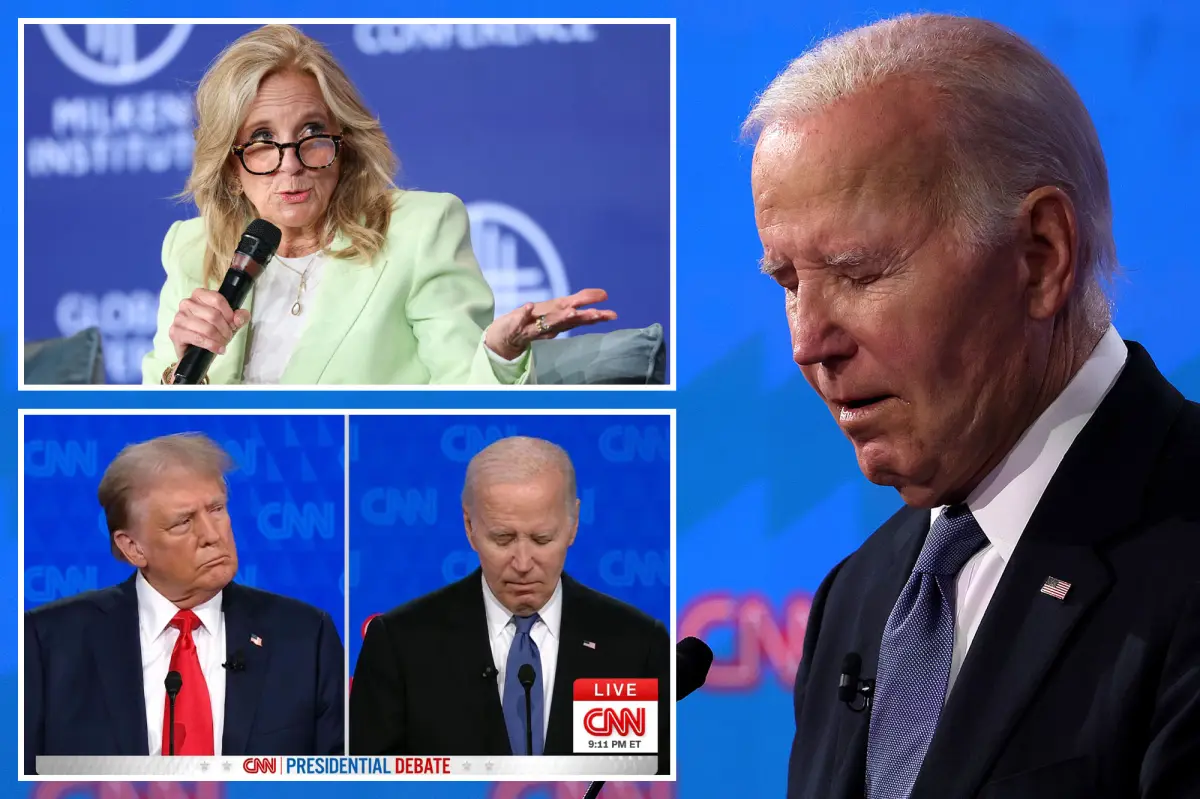
Behind the polished, unyielding facade of modern American politics lies a fragile, deeply human world of personal relationships, aging, and the quiet agony of watching a loved one struggle on the world’s most relentless stage. The historic and devastating presidential debate of June 2024 between Joe Biden and Donald Trump is primarily remembered as a seismic political turning point that altered the course of an election—and ultimately, a presidency. Yet, strip away the polling data, the media frenzy, and the strategic calculus of Washington, and what remains is the raw, intimate perspective of a wife witnessing her husband of over forty years endure a public unraveling. For Jill Biden, standing in the wings that fateful summer night, the experience was not merely a political setback; it was a terrifying personal crisis. As she watched her husband struggle to find his footing and deliver coherent responses under the harsh, uncompromising television lights, her mind did not immediately leap to campaign strategy or damage control. Instead, she was gripped by a visceral, protective panic, fearing that she was witnessing a major medical emergency unfolding in real-time before an audience of millions. The sudden, uncharacteristic frailty of a man who had built his entire career on resilience and overcoming personal tragedy led her first to a dark, instinctual worry: that the President of the United States was suffering a stroke right there on live television.
In the painful and reflective aftermath of that evening, as the political machinery of the Democratic Party began to turn against her husband, the First Lady was left to grapple with the agonizing question of what had actually gone wrong. In a deeply personal revelation from her forthcoming memoir, View from the East Wing—highlighted in a poignant excerpt published by The Atlantic and discussed in an emotional upcoming interview with CBS News—Jill Biden opens a window into the desperate, confusing hours that followed the debate. Her thoughts, she reveals, state-shifted from medical concern to a darker, more haunting suspicion, wondering if her husband had somehow been covertly drugged before taking the stage. It is a striking, controversial theory that speaks volumes, not necessarily about geopolitical conspiracies, but about the profound psychological defenses of a spouse trying to make sense of the inexplicable decline of a partner. She writes with a painful, lingering regret of the immediate aftermath, lamenting that she had not trusted her gut instincts enough to demand a comprehensive blood test immediately following the event. This raw admission humanizes the immense burden carried by those in the highest echelons of power, where even the most basic human impulses—like a wife wanting to clinically investigate her husband’s sudden, alarming physical state—are often suppressed, delayed, or managed away by the relentless demands of a presidential campaign apparatus.
This internal conflict highlights a deeper, more turbulent friction between the protective instincts of a family and the cold, pragmatic operations of a modern political campaign. In her memoir, Jill Biden details her own attempts to guide her husband through the crisis, claiming she suggested he undergo a formal cognitive examination only to be systematically overruled and dismissed by his advisory team. This assertion, however, exposes a jarring discrepancy within the administration’s inner circle, directly contradicting the congressional testimony of Joe Biden’s chief of staff, Jeffrey Zients. Zients previously testified to lawmakers that it was he, standing as the gatekeeper of the West Wing, who actively pushed for the President to take a cognitive test following the disastrous debate performance, only to face resistance. This clash of narratives reveals the isolating, often paranoid ecosystem that envelopes a struggling leader, where loyalties blur, communication breaks down, and the line between protecting a man’s health and preserving his political viability becomes hopelessly entangled. For Jill Biden, navigating this web of advisers, spin-doctors, and political strategists meant fighting a losing battle to preserve her husband’s dignity while the system around him scrambled to manage a historic crisis of confidence.
At its core, this chapter of the Biden presidency is a deeply poignant study of the universal human struggle with aging, vulnerability, and the ultimate, inevitable surrender to time. Joe Biden’s entire life has been defined by his ability to punch through tragedy—from the devastating loss of his first wife and daughter in a car crash to the agonizing death of his son Beau from brain cancer, and even his own survival of life-threatening brain aneurysms in the late 1980s. For decades, he and Jill forged a partnership built on weathering the worst storms of life, emerging scarred but unbroken. Yet, the merciless nature of aging presents a different kind of adversary—one that cannot be out-legislated, out-campaigned, or defeated by sheer force of will. To watch a spouse of nearly half a century face this slow quietude under the magnifying glass of global scrutiny is a unique form of torment. Jill Biden’s memoir serves as an emotional shield, a desperate attempt to contextualize her husband’s vulnerability not as a failure of capability or leadership, but as an anomaly, an unresolved mystery, or perhaps even a tragedy of circumstance. It reveals a wife fiercely defending the legacy of the man she loves, refusing to allow his half-century of public service to be defined solely by the cruel, unsparing ninety minutes of a single summer evening.
The emotional trajectory of the weeks that followed that debate was a slow, public march toward a heartbreaking sacrifice—the decision to step aside and relinquish the pursuit of a second term. The transition from the pinnacle of global power back to the reality of their private lives was accompanied by a deep, quiet grief that few outside their immediate circle could truly comprehend. For Jill Biden, writing View from the East Wing became a vital avenue for processing this profound life transition, allowing her to reclaim some semblance of agency over a narrative that had been violently hijacked by pundits, political rivals, and nervous allies alike. The book acts as both a historic record and an intimate love letter, capturing the immense psychological toll of the presidency on a family. It details the heavy burden of keeping up appearances, the exhaustion of constant public defense, and the painful exposure of their private vulnerabilities to a world that often consumes political figures as mere characters in a high-stakes drama rather than as flesh-and-blood human beings with limits, fears, and heartaches.
Ultimately, the most resonant and humanizing aspect of Jill Biden’s reflection is her quiet surrender to the unknown, encapsulated in her haunting admission: “To this day, I still don’t know what happened. I only wish I had the answer.” In these simple, vulnerable words, the First Lady steps down from the pedestal of political royalty and stands alongside anyone who has ever watched a loved one slip away, suffer an inexplicable setback, or change before their eyes without a clear explanation. It is a universal human truth that when faced with sudden, devastating changes in those we love, we desperately claw for reasons—be it a stroke, a drug, or a hidden ailment—because accepting the raw reality of natural decline or a bad night is far too painful to bear. As the dust settles on the Biden administration and the history books begin to draft their chapters, this poignant account serves as a gentle reminder of the human cost of leadership. Beneath the immense power of the presidency, there remains a husband and a wife, holding onto each other in the quiet dark of the East Wing, left with only their memories, their enduring bond, and the unresolved mysteries of a night that changed their lives forever.