







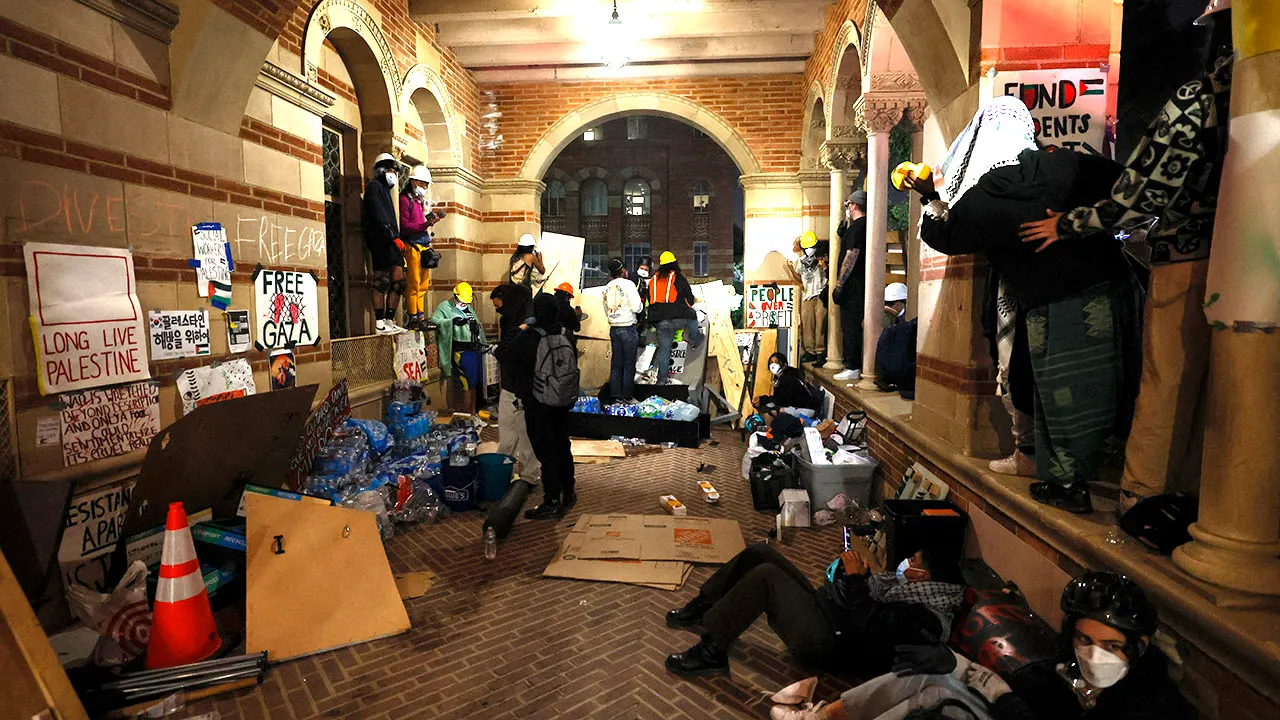
The college experience is traditionally envisioned as a transformative journey of intellectual discovery, self-reliance, and personal growth, a sacred period where young minds from diverse backgrounds converge to debate complex ideas in a spirit of mutual respect and safety. However, for Jewish and Israeli students at the University of California, Los Angeles (UCLA) in the spring of 2024, this fundamental promise dissolved into a terrifying nightmare of isolation, physical danger, and systemic exclusion. A landmark civil rights lawsuit filed by the United States Department of Justice (DOJ) paints a harrowing, detailed picture of a prestigious public campus transformed into a hostile, lawless territory where basic constitutional rights were stripped away. The legal complaint, filed in the United States District Court for the Central District of California, alleges that beginning around April 25, 2024, the heart of the UCLA campus—specifically the heavily trafficked and historically significant Royce Quad—was systematically occupied by masked, armed agitators. These individuals established illegal encampments, reinforced them with makeshift barricades made of heavy plywood, metal bicycle racks, ropes, and trash cans, and set up coordinated “human phalanxes” to block access. When we humanize this dry legal data, we find a profound psychological toll: young individuals who had worked their entire academic lives to attend an elite public university suddenly found themselves physically barred from entering the libraries where they studied and the lecture halls where they learned, solely because of their religious identity or national origin. The sheer terror of navigating a gauntlet of ideological checkpoints just to attend a class shattered the educational compact, revealing a heartbreaking breakdown of safety where a public sanctuary quickly became an exclusionary zone defined by intimidation and systemic prejudice.
Beyond the structural blockades, the physical violence and personal degradation detailed in the federal lawsuit illustrate a level of hostility that is profoundly shocking for any modern American educational institution. For many Jewish and Israeli students, routine campus walks became a terrifying gauntlet where they faced targeted, vicious assaults, including being kicked, slapped, struck with wooden blunt instruments, and sprayed directly in the face with chemical irritants. The human devastation of this environment is laid bare in the agonizing individual stories documented by federal investigators: one pro-Israel student was cornered, pummeled to the ground, and beaten unconscious, suffering a severe, open head wound that required immediate emergency hospitalization. In another deeply unsettling incident, a Native American Jewish woman who courageously counter-demonstrated with a sign reading, “Hamas supporters are not welcome on Native land,” was swiftly surrounded by a hostile, aggressive mob and subjected to physical assault. Unbelievably, the lawsuit alleges that university police officers stood directly behind her and watched the violence unfold without taking any action to protect her or arrest the perpetrators. Additional accounts describe occupiers pepper-spraying a woman wearing a Star of David and physically assaulting a Jewish man while mockingly telling him that “Hitler missed one.” These are not abstract legal classifications; they represent real people—young men and women—subjected to severe physical pain and lasting trauma on public property. The establishment of “militia-style checkpoints” where students were forced to denounce core tenets of their faith to walk safely on their own campus represents an egregious modern-day relapse into segregated spaces and religious persecution.
For the victims of this hostility, the physical injuries were compounded by a profound, paralyzing sense of institutional betrayal, as the very administrators and faculty members trusted with their safety allegedly chose silence over action. The DOJ lawsuit levies a damning accusation against the University of California system, asserting that UCLA administrators inexplicably turned a blind eye to the ongoing physical and psychological abuse, taking “no serious action whatsoever” to protect their students for weeks. This administrative abandonment directly violates Title VI of the Civil Rights Act of 1964, a cornerstone of American civil rights law that prohibits discrimination based on race, color, or national origin in any educational program receiving federal funding. Even more disturbing are the allegations that several university faculty members actively betrayed their professional ethics by joining the anti-Israel demonstrations, aiding and abetting illegal activities, and supporting the exclusionary checkpoints. For any student, realizing that the professors responsible for their education and the administrators managing their campus are actively complicit in their exclusion is an isolating, terrifying experience. The implementation of a system where selected students were issued special wristbands to freely navigate public paths, while Jewish and Israeli students were systematically turned away, is a horrifying throwback to the darkest eras of discrimination. This complete failure to enforce safety standards sent a chilling, unmistakable message to the Jewish student body: that their civil rights, their safety, and their dignity were deemed secondary to administrative convenience.
As the spring semester progressed, the administrative vacuum on campus allowed tensions to reach a dangerous boiling point, culminating in a series of chaotic, violent events that transformed the prominent public university into an active conflict zone. On April 30, 2024, administrators finally declared the encampment illegal and warned participants of disciplinary action, with then-Chancellor Gene Block admitting that Jewish students were trapped in an paralyzing state of anxiety and fear. However, this delayed administrative response did nothing to decelerate the growing volatility, which exploded late that evening into raw, unchecked street combat between occupiers and counter-protesters. Under the cover of darkness, the campus became a chaotic battleground as opposing groups clashed with wooden boards, chemical sprays, and even pyrotechnic devices, throwing fireworks into crowded areas while security forces struggled to regain control. The psychological atmosphere of hatred was further intensified the following morning when a van adorned with deeply offensive antisemitic imagery—including a Nazi swastika merged with a Star of David—was parked on campus grounds to support the occupiers. The vehicle was covered in vile, conspiratorial text referring to Jewish people as “puppet masters,” a historic and dangerous trope designed to incite violence, yet it was reportedly welcomed and cheered by onlookers in the area. This disturbing open display of antisemitic hatred, allowed to operate on public property, signaled a complete collapse of civil order and demonstrated how quickly a failure of administrative leadership can turn an academic community into a dangerous hotbed of lawlessness and physical threats.
The eventual dismantling of the physical encampments did not bring an end to the crisis, as the deep emotional scars and massive financial fallout continue to weigh heavily on the university community and public resources. A comprehensive subsequent survey of 428 Jewish and Israeli students, faculty members, and staff revealed the heartbreaking extent of the lasting collective trauma, with approximately 50% of respondents reporting that they had personally witnessed physical threats or direct violent assaults. The personal testimonies of the students themselves, preserved in the survey, are raw and devastating; one student described being chased, threatened, and physically shoved for displaying an Israeli flag, while another detailed the sheer terror of being blocked from public facilities simply for being Jewish while mobs openly chanted calls for violence. Humanizing these statistics reveals a student population carrying immense trauma, with many admitting they still experience severe anxiety merely walking past the spots where they were once assaulted or harassed. Beyond the human wreckage, the tangible destruction left in the wake of the protests was staggering, with physical damage to the taxpayer-funded campus totaling a massive $12.3 million in ruined property, shattered fixtures, and extensive graffiti. This immense financial burden, which must ultimately be borne by the public, stands as a grim, physical monument to the failure of institutional oversight and highlights how a university’s neglect of civil rights has high, compounding costs for both human lives and public infrastructure.
Today, the Department of Justice’s lawsuit has set the stage for a critical legal and moral turning point in American higher education, forcing a much-needed national evaluation of the boundaries of campus safety and civil rights enforcement. In announcing the litigation, Assistant Attorney General Harmeet Dhillon made it clear that the federal government will hold the university system fully accountable for tolerating an “equally appalling hostile educational environment” against its Jewish and Israeli students. This sentiment was strongly reinforced by First Assistant U.S. Attorney Bill Essayli, who emphasized that civil rights laws are non-negotiable and that institutions repeatedly failing to shield their students from systemic bigotry must face severe legal consequences. While University of California President James Milliken and UCLA’s newly appointed leadership, led by Chancellor Julio Frenk, have defended their institution by highlighting extensive safety reforms and their personal dedication to combating antisemitism, the lawsuit argues that these ongoing efforts have failed to recognize the gravity of the past violations. This historic legal confrontation sends an unmistakable, powerful warning to boards of regents and university administrators across the country: that safety and inclusivity must never be applied selectively. For a society to remain just and free, its premier academic institutions must remain havens of intellectual freedom where peace, safety, and civil rights are guaranteed to every single student, regardless of their identity, heritage, or faith.