



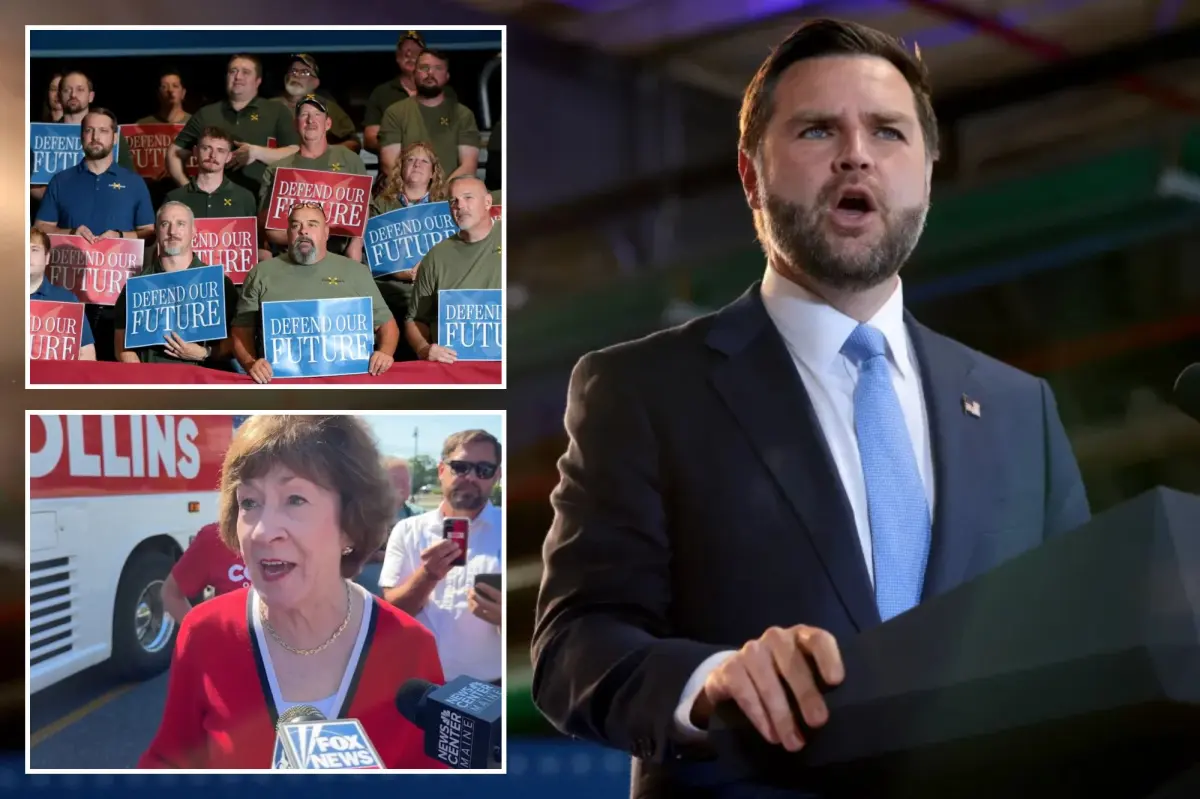
The late summer sun hangs low over the Penobscot River, casting a shimmering, golden path across the water as it winds its way through the heart of rural Maine. In the small city of Brewer, just across the bridge from Bangor, the air carries a mix of river dampness and the faint, sweet scent of pine. On this particular Monday, the local fairgrounds have been transformed into a staging ground for a high-stakes political rally. Here, Vice President JD Vance is doing something that feels almost paradoxical in today’s fiercely polarized climate: he is standing before a crowd of Republicans and pleading with them to embrace Susan Collins, a senator who has spent her entire career frustrating the party’s hardliners. Vance’s speech is not a fiery, bombastic call to arms. Instead, it is a careful, almost intimate appeal, rooted in personal friendship and pragmatic political necessity. He greets the crowd with a folksy warmth, acknowledging the unique character of the state and its people, before pivoting to his main purpose. He knows that many in this audience might harbor deep reservations about Collins, who has a long history of breaking with her party. Yet, his message is clear: she is not just a senator; she is an institution, and in a political environment defined by razor-thin margins, she is the indispensable anchor that keeps the Republican ship from capsizing in this deep blue corner of New England.
Vance’s rhetoric is a masterclass in political triangulation, blending humor, respect, and gentle scolding to reframe the narrative around Collins’s well-documented independence. He begins by playfully admitting, “Whenever I’m in Maine, I give Susan a little bit of crap because, as you know, Susan is the most independent member of the United States Senate.” The crowd chuckles, recognizing the truth in the statement. Vance then expands on this dynamic, revealing the friction that exists behind closed doors. As the President of the Senate, his job is to whip votes and ensure party unity, yet Collins often makes that task exceptionally difficult. He acknowledges this tension directly, stating, “She makes my job a little harder.” But he immediately pivots, transforming what could be perceived as a criticism into a powerful endorsement of her character. He explains that her independence is not a flaw, but rather a deeply ingrained commitment to her constituents above all else. To humanize her, Vance shares a glimpse into their personal relationship, revealing that she has visited his residence at the Naval Observatory “half a dozen times.” This revelation shifts her from a distant political figure into a neighbor, a friend. He describes their conversations, which rarely revolve around party messaging or national talking points, but instead center on the granular, often tedious details of how federal policy impacts the daily lives of everyday Mainers. Through this anecdote, Vance paints a portrait of a woman who is not swayed by the pressures of Washington, but is absolutely consumed by the needs of her state.
The core of Vance’s appeal lies in his detailed recounting of Collins’s obsessive focus on local economic issues, which he uses to bridge the gap between her maverick streak and the practical needs of the voters before him. He brings up her deep concerns about international trade, specifically the looming threat of a 50% tariff on goods coming from Canada. Maine is not just a coastal state; it is a border state in economic spirit, deeply intertwined with its northern neighbor. Vance highlights Collins’s relentless pressure on the administration to protect Maine’s unique industries—the delicate blueberry harvests that cover the barrens of Washington County, the lucrative lobster fisheries that sustain coastal communities, and the timber that feeds the paper mills and lumber yards inland. He mimics her persistent questioning, recalling how she relentlessly asks, “What does this do for Maine? How is this good for Maine? How is this bad for Maine?” By doing so, Vance is essentially arguing that her independence is born out of a profound, almost maternal protectiveness over her state. He insists, “She tries to get as much good for the state out of Washington and as little bad out of Washington.” This line is carefully crafted to resonate with a crowd that might otherwise be skeptical of her moderate voting record. He is telling them that while she may not always align with the party line on social or cultural issues, she is a bulldog when it comes to the material well-being of Maine, and that is a trade-off worth making. He deliberately frames her as a “workhorse, not a showhorse,” a senator more interested in the arduous task of securing funding for a bridge in a small town than in appearing on cable news to score political points. He demonstrates that he understands the complex, often unglamorous reality of representing a geographically vast, economically diverse, and politically independent state.
However, the immense effort Vance is putting into this rally underscores the crushing weight of the political stakes involved. This is not a random visit; it is a strategic intervention in what is widely considered the tightest Senate race in the country. Republicans are clinging to a fragile majority in the upper chamber, and the loss of this single seat in Maine would be catastrophic, effectively handing control of the Senate to the Democrats. Such a shift would not just slow down the legislative agenda; it would completely paralyze it. It would severely hamper President Trump’s ability to confirm judicial and executive appointments, stymie his legislative priorities, and open the door for democratic-led investigations and oversight. The GOP’s short-term memory is remarkably selective. They remember Collins’s vote to convict Trump in his 2021 impeachment trial, a decision that enraged the base and nearly ended her career. Yet, in the face of losing the majority, party leaders are willing to forgive and forget. Vance’s presence is the official signal that a truce has been declared. He is carrying an olive branch from Mar-a-Lago to the moderate suburbs of Portland, imploring the party faithful to swallow their resentment. He is essentially telling them, “I know you are angry, and I know she has betrayed us, but we need her to stop the Democratic agenda.” This political calculus is cold and pragmatic, stripping away any illusion of ideological purity in favor of the raw, unyielding arithmetic of power in Washington, D.C.
Yet, the most conspicuous aspect of the rally is the absence of its own guest of honor. Senator Susan Collins is nowhere to be found. Standing behind the podium, Vance is the star of the show, but the person he came to support has deliberately chosen to be elsewhere. The official reason provided by her office is a “scheduling conflict,” a vague and rather transparent excuse—she stated she was “already scheduled on Monday.” This is not the first time she has dodged the Vice President; she also skipped his visit to Bangor back in May, citing the session in the Senate. This carefully choreographed avoidance is a testament to the treacherous tightrope she has walked for decades. Collins absolutely needs the financial and organizational support of the national Republican Party to win re-election. She needs the ground game, the advertising dollars, and the voter turnout that a unified party provides. However, she also understands that a photograph of her embracing the Vice President or standing alongside a polarizing former president would be political poison for the moderate, independent, and even some Democratic voters who have consistently provided her margin of victory in the past. By staying away, she is sending a muted but unmistakable message to those voters: “I am not one of them.” She is attempting to project an image of independence, even as her party’s machinery works overtime to secure her victory. The subtext is deafening; the strategic distance she maintains is a silent tribute to the death of old-school, bipartisan politics, where a senator could proudly defy their national ticket and still survive.
As Vance wraps up his remarks and the crowd filters out, the focus inevitably shifts to the opposition. The Democrats are pouring resources into this race, determined to unseat the long-serving Republican. Their chosen standard-bearer is Troy Jackson, a former state lawmaker and a logger by trade, who embodies a gritty, authentic brand of blue-collar politics that could appeal to the same working-class voters who have historically supported Collins. Jackson’s path to the nomination was not straightforward, however. The initial Democratic candidate, Graham Platner, was forced to drop out after a series of damning allegations surfaced, including accusations of sexual misconduct and the shocking revelation of a Nazi-related tattoo. This scandal forced the party into a scramble, elevating Jackson as the backup plan. Yet, Jackson represents a formidable challenge, one that pits the idea of party loyalty against the sheer force of personal brand politics. The race becomes a philosophical referendum on the very nature of representation: Is it better to have an independent-minded senator who occasionally frustrates you but consistently delivers concrete benefits, or one who adheres to party orthodoxy but might lack the seniority and know-how to navigate the complex corridors of power? Vance leaves the stage, returning to his motorcade. The Penobscot river continues its relentless, quiet flow. In the end, the story of Susan Collins is not just a political battle; it is a deeply human story of survival, of navigating the immense pressures of an era defined by extreme partisanship, and of a woman who must constantly negotiate between who her party wants her to be, who her constituents believe she is, and the legacy she hopes to leave behind.