





A Midnight Truce: How Strategic Flashpoints in South Lebanon and Chokepoint Diplomacy in the Strait of Hormuz Reshaped the Middle Eastern Balance of Power
The Fragile Calm Over the Litani: A Breath of Wind Amidst the Embers of War
The restless borderlands of southern Lebanon fell into an uneasy, almost surreal silence on Sunday, offering a temporary reprieve to a region teetering on the precipice of an all-out regional catastrophe. This sudden cessation of hostilities followed a high-stakes, late-night directive from the Israeli war cabinet, which ordered the Israel Defense Forces (IDF) to cease proactive offensive maneuvers and restrict their operations to strictly defensive postures across the frontier. By Sunday midday, the thunderous artillery barrages and precision airstrikes that have characterized this grinding conflict were conspicuously absent, replaced by a tense quiet that hung over the smoke-singed valleys of Nabatieh and the Galilee. Yet, for seasoned observers of Middle Eastern geopolitics, this tranquil interlude is viewed with profound skepticism rather than celebration. The border has witnessed a dizzying cycle of unilaterally declared cease-fires, sudden escalations, and subsequent collapses over recent months, primarily because the opposing factions remain hopelessly polarized over the practical definition of what constitutes a “defensive action.” As Israeli military patrols continue to monitor the rugged terrain, the underlying structural drivers of this conflict remain entirely unresolved, leaving diplomats and commanders alike to wonder whether this current pause represents the genesis of an enduring peace or merely a brief, tactical opportunity for both sides to rearm and reconstitute their forces before the next inevitable conflagration.
The Battle for Ali al-Taher: Topography, Terraces, and the Subterranean Fortress
    TYRE
     │
     ├──► NABATIEH (Major Urban Center)
     │     └──► Ali al-Taher Ridgeline (Strategic High Ground)
     │           └──► Tebnit (Hezbollah Defensive Hub)
     │
 BLUE LINE (UN Border) ~ ~ ~ ~ ~ ~ ~ ~ ~ ~ ~ ~ ~ ~ ~ ~ ~
     │
ISRAELI BORDER (Northern Galilee)
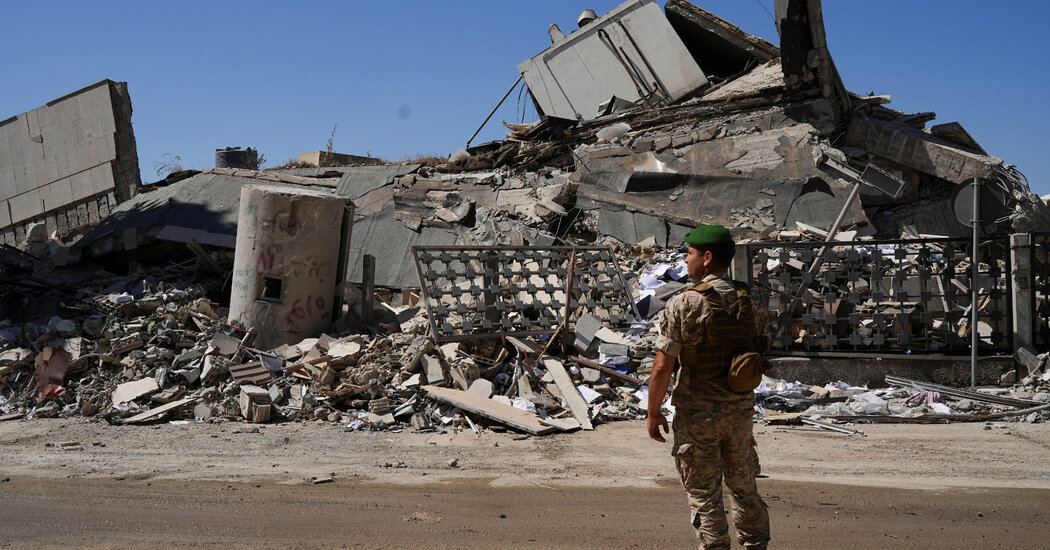
At the strategic epicenter of the weekend’s bloodiest exchanges lies the imposing ridgeline of Ali al-Taher and the adjacent municipality of Tebnit, a geographic vantage point that commands a sweeping, unobstructed view of the major southern Lebanese city of Nabatieh. To understand the ferocity of the fighting here is to understand the cold calculus of military topography; whoever controls this high ground controls the kinetic flow of operations throughout the entire sector. For years, the Iran-backed militant group Hezbollah has meticulously transformed this rugged, terraced landscape into a highly fortified defensive bastion, carving out deep subterranean tunnels, reinforced concrete bunkers, and hidden missile launch sites designed to survive the most punishing aerial bombardments. Recently, the Israeli military redrew its operational maps to officially include Tebnit and the Ali al-Taher ridge line within its unilaterally declared “security zone”—a buffer territory extending roughly six miles north of the internationally recognized border. This cartographic adjustment effectively formalized the ongoing Israeli occupation of the ridge, transforming this long-contested terrain into an existential flashpoint. For the IDF, securing these heights is viewed as a non-negotiable prerequisite to protecting its northern civilian communities from direct anti-tank guided missile fire; for Hezbollah, the presence of Israeli armor on these ridgelines represents an intolerable expansion of foreign occupation, prompting a fierce defensive campaign to dislodge the advancing Israeli forces.
A Weekend of Flame and Fury: The Deadly Calculus of Escalation and Retaliation
The fragility of the regional truce was laid bare during a devastating 48-hour window of violence that commenced early Friday morning. In a meticulously planned ambush, a combat team from Hezbollah targeted an Israeli armored unit operating on the outskirts of Tebnit, firing a heavy anti-tank guided missile that successfully penetrated an Israeli main battle tank, killing four soldiers instantly—including a highly respected battalion commander. The loss of a senior tactical officer sent shockwaves through the IDF command structure, and the situation deteriorated further on Saturday when a fifth Israeli soldier was mortally wounded during a clearing operation in the same sector. As Hezbollah launched a staggering volley of more than 50 heavy rockets into operational zones across southern Lebanon to deter further ground advances, the Israeli leadership unleashed a devastating, multi-axis retributive campaign. Over the course of Friday and Saturday, Israeli combat aircraft and heavy artillery units struck more than 300 targets throughout Lebanon, claiming to have neutralized at least 100 Hezbollah combatants while destroying key administrative centers and underground armories. However, the human toll extended far beyond militancy; Lebanon’s Ministry of Public Health reported significant civilian casualties across nearly two dozen sovereign municipalities, prompting Lebanese President Joseph Aoun to issue a blistering condemnation accusing Israel of deliberately targeting non-combatants and destroying civilian infrastructure under the guise of counter-terrorism.
+————————————————————————-+
| CHRONOLOGY OF A CRITICAL WEEKEND |
+————————————————————————-+
| FRIDAY MORNING: ATGM strike on IDF tank outside Tebnit. |
| 4 IDF soldiers killed, including a Battalion Commander. |
+————————————————————————-+
| FRIDAY AFTERNOON – SATURDAY: Israeli military retaliatory campaign. |
| 300 targets struck across south and central Lebanon. |
| ~100 Hezbollah casualties reported; civilian infrastructure damaged. |
+————————————————————————-+
| SATURDAY AFTERNOON: Tehran enters the fray via the Strait of Hormuz. |
| Iranian Armed Forces announce symbolic “closure” of shipping lanes. |
| U.S. Fifth Fleet disputes Iranian legal authority over the strait. |
+————————————————————————-+
| SATURDAY NIGHT: Israeli Cabinet shifts to a “defensive only” model. |
| PM Netanyahu and Defense Minister Katz issue updated directives. |
+————————————————————————-+
| SUNDAY MIDDAY: Kinetic operations subside; a tense quiet holds. |
+————————————————————————-+
The Threatened Detente: How the Border War Imperils U.S.-Iran Diplomacy
This localized border violence does not occur in a geopolitical vacuum; rather, it threatens to shatter the highly delicate, behind-the-scenes diplomatic efforts spearheaded by Washington and Tehran to establish a comprehensive framework for regional peace. For months, senior American and Iranian diplomats have engaged in painstaking, backchannel negotiations aimed at de-escalating the broader Middle Eastern cold war, addressing everything from regional militia activity to maritime security and nuclear non-proliferation. The primary objective of these negotiations is to construct a stable regional architecture that would allow global powers to pivot their strategic focus elsewhere, but the persistent warfare along the Blue Line acts as a constant, destabilizing wild card. Each major escalation in Nabatieh or the Galilee forces both Washington and Tehran into rigid, defensive diplomatic postures, as neither can afford to be seen as abandoning their respective regional allies. Pro-Israel lawmakers in Washington demand absolute solidarity with Jerusalem’s military maneuvers, while hardliners in Tehran pressure the regime to preserve Hezbollah’s deterrent capabilities at all costs. Consequently, the blood spilled on the terraced hillsides of Tebnit acts as an immediate threat to this budding international peace deal, proving once again that a localized tactical miscalculation in South Lebanon can instantly paralyze the grand strategy of global superpowers.
Chokepoint Diplomacy: The Strait of Hormuz and the Global Maritime Threat
                    ▲ To Central Asia / Iran Range
                    │
              [ IRANIAN MAINLAND ]
                    │
◄ Gulf of Oman ▼ (Strait of Hormuz Chokepoint) Persian Gulf ►
======================[ CRITICAL SHIPPING LANES ]========================
▲ (U.S. Fifth Fleet Patrol Sector)
│
[ ARABIAN PENINSULA / OMAN / UAE ]
As the ground combat in south Lebanon reached a fever pitch on Saturday afternoon, the theater of conflict instantly expanded thousands of miles to the east, highlighting the globalized nature of modern asymmetric warfare. In a highly dramatic and calculated escalatory move, the Iranian military high command announced the temporary closure of the Strait of Hormuz—the world’s most critical maritime oil transit chokepoint, through which nearly a fifth of the world’s daily petroleum consumption passes. This announcement was explicitly framed by Tehran as a direct response to Israel’s expanded ground campaign in Lebanon and the alleged complicity of Western backers in the destruction of Lebanese sovereign territory. While the United States Fifth Fleet, stationed in Bahrain, was quick to issue a reassuring statement asserting that global commercial maritime traffic continued to navigate the waterway unimpeded and emphasizing that Iran possesses no legal authority or practical capability to unilaterally close the international strait, the psychological damage to the global economy was immediate. The threat of a prolonged disruption along this vital maritime artery sent energy markets into a tailspin, with Brent crude futures spiking sharply and insurance premiums for commercial tankers operating in the Persian Gulf reaching exorbitant heights. By leveraging its geographic proximity to this economic chokepoint, Iran demonstrated its capacity to transform a localized border war into a global economic crisis, utilizing energy security as a powerful diplomatic lever to force Western powers to restrain the Israeli military machine.
The Ambivalent Peace: Passive Defense, Discretionary Loopholes, and the Road Ahead
The sudden de-escalation that materialized late Saturday night was the direct result of intense, high-pressure consultations between Israeli Prime Minister Benjamin Netanyahu, Defense Minister Israel Katz, and senior security officials, who recognized that the double pressure of the tank casualties and the Iranian maritime threat required a calibrated tactical adjustment. The subsequent military communiqué stating that the IDF would no longer conduct “proactive strikes” on Lebanese territory was designed to project a willingness to de-escalate, yet the language of the directive contains significant, intentional strategic loopholes. Defense Minister Katz made it abundantly clear that Israeli commanders retain absolute battlefield discretion, emphasizing that “there has never been, and there is no, restriction on IDF soldiers in Lebanon to act to eliminate threats.” Furthermore, the military confirmed that clearing operations, the demolition of subterranean infrastructure, and targeted raids within the strategic Tebnit sector will proceed uninterrupted under the banner of “defensive stabilization.” This unresolved ambiguity means that the current peace is built upon incredibly shaky foundations; as long as the IDF defines defensive actions as the active demolition of local infrastructure and Hezbollah defines defensive actions as the expulsion of Israeli forces from the Ali al-Taher ridge, the cycle of violence remains merely paused, waiting for the spark that will ignite the next inevitable explosion in this protracted struggle for regional dominance.