




Diplomatic Maneuvers Amidst Middle East Turmoil: Iran’s Foreign Minister Courts Russian Support
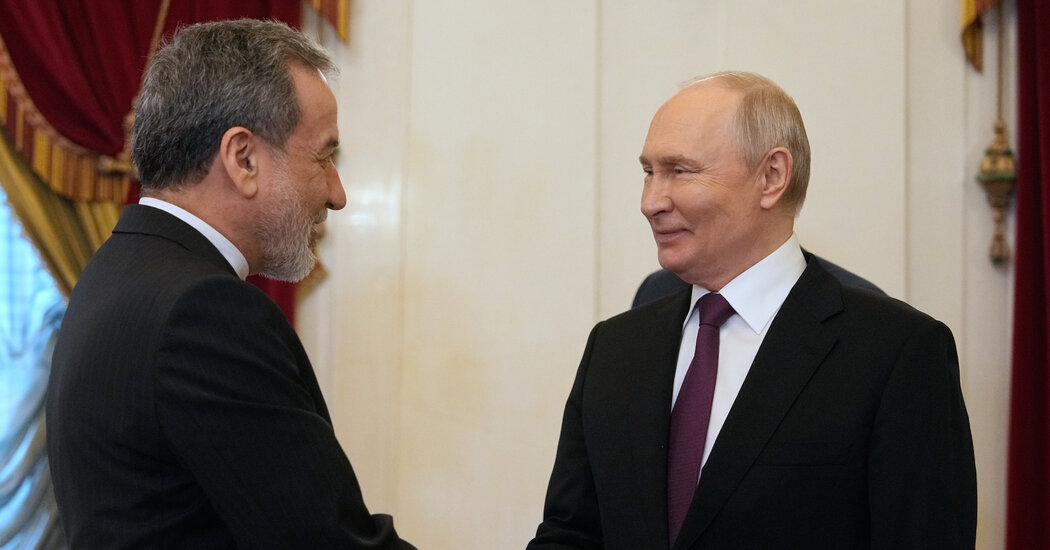
In the labyrinthine world of international diplomacy, where alliances shift like desert sands, Iran’s Foreign Minister Abbas Araghchi landed in St. Petersburg on a brisk Monday morning, eager to navigate the stormy waters of geopolitics. His destination: a pivotal meeting with Russian President Vladimir V. Putin, where the agenda centered on Iran’s protracted conflict with the United States. With negotiations to end the hostilities seemingly at an impasse, Araghchi’s visit underscored the deepening ties between Tehran and Moscow—a relationship fraught with mutual benefits and hidden tensions. As global powers grapple for influence in the volatile Middle East, this encounter highlighted Russia’s delicate balancing act, striving to remain a linchpin in regional affairs without jeopardizing its broader strategic ambitions, particularly in the quagmire of Ukraine.
Putin’s public remarks before their closed-door discussions painted a picture of solidarity, laced with careful diplomacy. He revealed receiving a personal message from Mojtaba Khamenei, the newly appointed supreme leader of Iran, and praised the Iranian people’s “courageous and heroic” struggle for sovereignty amid adversity. Moscow, Putin emphasized, hoped that under Khamenei’s guidance, Iran would weather the storm toward eventual peace. “We will do everything in your interests and those of the region to achieve peace as soon as possible,” he declared, his words resonating with the gravitas of a global leader intent on signaling support. Yet, beneath this rhetoric lay the complexities of Russia’s position. Analysts note that Putin views his ties with Iran as a potential lever in dealings with Washington, especially regarding Ukraine. But Russia walks a tightrope: providing aid to Tehran while avoiding overt entanglement that could alienate other partners, including Israel and Persian Gulf nations hostile to Iran. This juxtaposition of warmth and caution defines the current phase of Iran-Russia relations, where pragmatism often trumps ideology.
The backdrop to Araghchi’s Russian foray was a whirlwind of diplomatic setbacks. Just days earlier, he had shuttled between Pakistan and Oman, both serving as mediators in the fraught talks between Iran and the US. Scheduled meetings with Steve Witkoff—President Trump’s special envoy—and Jared Kushner, the president’s son-in-law, in Pakistan were abruptly scrapped by Trump himself. This cancellation served as a stark indicator of the chasm separating the two sides on forging a comprehensive agreement to halt the war. In statements to Russian state media on the meeting’s sidelines, Araghchi hinted at American overtures for renewed negotiations, with Iran mulling the proposal. However, ambiguity lingered—was this a nod to salvaging the derailed weekend talks, or something fresh? Both nations have engaged in a verbal tug-of-war, each claiming leverage, with officials and pundits trading barbs over who holds the upper hand. Upon touching down in Russia, Araghchi articulated his objectives plainly: to delve into the war’s intricacies with Putin and his team, ensuring “necessary coordination” as reported by Iranian media. Experts like Omid Memarian, a senior fellow at DAWN, a Washington-based think tank focused on Middle East dynamics, speculate on a phased resolution—perhaps starting with a ceasefire and reopening the Strait of Hormuz, followed by wider discussions. Such an approach, Memarian suggests, could offer both sides a semblance of victory, alleviating immediate pressures. He frames Putin as Iran’s potential ace, leveraging Moscow’s influence to coax Trump toward compromise.
Russia’s intricate dance in the Middle East reveals a strategy of selective engagement, prioritizing its interests in Ukraine while engaging with regional players. Analyst Nikita Smagin, based in Baku, Azerbaijan, and specializing in Russia’s regional role, points out that Moscow has endeavored to dodge deep involvement in the Iran-US standoff. Putin’s primary calculus, Smagin argues, revolves around nudging Trump to pressure Ukraine into a Moscow-friendly peace deal. Consequently, Russia has tempered its support for Iran, maintaining robust links with Israel and Persian Gulf states targeted by Tehran’s strikes since the war’s outbreak in late February. “Russia is largely limiting its interactions with Iran,” Smagin observes, deeming this “rational” given long-term goals in Eastern Europe. Even on weapon supplies—crucial to Iran’s defense—Russia exhibits restraint, wary of souring ties with Washington, the Gulf monarchies, and Tel Aviv. This cautious posture extends to diplomatic spheres, where Moscow provides intelligence, such as satellite feeds on US naval positions, and shields Iran at the UN by vetoing resolutions aimed at unblocking the Strait. Yet, Smagin warns of Russia’s delicate predicament amidst spiking global energy prices, fueled by blockades on Iranian ports and shipping lanes. Iran has crippled the Strait of Hormuz, a vital artery for oil and gas, prompting US sanctions that, ironically, have boosted Russian coffers through elevated commodity values. But this boon is fleeting; Smagin cautions that Russia risks squandering influence if it doesn’t thread the needle skillfully, potentially losing leverage in a region where economic and strategic currents are in constant flux.
At the heart of the Iran-US rift lies the thorny issue of Iran’s enriched uranium stockpile, a relic of nuclear ambitions and international accords. In April, the Kremlin reiterated its willingness to accept this material, echoing a 2015 agreement under which Russia took most of Iran’s reserves before Trump’s withdrawal. Such gestures underscore Moscow’s nuanced aid, which includes potential advanced drone deliveries, as European officials have cautioned. Beyond arms and uranium, Russia offers diplomatic bulwarks, having blocked UN moves to reopen critical sea routes. Trade between the two nations, though not land-based, thrives via the Caspian Sea, a lifeline that has swelled in significance under US embargoes on Iranian ports. This economic interdependence, coupled with shared animosity toward Western sanctions, cements their partnership. However, Russia’s reluctance to deepen military commitments—while keeping options open—reflects a calculated game of chess, where every move considers fallout on the Ukrainian front. As Smagin notes, Moscow strives to unlock “keys” for influence, balancing short-term gains from energy volatility with enduring geopolitical equities. In this high-stakes drama, Putin’s meeting with Araghchi emerges as a testament to how superpowers like Russia navigate alliances, often blending overt support with sub rosa caveats to safeguard multifaceted interests.
As the dust settles on Araghchi’s St. Petersburg visit, the ripple effects of Iran-Russia entanglements extend far beyond bilateral talks, rippling into the fabric of global stability. The war’s economic toll—skyrocketing energy prices from strait blockades—has inadvertently filled Kremlin coffers, yet analysts warn this influx is no panacea for Russia’s vulnerabilities. Smagin articulates the irony: despite apparent financial wins from disrupted markets, Moscow teeters on the edge of losing true sway if it mishandles Middle Eastern alliances. Iran, for its part, leans on Russia as a bulwark against isolation, drawing on intelligence sharing, UN vetoes, and potential weaponry. Yet, this reliance coexists with Russia’s broader tapestry, where maintaining distance from overt conflict preserves doors to Trump, Israel, and Gulf allies. A phased ceasefire, as envisioned by experts, could pave the way for détente, easing strains on supply chains and dialogue. Ultimately, these diplomatic waltz—amid stalled negotiations and strategic posturing—illustrates the intricate interplay of power in a multipolar world, where every handshake and veto shapes the contours of peace and conflict alike. As stakeholders await the next chapter, the Kremlin and Tehran continue to recalibrate, their partnership a mirror to the unsteady ground of international relations in an era of unpredictability.