



A Silent Contraction: Japan’s Historic Population Collapse Redefines the Modern State
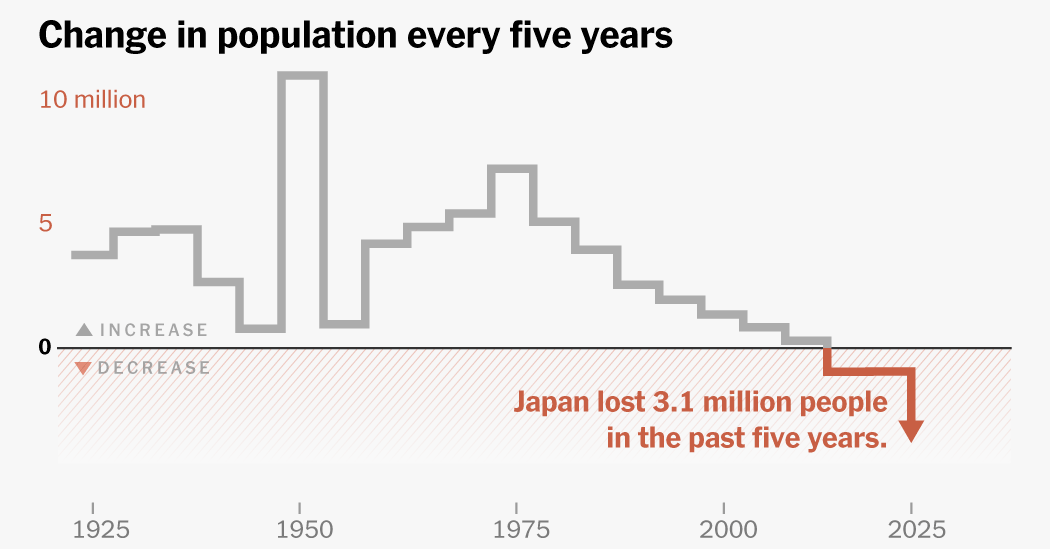
The newly released 2025 preliminary census results from the Statistics Bureau of Japan have delivered a sobering and unprecedented confirmation of a nation in rapid, structural contraction. Over the last five years alone, the country’s population plummeted by more than 3 million citizens, shrinking from 126.1 million in 2020 to just 123 million in 2025. This historic loss represents the steepest five-year decline recorded since Japan first began systematically collecting census data in 1920, signaling that the long-anticipated demographic crisis has transitioned from a distant economic forecast into an immediate, disruptive reality. Once a high-growth industrial juggernaut whose economic model was studied globally, Japan has now receded to a population size roughly identical to where it stood in 1989—the zenith of its post-war asset bubble. Since peaking in 2008 at 128 million, the nation’s demographic trajectory has resembled a steady sovereign retreat, with official projections warning of a further drop to a mere 87 million residents by the year 2070. By analyzing this dramatic contraction, sociologists and economists find themselves observing a watershed moment in modern history: a major, advanced G7 economy navigating the uncharted waters of sustained, peacetime depopulation. This shift forces a complete reimagining of urban planning, national defense, social welfare, and the very concept of infinite economic growth. Far from being a sudden shock, this demographic contraction represents the culmination of decades of declining fertility rates and rising life expectancies, creating an unsustainable imbalance that is now restructuring Japanese society from the ground up.
The Arithmetic of Decline: Why Decades of Pronatalist Policies Have Failed to Move the Needle
At the heart of Japan’s accelerating demographic crisis lies a stark, unyielding biological deficit: for every single birth recorded across the archipelago, there are now two deaths. This demographic math has defied decades of increasingly urgent government interventions, ranging from local matchmaking programs to direct monthly cash allowances, expanded subsidized childcare, and government-backed fertility treatments. Despite these sweeping pronatalist initiatives, the nation’s average fertility rate remains stubbornly depressed at approximately 1.1 children per woman national average, well below the 2.1 replacement rate required to keep a population stable. Sociological experts point out that the government’s remedies have largely failed to address the root systemic stressors that deter young Japanese from marrying and starting families. Chief among these issues is a demanding corporate work culture that leaves young professionals with minimal work-life balance, combined with persistent gender inequality in household division of labor and decades of stagnant wages that make the high cost of urban child-rearing feel financially prohibitive. Consequently, a growing percentage of young adults view marriage and family planning not as a natural transition of adulthood, but as an unattainable luxury or a direct threat to their career stability. The policy failure demonstrates that financial cash rewards alone cannot reverse deep-seated cultural anxieties, suggesting that Japan’s demographic decline is fundamentally a symptom of modern capitalist pressures operating within a highly conservative social structure.
The Devastated Hinterlands: Ghost Towns, Empty Schools, and the Death of the Japanese Countryside
The geographic distribution of this population loss reveals that the crisis has deeply penetrated nearly every corner of Japan, with 45 of its 47 prefectures reporting accelerating population contractions in 2025. The hardest-hit regions are the northern prefectures of Akita and Aomori, which suffered a staggering 8 percent reduction in their populations over the span of just five years. These rural hinterlands are enduring a brutal double-blow: they are home to some of the most elderly demographics on Earth, while simultaneously experiencing a youth exodus as young people flee the harsh winter climates, limited cultural amenities, and low-wage local economies. As a result, the picturesque Japanese countryside is rapidly hollowing out, creating a landscape of overgrown, vacant homes known as akiya, which now number in the millions. Rural infrastructure is entering a state of terminal decline: historic local rail lines are being mothballed, municipal offices and regional hospitals are actively downsizing their services, and primary schools are being converted into geriatric daycare centers and senior community hubs. In these quiet mountain villages and fishing ports, the physical remnants of the mid-century boom stand as silent, decaying monuments to an era when young families populated the landscape, highlighting the painful social isolation currently felt by the vulnerable, elderly residents left behind.
The Lure of the Metropolis: Tokyo’s Hyper-Density as an Illusion of Vitality
While Japan’s provinces languish under the weight of depopulation, the country’s major urban agglomerations manage to temporarily stave off this decline, resulting in a stark demographic imbalance. The Tokyo metropolitan area—the vast urban conurbation comprising the capital city alongside the neighboring prefectures of Kanagawa, Saitama, and Chiba—actually experienced a slight expansion to 37 million people in 2025, consolidating its position as one of the most populous urban environments on Earth. Tokyo proper saw its population rise by over 1 percent to 14.2 million, driven by a continuous stream of ambitious university graduates and young professionals seeking career advancement, dynamic lifestyles, and white-collar employment opportunities. This massive influx of youth has transformed Tokyo into a cultural and financial powerhouse that is roughly 20 times denser than the rest of the nation, effectively creating a demographic vacuum that drains the vitality out of regional Japan. However, experts warn that Tokyo’s hyper-concentration masks a structural vulnerability: the capital itself possesses the lowest fertility rate in the entire country, meaning it is essentially consuming Japan’s youth without reproducing them. An interesting counter-narrative can be found in the subtropical islands of Okinawa, which stood as a rare bright spot in the census by posting modest population growth due to its national-high fertility rate of 1.5, showing that regional cultural norms, strong community networks, and a slower pace of life can foster higher birth rates even amidst nationwide decline.
The Immigration Dilemma: Nationalism, Taboos, and the Irreversible Path of Isolation
As Japan’s domestic labor supply contracts to critical levels, the debate over how to sustain the nation’s workforce has brought its long-standing immigration taboos to the forefront of domestic politics. Historically, the Japanese government has maintained highly restrictive immigration policies, prioritizing social cohesion, homogeneity, and cultural preservation over international labor integration. Although modern economic realities have forced modest concessions—such as the creation of specialized visa categories for blue-collar foreign workers in crucial sectors like agriculture, construction, and nursing care—integration remains administratively complex and politically sensitive. Nationalist politicians and populist commentators championing a “Japan First” agenda have gained significant traction in recent years, warning that substantial immigration could permanently alter the country’s social fabric. This ideological resistance stands in direct opposition to the growing academic and economic consensus that Japan has reached a developmental threshold where demographic stabilization is mathematically impossible without massive, sustained international immigration. As Princeton University sociology professor James Raymo succinctly notes, the current rate of decline is entirely irreversible in the short to medium term in the absence of mass immigration, presenting Japan with a fundamental choice between preserving its traditional cultural insularity or embracing multiculturalism to preserve its economic vitality.
The Global Crucible: How Japan’s Demographic Sunset Prefigures the Future of the Industrialized World
The acute challenges currently confronting Japan are not isolated regional anomalies, but rather a preview of the structural pressures destined to reshape other highly developed countries across the globe. From South Korea and Taiwan to Italy, Spain, and Germany, industrial nations are rapidly heading toward similar demographic cliffs, characterized by plummeting birth rates and expanding elderly populations. Japan has effectively become the global test kitchen for navigating a post-growth society, desperately attempting to maintain its standard of living, sovereign debt levels, and national defense commitments with a shrinking tax base and a strained healthcare system. As labor shortages worsen in essential public services—including transportation, policing, healthcare, and education—the nation is increasingly leaning on automation, artificial intelligence, and elder-care robotics to cushion the blow. However, technology can only do so much to replace the human capital required to sustain a vibrant national economy. For international policymakers, economists, and sociologists, the lessons of Japan’s struggle will be invaluable; how the world’s fourth-largest economy adapts to its ongoing contraction will ultimately determine whether a shrinking nation can maintain its prosperity, or if demographic decline inevitably leads to long-term societal and economic stagnation.