






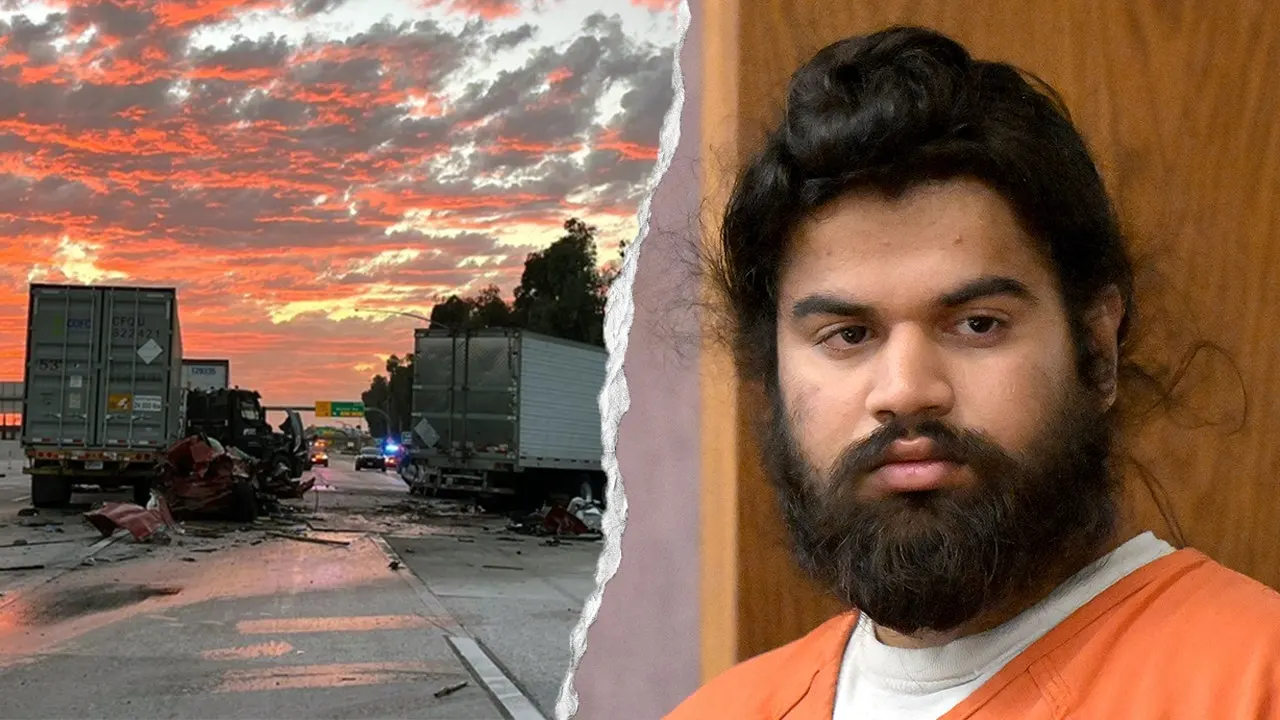
To understand the true weight of the tragedy that unfolded on a Southern California highway, one must look past the dry court documents and recognize the devastating reality of a system that failed at multiple levels, costing three innocent people their lives. In October 2025, a horrific, fiery multi-vehicle crash on Interstate 10 in San Bernardino County brought traffic—and several families’ lives—to a sudden, violent halt. Behind the wheel of the massive semitruck that plowed into slow-moving traffic without ever applying the brakes was Jashanpreet Singh, a 21-year-old Indian national. Investigators and dashcam footage revealed a chilling scene of sheer negligence, showing the heavy truck obliterating smaller vehicles in its path. Beyond the immediate chaos of the wreck lay a complex web of border enforcement gaps, bureaucratic finger-pointing, and regulatory loopholes that allowed an unqualified, undocumented driver to operate a lethal piece of machinery on public American roads.
The human cost of this disaster was quickly followed by legal accountability, though many victims’ advocates feel the punishment hardly fits the immensity of the loss. On Tuesday, Singh was sentenced to four years and eight months in federal prison after pleading guilty to three felony counts of vehicular manslaughter with gross negligence. While toxicology tests eventually confirmed that Singh was not under the influence of drugs or alcohol at the time of the collision, the prosecution emphasized that his complete lack of professional driving competence and total disregard for road safety constituted a lethal threat. For the families of the three deceased victims and the numerous other commuters who sustained severe injuries, the modest prison sentence offers a cold, frustrating closure, highlighting a painful consensus that this entire catastrophe was entirely preventable had existing laws been properly enforced.
At the heart of the public outrage surrounding this case is Singh’s immigration status and his journey into the United States, which critics argue exposes severe vulnerabilities in national security and border management. Singh entered the country illegally from India in March 2022, crossing through California’s El Centro Sector. Rather than being deported, he was encountered by U.S. Border Patrol agents and subsequently released into the American interior under the Biden administration’s policy of issuing notices to appear at future immigration hearings. This practice, often criticized as “catch-and-release,” allowed Singh to roam the country and establish a life, ultimately leading him to seek employment in the commercial trucking industry—a highly regulated sector that is supposed to require rigorous vetting, legal residency, and strict safety qualifications.
The controversy deepens when examining how an undocumented immigrant with pending deportation proceedings managed to obtain a Commercial Driver’s License (CDL) to operate heavy transport vehicles. According to the United States Department of Transportation, Singh was granted a California CDL in June 2025. This sparked an intense jurisdictional battle between state and federal agencies over who was responsible for allowing him on the road. California Department of Motor Vehicles officials defended their decision by stating that Singh’s commercial license eligibility was based on federally approved employment authorization documents. Conversely, federal transportation officials asserted that under new, strict emergency guidelines, Singh should have been completely disqualified from driving such vehicles, pointing to a systemic breakdown in communication and policy enforcement between Sacramento and Washington.
This bureaucratic friction was not a sudden revelation; indeed, federal authorities had already identified California’s lax licensing procedures as an accident waiting to happen. Just capped months before the fatal crash, in September, federal regulators explicitly warned California officials about severe compliance issues regarding the issuance of commercial driver’s licenses to non-citizens. The federal government ordered the state to pause the issuance of licenses to non-citizens, audit existing files, and immediately revoke licenses for anyone who did not meet the strict federal criteria. Astonishingly, despite these urgent directives, a restriction on Singh’s commercial license was actually removed on October 15, immediately after he turned 21. Just six days later, he was behind the wheel of the semi-truck that caused the deadly pileup, proving that the warnings had come too late to save three lives.
Ultimately, the tragedy of Jashanpreet Singh serves as a sobering wake-up call regarding the intersection of border security, federal oversight, and public safety on American highways. Lawmakers and industry insiders have warned that the trucking sector is increasingly utilizing unqualified, unauthorized drivers, creating a ticking time bomb for everyday commuters. This incident has galvanized critics who argue that political correctness and administrative laziness have compromised the basic safety of the American public. As Singh begins his prison sentence, the families of those lost are left to mourn, and the nation is left to grapple with a haunting question: how many more unlicensed, unchecked drivers are currently navigating massive rigs alongside unsuspecting families daily, waiting for the next system failure to occur?