





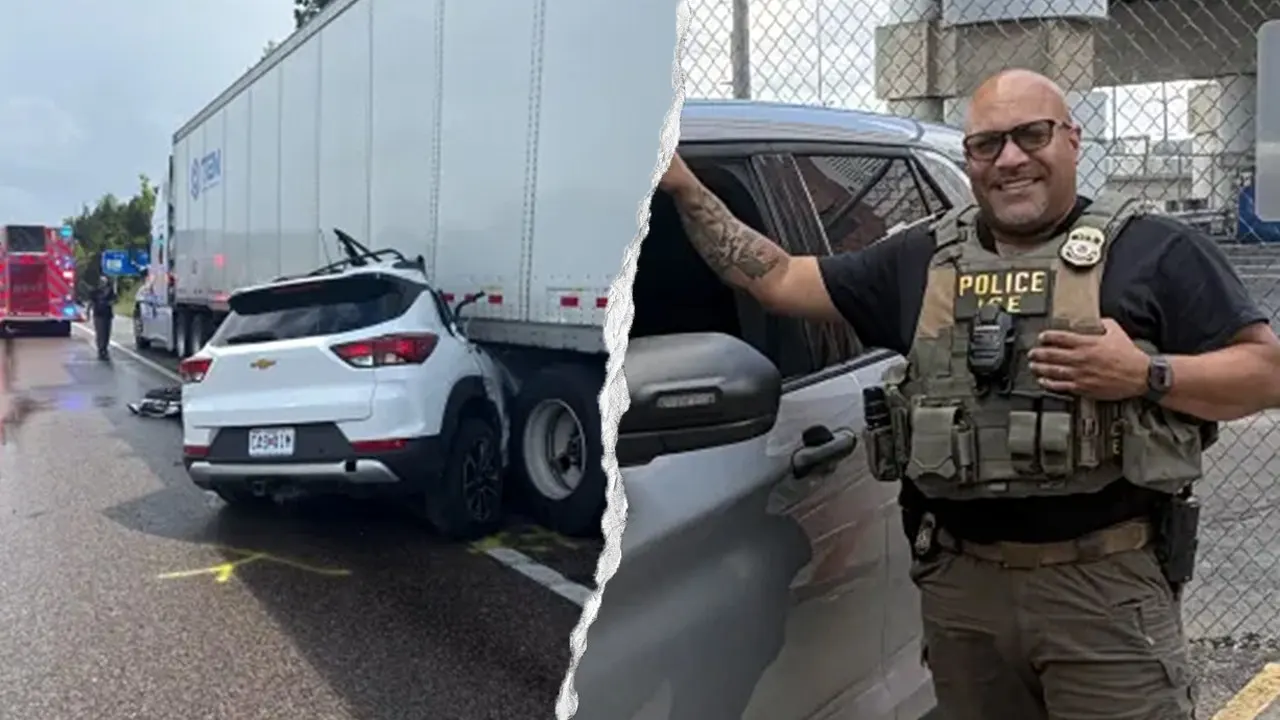
When we think of Immigration and Customs Enforcement (ICE) officers, our minds usually drift toward administrative duties, border enforcement, or complex federal investigations. However, a recent life-or-death emergency in Missouri reminded us that these officers are, first and foremost, human beings dedicated to protecting lives wherever and whenever danger strikes. On a warm summer afternoon, Curtland Sawyer, an ICE officer based out of the agency’s St. Louis sub-office, found himself transitioning from an ordinary commuter into a guardian angel. While driving home along a busy highway near the city of Festus, Missouri, Sawyer witnessed a horrifying, high-speed collision between a passenger vehicle and a massive tractor-trailer. Without a single moment of hesitation, he pulled his car over and sprinted toward the mangled wreckage, driven by a pure instinct to help.
The scene Sawyer encountered was chaotic and incredibly tense, with the driver of the crushed vehicle suffering from severe, life-threatening injuries. Drawing on his intensive law enforcement training, Sawyer quickly assessed the situation and noticed that the driver was bleeding out rapidly from a deeply mangled arm. Understanding that every passing second could mean the difference between life and death, he immediately applied a tourniquet to the driver’s arm, effectively halting the catastrophic blood loss. He then remained knelt by the victim’s side in the wreckage, offering quiet comfort and monitoring their vital signs until local emergency medical technicians arrived to take over. It was a display of profound empathy and steady professionalism under immense pressure, proving that heroes do not always wear capes—sometimes, they are just ordinary public servants on their evening commute.
This act of selfless bravery did not go unnoticed, earning Officer Sawyer widespread praise from the highest levels of the federal government. The Department of Homeland Security (DHS) publicly commended his decisive actions, highlighting how his swift intervention directly prevented a tragedy. DHS Assistant Secretary Lauren Bis released an emotional statement celebrating Sawyer’s heroism, pointing out that his conduct represents the absolute best of what federal law enforcement officers have to offer. Bis emphasized that when these officers see a fellow human being in desperate need, they do not hesitate to spring into action, regardless of whether they are officially on the clock. She urged the public to recognize the humanity and dedication of these agents, reminding everyone to express gratitude to officers like Sawyer who quietly serve and protect American communities every day.
What makes Sawyer’s story even more remarkable is that it is not an isolated incident, but rather part of a heartening trend of ICE officers stepping up in moments of civilian crisis. Just last month, another dramatic rescue unfolded in Florida when an off-duty ICE officer noticed a six-year-old child drowning in a swimming pool. The officer dove into the water without a second thought, pulled the unresponsive child to safety, and immediately administered lifesaving CPR until the child began breathing again. These stories highlight a deeply rooted culture of vigilance and compassion within the agency, showing that these men and women carry their duty to protect human life into their personal lives, remaining vigilant even during their well-deserved downtime.
In yet another harrowing episode that occurred recently in Milwaukee, Wisconsin, a team of ICE officers found themselves in the right place at the right time during a routine patrol. They witnessed a reckless driver run a red light, violently T-boning another vehicle and causing it to flip completely upside down. Ignoring the potential danger of leaking fuel or a secondary collision, the officers paused their scheduled law enforcement operation and rushed to the smoking, overturned car. Working together, they managed to safely extract a terrified woman who was trapped inside the metal cabin. By prioritizing human life over their immediate administrative duties, these officers demonstrated a profound level of civic duty and situational awareness that kept a scary accident from becoming fatal.
Ultimately, these stories of everyday valor serve as a powerful reminder of the shared humanity that connects law enforcement officers to the communities they patrol. Beyond the politics, debates, and daily headlines surrounding immigration enforcement, the individuals wearing the badge are fathers, mothers, neighbors, and citizens who care deeply about the safety of those around them. Curtland Sawyer’s split-second decision to run toward danger in Missouri, alongside the heroic actions of his colleagues in Florida and Wisconsin, paints a picture of public servants who are always ready to answer the call of duty. Their actions remind us that true service is not just about enforcing the law, but about showing up for one another with empathy, courage, and a willingness to help when help is needed most.