






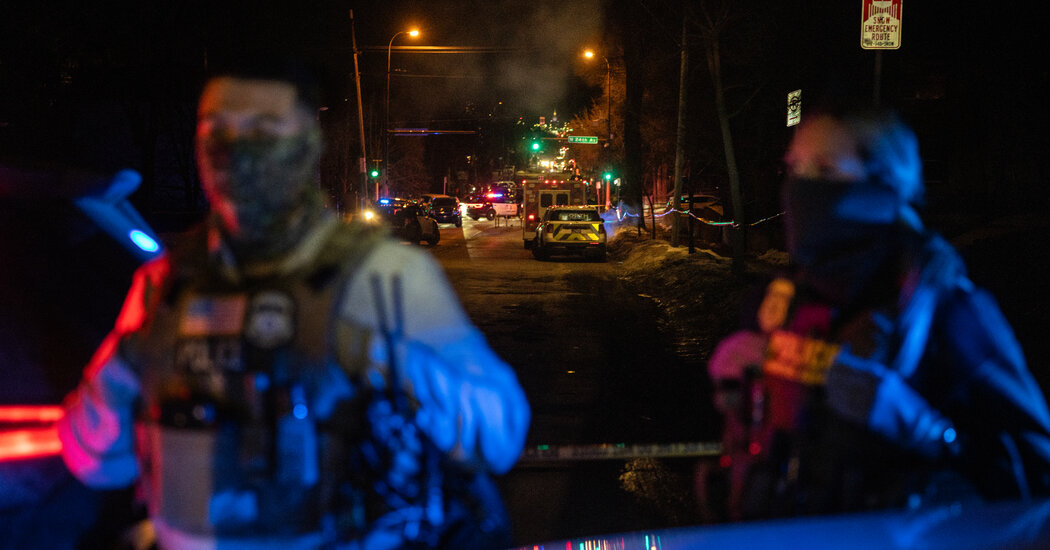
On a quiet Friday morning in the border town of Harlingen, Texas, the distant reverberations of a cold Minnesota winter finally caught up with fifty-two-year-old Christian J. Castro. The federal Immigration and Customs Enforcement agent was taken into custody by a coordinated task force of state investigators and Texas Rangers, bringing a dramatic close to his brief period on the run. Castro now faces four grave counts of second-degree assault and an additional charge of filing a false police report, arising from a chaotic evening on January 14 of this year that shattered the fragile trust between Minneapolis’s immigrant communities and the federal officers patrolling their streets. The incident, which began as a routine enforcement action, quickly deteriorated into a violent flashpoint after Castro allegedly fired his service weapon through a residential door, wounding an innocent bystander, Julio C. Sosa-Celis. In the immediate aftermath, as the community erupted in outrage, the human cost of the encounter was instantly obscured by a tangled web of official fabrications and political defensiveness, leaving a traumatized family to pick up the pieces of their lives while caught in the crosshairs of a high-stakes legal battle.
The roots of the crisis lie in a brief, frantic scuffle that took place outside a Minneapolis residence, where Castro had pursued Alfredo Aljorna, a Venezuelan migrant, following a brief vehicular chase. According to court records, when Aljorna managed to break free from the agent’s grasp and seek sanctuary inside his home, Castro did not halt to de-escalate; instead, he fired a single round through the closed front door, striking Aljorna’s roommate, Sosa-Celis, in the leg. To shield himself from the professional and legal ruin of an unauthorized shooting, Castro constructed a harrowing narrative of survival, claiming that he had been savagely set upon by three men who beat him relentlessly with a broom and a shovel, forcing him to shoot in fear for his life. This falsehood carried devastating human consequences, as federal authorities, relying on Castro’s fabricated testimony, immediately locked up the injured Sosa-Celis and Aljorna on charges of assaulting a federal officer. It was only when investigators unearthed a local police surveillance video—which vividly contradicted Castro’s claims and showed no such assault took place—that the charges against the two Venezuelan men were dropped, exposing the profound vulnerability of migrants who can be instantly criminalized by a single officer’s lie.
The unraveling of the state’s case against the target migrants has ignited a fierce, multi-jurisdictional turf war over accountability, spearheaded by Hennepin County Attorney Mary Moriarty. Moriarty has emerged as an uncompromising advocate for local justice, insisting that federal badges do not grant agents a license to commit violence or lie under oath with impunity. Her bold prosecution has met with fierce resistance from ICE leadership, who quickly labeled the charges against Castro as an “unlawful political stunt,” laying bare the deep-seated institutional defense mechanisms that protect federal personnel. The prosecution now faces a daunting legal steeplechase, as federal employees enjoy a robust shield of immunity under the Supremacy Clause of the U.S. Constitution for actions taken in the line of duty. Additionally, the physical act of bringing Castro back to Minnesota to face these charges has become a political football; if Castro fights his extradition from Texas, the process will require a formal gubernatorial request from Minnesota’s Democratic Governor Tim Walz to Texas’s Republican Governor Greg Abbott, transforming a quest for criminal accountability into a partisan diplomatic negotiation.
This incident, however, is far from an isolated aberration; it represents a systemic pattern of aggression that characterized the massive deployment of federal immigration agents to Minnesota last winter. Castro is the second ICE agent Moriarty has charged with physical violence in recent months, following the April indictment of thirty-five-year-old Gregory Donnell Morgan Jr. Morgan, a Maryland-based agent assigned to the Minnesota crackdown, is accused of pointing his firearm at terrified motorists on a state highway in February. Morgan’s defense attorney, Ryan Pacyga, offers a window into the intense, claustrophobic stress experienced by federal agents deployed to unfamiliar, hostile environments, arguing that human beings under immense pressure perceive danger differently and must make split-second decisions in rapidly evolving situations. While this defense highlights the very real psychological toll on law enforcement officers who feel constantly threatened and harassed, it does little to soothe the terror of local civilians who find themselves staring down the barrels of guns held by federal agents operating under a perceived state of siege.
The legal mechanisms governing these prosecutions are as unique as they are severe, carrying immense stakes for the accused agents and the broader discourse on police accountability. If the cases against Castro and Morgan are successfully transferred to federal court—a strategic move their defense teams are actively pursuing—state prosecutors will find themselves in the highly unusual position of arguing state-level assault charges before a federal judge and jury. Under Minnesota law, the second-degree assault charges both men face carry a mandatory minimum sentence of three years in prison upon conviction. Crucially, because these are state-level indictments and not federal offenses, even a sweeping presidential pardon from Donald Trump would be powerless to erase a conviction secured under Minnesota law, making these trials a definitive test of local sovereignty over federal overreach. This high-stakes legal reality highlights the profound desperation of a community searching for structural limits on federal departments that have historically operated with little local oversight.
Ultimately, the prosecutions of Castro and Morgan are merely the visible tip of a much deeper humanitarian crisis in Minnesota, where more than thirty active investigations into federal immigration misconduct remain open. Moriarty’s office is currently locked in a bitter legal battle with the federal government to compel the release of evidence involving the tragic, fatal shootings of two American citizens, Renee Good and Alex Pretti, during the same winter immigration surge. Behind the legal briefs and political posturing are grieving families and traumatized neighborhoods, left wondering how a routine federal security operation could morph into a campaign of violence against citizens and immigrants alike. As the civil lawsuits wind their way through the courts and the criminal trials of these agents drawing near, the residents of Minneapolis are left seeking a fundamental recalibration of justice—one where the safety of a community is not sacrificed in the name of immigration enforcement, and where the human rights of every resident, regardless of their country of origin, are protected under the law.