






In the cutthroat and performative arena of New York politics, sports serve as far more than just a casual pastime; they are a vital cultural currency that politicians use to prove their connection to the everyday, working-class voter. So, when New York Governor Kathy Hochul saw a seemingly golden opportunity to take a public swipe at former President Donald Trump’s self-proclaimed lifelong devotion to the New York Knicks, she muddying the waters with what she undoubtedly thought would be a flawless rhetorical slam dunk. Instead, she ended up throwing up a spectacular, air-balled brick that immediately ricocheted right back into her own face. During a press conference in the Big Apple, Hochul was asked by a reporter about Trump’s enthusiastic statements regarding his desire to watch the Knicks play in the NBA Finals at Madison Square Garden for the first time in decades. Attempting to gatekeep the former president’s fandom and expose him as an inauthentic, fair-weather bandwagoner, Hochul smugly challenged him to name the starting lineup of the Knicks’ “1993 championship team” to see how he would fare. It was a classic political “gotcha” moment designed to humiliate her political rival on live television and assert her own New York street cred. However, the smugness evaporated the very instant basketball historians, sports fans, and journalists realized that the Governor had her historical facts completely backwards. There was no 1993 championship team; the Knicks’ legendary but agonizingly distant golden era actually peaked in 1973. By fabricating an entire championship out of thin air to score a quick political point, Hochul accidentally exposed her own lack of genuine familiarity with New York sports history, transforming what she hoped would be a viral victory into a highly publicized, embarrassing self-own.
To truly grasp why this particular blunder resonated so deeply—and so painfully—with New Yorkers, one has to understand the delicate, often agonizing history of the New York Knicks franchise. The team’s incredibly loyal fan base has been desperately starved of a Larry O’Brien Championship Trophy for over half a century, with their last victory parade taking place down the famous Canyon of Heroes way back in 1973 under the leadership of legendary figures like Walt “Clyde” Frazier, Willis Reed, and Earl Monroe. By the time the early 1990s rolled around, the Knicks were indeed a dominant, heavy-hitting powerhouse in the Eastern Conference, led by head coach Pat Riley and Hall of Fame center Patrick Ewing, but their ultimate prize was repeatedly and tragically blocked by Michael Jordan’s unstoppable Chicago Bulls. While the gritty, physical Knicks did manage to claw their way to the NBA Finals in 1994 during Jordan’s temporary baseball retirement, they ultimately lost a devastating, heartbreaking seven-game series to Hakeem Olajuwon and the Houston Rockets. For a local politician to casually invent a 1993 championship title does not merely show a simple slip of the tongue; it demonstrates a fundamental ignorance of the actual, lived history of local sports enthusiasts. It retroactively erases the decades of genuine heartbreak, intense rivalry, and unparalleled resilience that define what it actually means to be a loyal, long-suffering Knicks fan. By presenting a fictional history where the beloved 1990s Knicks were crowned champions, Hochul inadvertently alienated the very sports-loving demographic she was trying to court, proving that her attempt at sports-based camaraderie was nothing more than a poorly researched, superficial talking point written by advisors who clearly failed to do their basic homework.
This entire episode shines a glaring spotlight on a much larger, recurring phenomenon in modern democratic politics: the manufactured, highly performative sports fandom of political elites. For decades, highly paid political consultants have advised candidates to align themselves with local sports franchises to project a relatable, “salt-of-the-earth” persona that transcends complex partisan divides. When executed naturally, this strategy can build instantaneous, organic trust between a representative and their constituents; however, when it goes wrong, it quickly becomes a cringeworthy textbook example of artificial pandering. Modern voters possess an incredibly sensitive, near-faultless radar for inauthenticity, and nothing triggers that system faster than a politician reading a prepared script about a sports team they clearly do not follow or understand. From Mitt Romney’s awkward attempts to discuss his favorite “sporting” events to Hillary Clinton claiming a dual lifelong allegiance to both the Chicago Cubs and the New York Yankees, political history is littered with the carcasses of public campaigns that tried and failed to bend sports culture to their political will. Sports fandom is sacred to millions of everyday people because it represents community, family tradition, shared struggle, and deep emotional investment. When a politician tries to weaponize that raw loyalty to score cheap political points against a partisan opponent, they are playing with fire. If you are going to publicly gatekeep someone else’s fandom, you absolutely must have your own facts correct; otherwise, you invite the collective, unforgiving wrath of a passionate community that does not appreciate being used as a mere prop.
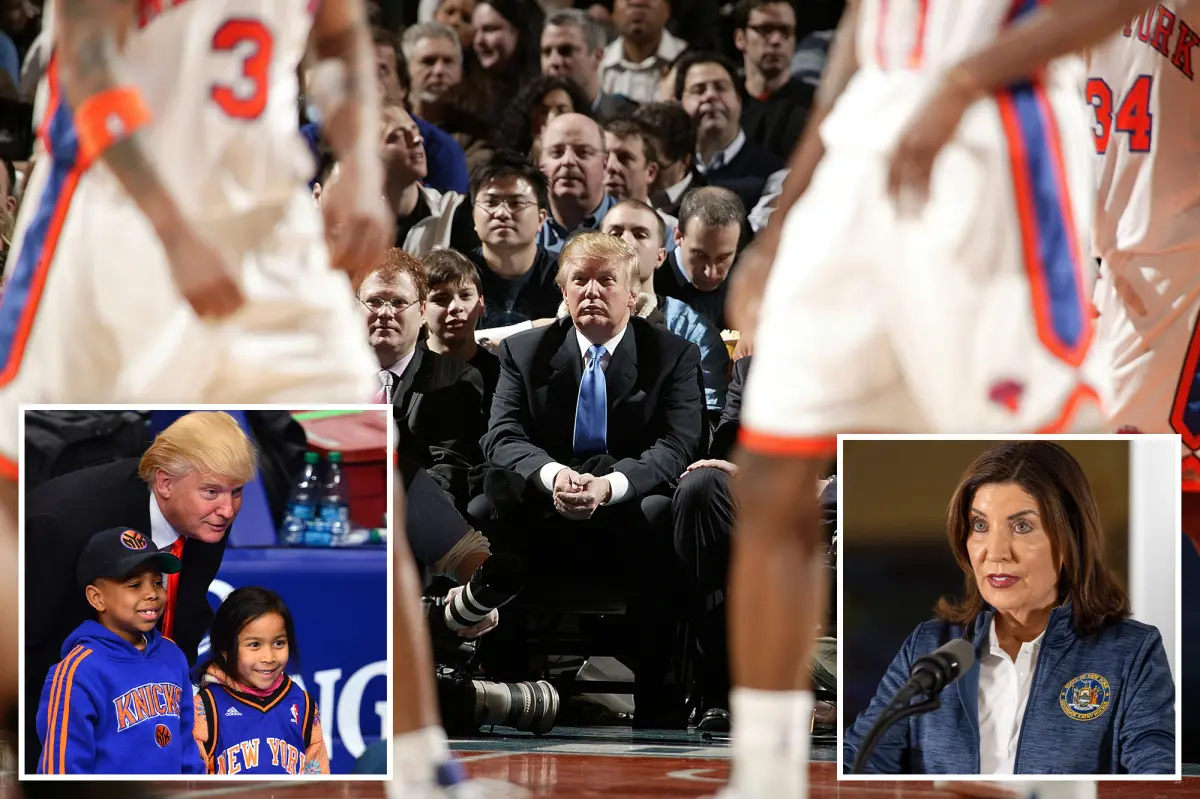
The sheer irony of Hochul attempting to lecture Donald Trump on his New York sports credentials makes the entire situation even more fascinating to political observers and cultural commentators alike. Whatever one’s political opinions of Trump may be, his identity as a quintessential, larger-than-life New York figure is deeply woven into the city’s media and architectural history over the past forty years. Long before his entry into national politics, Trump was a highly visible, permanent fixture in the front-row seats of Madison Square Garden, attending high-profile boxing matches, New York Rangers hockey games, and legendary Knicks matchups throughout the golden eras of the 1980s and 1990s. His connection to the city’s sports scene was not retrofitted or manufactured by a team of political strategists ahead of an upcoming election cycle; it was an organic, highly documented part of his lifestyle as a Manhattan real estate mogul who thrived on the high-octane energy of New York’s grandest public arenas. When Trump expressed his genuine desire to watch his beloved Knicks play in the NBA Finals—something they haven’t reached since their magical run in 1999—he was speaking directly to that deep-seated, nostalgic longing for the grand old days of New York sports dominance. By trying to cast doubt on Trump’s connection to the team, Hochul chose to stage a battle on a field where her opponent possessed decades of highly visible, photographic evidence of his presence. This strategic miscalculation made her historical error look less like an innocent, honest mistake and more like a desperate, fundamentally flawed political smear that backfired in spectacular fashion.
In our current hyper-connected digital landscape, a political gaffe of this nature is never just a passing, throwaway headline; it quickly transforms into a viral, memetic event that spreads across major social media platforms within a matter of minutes. Almost immediately after the video of Hochul’s press conference hit the internet, sports commentators, political critics, and ordinary citizens took to platforms like X (formerly Twitter) to dissect, analyze, and relentlessly mock the error. Online critics quickly labeled the Democratic governor a “fraud” and pointed out the supreme irony of her trying to gatekeep a beloved sport that she clearly does not watch. The rapid-fire nature of online media means that slip-ups are preserved forever, edited into shareable clips, and converted into digestible memes that damage a politician’s public credibility far more effectively than traditional negative advertising campaigns. For Hochul, who was already dealing with high-stakes political battles involving NYC’s budget, controversial state pension reforms, and public transit policies, this sports blunder added unwanted fuel to the fire. It allowed her detractors to paint her as an out-of-touch academic elite who is disconnected from the real lives, passions, and cultural activities of everyday New Yorkers. The swift digital backlash demonstrated that in the court of modern public opinion, trying to look cool, cultured, and intimidating while failing on basic sports trivia is a guaranteed recipe for instant, widespread ridicule.
Ultimately, this seemingly harmless but highly revealing sports gaffe points to a much broader crisis of authenticity currently plaguing modern political leadership. Today’s electorate is increasingly cynical, weary of overly polished, highly scripted politicians who seem to operate behind a protective barrier of focus groups, sterile press rooms, and pre-written talking points. When an elected official cannot even get basic local sports history right while trying to embarrass someone else, it deepens the public’s nagging suspicion that our leaders are fundamentally disconnected from the actual cultural fabric of the communities they represent. Truly authentic leaders do not need to fabricate a sports-loving persona or memorize trivia cards to connect with their constituents; they understand that honesty, intellectual humility, and real human connection are far more powerful than any manufactured public relations stunt. Perhaps the greatest lesson Governor Hochul can take away from this embarrassing experience is that it is always better to admit what you do not know rather than pretend to be an expert to mock a political rival. In the endlessly passionate, highly critical, and unforgiving world of New York sports and politics, absolute honesty remains the best game plan. If you aren’t actually losing sleep over a tough game, and if you can’t remember whether the legendary Patrick Ewing actually won a championship ring or suffered iconic near-misses, it is probably best to leave the sports talk to the true fans in the nosebleed seats—and keep your political maneuvers strictly confined to the legislative floor.