



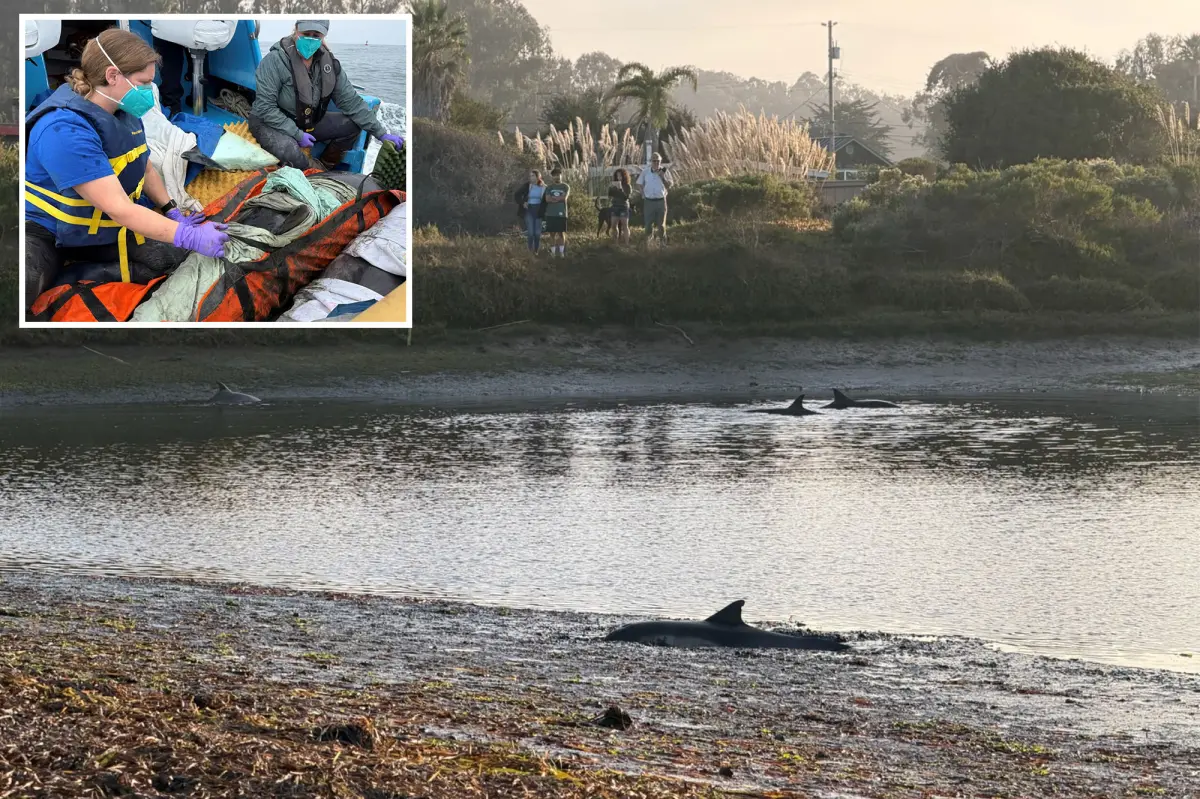
There is something uniquely heartbreaking about a creature born for the open ocean finding itself sinking into mud. The dolphins that arrived in the waters near Morro Bay, California, were not supposed to be there, and yet there they were—a pod of common dolphins, sleek and wild, suddenly confused and trapped in a shallow inlet called Cuesta Inlet. What began as a curious spectacle quickly turned into a delicate rescue effort, and by the end, one of the animals had died, stuck in the mud before help could reach it. On Wednesday, the Marine Mammal Center confirmed the death of the stranded dolphin, while also sharing the bittersweet news that three others had been saved. The pod had wandered off course, likely drawn into the inlet by shifting tides or perhaps by something deeper in the ocean’s changing rhythms. For a moment, the sight of dolphins close to shore brought excitement to spectators, but the ocean’s beauty has a way of concealing its dangers, and the same water that carried them in soon pulled away, leaving the animals stranded in thick mudflats with no way back to deeper water.
The ordeal unfolded over a dramatic two-day stretch, as calls began flooding in to local authorities from people who spotted the common dolphins outside the bay. The Marine Mammal Center and the California Department of Fish and Wildlife responded quickly, hoping the animals would simply turn around and swim back to safety. At first, there was reason for optimism. The dolphins appeared to be behaving normally, and officials knew that these were wild, native animals, not pets or performers. The best-case scenario, as the Marine Mammal Center put it, was for the dolphins to find their own way out of the inlet, to let instinct take over and guide them back to familiar waters. But the tide does not care about hopeful plans. By Tuesday afternoon, the water had receded dramatically, and the dolphins became stuck in the mud, their bodies too heavy to move without the buoyancy of the sea. What had been a brief moment of wonder for onlookers turned into a slow, painful realization: these animals were in serious trouble, and time was running out.
By Wednesday morning, a rescue team was on the move. Marine Mammal Center experts, with help from Harbor Patrol, waded into the mudflats at Cuesta Inlet to reach the stranded animals. It was not a simple rescue. Dolphins are large, powerful creatures, and when they are frightened and stranded, they can be difficult to handle. But the team managed to safely secure three of the four dolphins and transport them out of the bay, releasing them back into the open ocean where they belonged. There is no way to know what those dolphins felt in that moment—relief, fear, exhaustion—but one can imagine the surge of hope as the water deepened beneath them and the horizon opened up again. The fourth dolphin, however, did not survive. It was discovered dead in the mud, its body having succumbed before rescuers could reach it. Officials said a necropsy would be performed to learn more about what happened. And as if to remind everyone how unpredictable these situations can be, a fifth dolphin had been spotted earlier in nearby Shark Inlet, but it was not found during the rescue efforts. The team vowed to continue monitoring the area, hoping the missing animal would either appear or have already made its way back to safety.
The question that lingers after any stranding event is always the same: why did this happen? In this case, officials admitted they were not entirely sure why the pod traveled off course, but they pointed to the unusual ocean conditions that have been affecting the California coast. The coming El Niño, combined with past marine heat waves such as the infamous “Blob,” has warmed the waters in ways that disrupt the natural balance of the marine ecosystem. Giancarlo Rulli, a representative from the Marine Mammal Center, explained that warmer waters can shift the distribution of fish and other prey, potentially forcing dolphins to adapt their feeding behavior and seek new food sources. In other words, the dolphins may have been following their stomachs, chasing food into unfamiliar territory, only to find themselves trapped in a place where the ocean itself seemed to abandon them. Climate change and natural weather cycles are difficult to untangle, but their effects are becoming more visible in the daily lives of marine animals. For dolphins, the ocean is not just a home—it is a map, a pantry, a playground, and a refuge. When that map changes unexpectedly, they are just as vulnerable as the rest of us.
Behind the clinical language of rescue reports and scheduled necropsies, there is a deeply human story of care and grief. The people who responded to this stranding were not indifferent; they were exhausted, worried, and saddened. Sarah Pattison, the Director of Hospital Operations at the Marine Mammal Center, spoke openly about the emotional weight of the event. “Seeing an animal in distress is emotionally difficult, and our team feels that too,” she said. “This has been a heroic effort by many partners, including Harbor Patrol and the community, to give these animals a second chance.” Her words are a reminder that wildlife rescue is not just a technical job; it is an act of empathy, a refusal to look away from suffering even when the outcome is uncertain. The team members who waded into the mud were not just performing a task—they were trying to make a difference for creatures that cannot ask for help in words. They carried the weight of the dead dolphin with them, even as they celebrated the release of the three survivors. And in the end, they expressed gratitude that at least some of the animals were able to return home, while promising to keep watching over the waters for the one that still had not been found.
There is no neat ending to this story, no simple moral that ties everything together. One dolphin died. Three dolphins were saved. One remains unaccounted for. The ocean, as always, continues to hold its secrets. But there is something to be said for the way the community came together, for the people who noticed the dolphins and made the calls, for the experts who rushed to help, and for the spectators who, despite their excitement, must have felt a pang of worry as the tide slipped away. This moment on a muddy inlet near Morro Bay is a small story in the grand scheme of things, but it echoes a larger truth about our changing world. The dolphins did not intend to get lost any more than we intend to lose the natural rhythms that have guided life on this planet for millennia. Yet here we are, all of us—animals and humans alike—trying to navigate a world that is shifting beneath our feet. The rescue team will continue to monitor the area, hoping for signs of the missing dolphin, and perhaps hoping for something more: that next time, the ocean might be a little more forgiving. For now, the survivors are back in the deep blue, swimming through waters that are no longer quite as familiar as they once were. And we are left on shore, with muddy boots and heavy hearts, grateful for second chances and mindful of how thin the line is between safety and struggle.