


The Lone Holdout: A Juror’s Solitary Stand and the Nation’s Unexpected Response
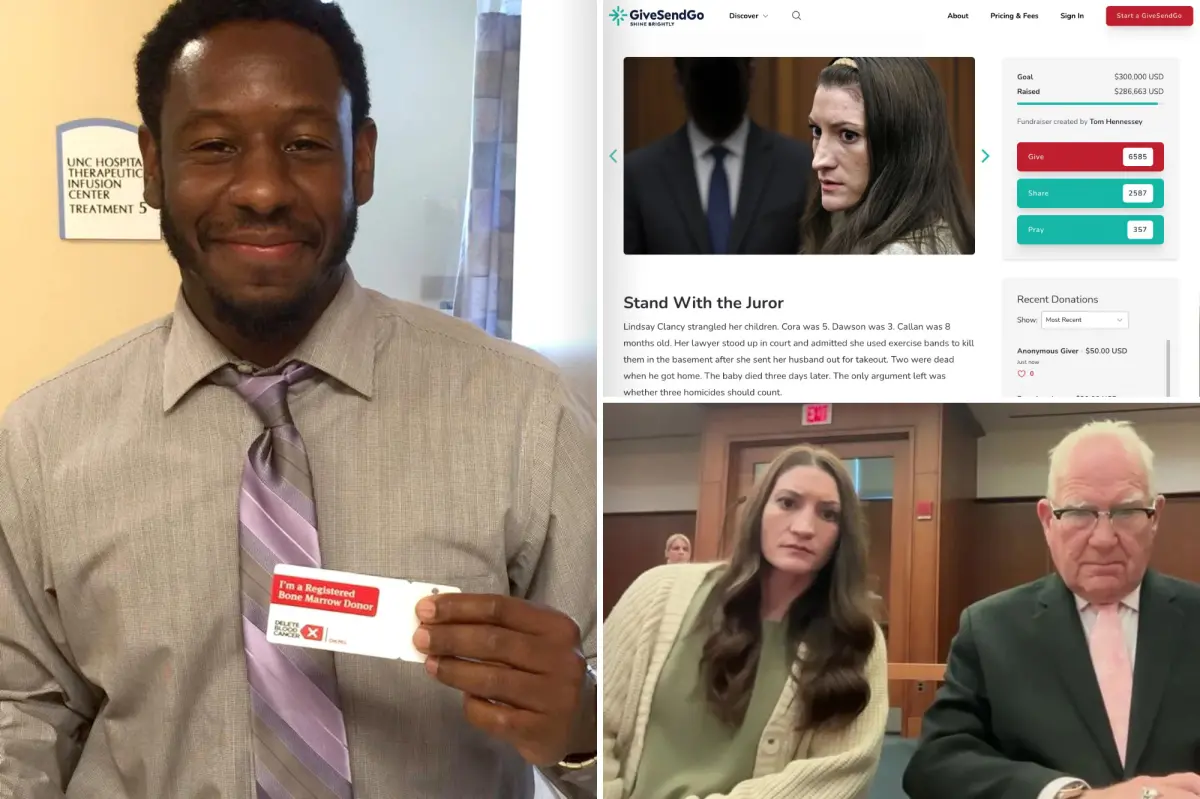
The courtroom had finally fallen silent, the last echoes of the verdict announcement dissipating into the heavy air of the Plymouth County courthouse. Michael P. Desronvil, a 48-year-old man who had walked into jury duty weeks earlier as an anonymous citizen, emerged into the harsh glare of the media spotlight carrying a weight that few could comprehend. The trial of Lindsay Clancy, a labor and delivery nurse accused of the unthinkable murder of her three young children, had concluded not with a definitive verdict, but with a mistrial—and the sole reason for this judicial stalemate was Desronvil’s unyielding conscience. While eleven of his fellow jurors had voted to acquit Clancy of murder by reason of insanity, Desronvil stood alone, convinced that the prosecution had presented “enough proof that she knew exactly what she was doing” when she fatally strangled Corinne, five, Dawson, three, and seven-month-old Callan with exercise bands in their Duxbury home. What happened next, however, was as unexpected as the mistrial itself. An online fundraiser, hastily assembled by a stranger named Tom Hennessy, exploded with donations from across the country, surging past $286,000 within hours of Desronvil’s public statement. The donations, ranging from modest five-dollar contributions to a staggering anonymous $10,000 gift, transformed this legal holdout into an unlikely folk hero, a symbol of individual conviction in an age of compromise.
The case that brought Desronvil to this precipice was a nightmare that had gripped the nation’s consciousness since January 2023, when the details of the Clancy family tragedy first emerged. Lindsay Clancy, a respected medical professional who had dedicated her career to helping mothers bring new life into the world, had allegedly used exercise bands to strangle her three sleeping children before attempting to take her own life by jumping from a second-story window. The prosecution wove a narrative of calculated premeditation, pointing to the timing of the attacks, the concealment of her actions from her husband as he left for work, and what they argued was a lucid understanding of the horror she was perpetrating. The defense, conversely, presented a heartbreaking portrait of a woman crushed by the weight of severe postpartum depression and psychosis, arguing that her mental state had deteriorated to such an extent that she was incapable of distinguishing right from wrong, rendering her legally insane at the moment of the killings. For eleven members of the jury, the defense’s narrative resonated deeply; they saw a broken mother, not a calculating murderer, and voted to spare her criminal culpability. But Desronvil, sitting in his chair at the far end of the deliberation table, saw something different. He saw intent, he saw choice, and he saw a woman who, in his eyes, understood the devastating finality of her actions. His refusal to bend, his insistence on holding the line against the overwhelming pressure of eleven other opinions, created an impasse that no amount of further deliberation could bridge, forcing the judge to declare a mistrial and leaving everyone involved suspended in a torturous limbo.
To truly humanize Michael Desronvil is to understand the profound isolation he endured during those weeks of testimony and deliberation. He was not a professional juror, not a legal scholar, not a pundit seeking attention; he was an ordinary citizen who had answered the call of civic duty, only to find himself thrust into the center of one of the most emotionally devastating cases in recent memory. He sat through hours of graphic testimony, listened to the frantic 911 calls, studied the autopsy photographs, and absorbed the chilling details of how those tiny lives were extinguished. The jury room became a pressure cooker of conflicting emotions, with eleven individuals slowly converging on a consensus while Desronvil remained a solitary island of dissent. The psychological toll of such isolation cannot be overstated; humans are social creatures, hardwired to seek belonging and agreement, and to stand alone against a unanimous group requires a form of moral fortitude that borders on the extraordinary. When Desronvil finally came forward on Thursday evening to explain his reasoning, his voice carried the exhaustion of someone who had been fighting not just a legal battle, but an internal war between his desire for resolution and his unshakeable conviction. He knew that by holding out, he would become the target of public scrutiny, potentially facing threats to his safety and his livelihood. His lawyer, Edward Andrew Paltzik, acknowledged these very real dangers, noting that the pressure on his client had been immense and that the decision to speak publicly was driven, at least in part, by the need to defend his character against the inevitable accusations of stubbornness or incompetence.
The explosive growth of the fundraiser launched by Tom Hennessy reveals a fascinating and deeply human psychological phenomenon that extends far beyond the simple mechanics of crowdfunding. Why would complete strangers open their wallets to support a juror they had never met? The answer lies in a complex mixture of sympathy, identification, and a desperate need to validate one’s own worldview through proxy. For many donors, Desronvil represents the embodiment of the “reasonable doubt” standard taken to its absolute extreme—a bulwark against what they perceive as a justice system too willing to excuse heinous acts through the lens of mental illness. By contributing money, these individuals are casting a virtual vote of confidence in his interpretation of the evidence, effectively saying, “I see the same facts you did, and I agree with your conclusion.” The anonymous donor who contributed a jaw-dropping $10,000 is emblematic of this fervent support—a quiet, massive gesture of solidarity from someone with financial means who wanted to make a loud statement without exposing themselves to the potential backlash. The steady stream of smaller donations, ranging from $5 to $100, arriving every few minutes creates a sense of collective action, a digital protest against what many perceive as a potential miscarriage of justice. This outpouring transforms the simple act of charitable giving into a public referendum on the case itself, allowing ordinary citizens to participate in the outcome by proxy, casting their financial ballots in support of the man who refused to surrender his principles to the pressure of conformity.
However, as the initial wave of euphoria begins to subside, the legal and logistical realities are quickly catching up with the whirlwind of support. While Paltzik expressed genuine gratitude for Hennessy’s efforts to protect his client, the attorney moved with admirable swiftness to formalize the financial situation, announcing that he would be “establishing an authorized, consolidated, and official fundraiser for our Heroic Holdout moving forward.” This transition from a spontaneous grassroots campaign to a structured legal fund is not merely a matter of administrative convenience; it is a crucial protective measure. Unsolicited crowdfunding campaigns can be fraught with legal complications, including tax liabilities, potential fraudulent copycat pages, and questions about how the funds should be properly allocated and distributed. Moreover, the money itself represents more than just a windfall; it is a lifeline for a man whose life has been fundamentally disrupted. Desronvil is likely facing lost wages from his extended absence at trial, the very real need for security measures if threats escalate, and the potential for significant legal fees if he is called upon to testify again in a retrial. The consolidated fund will provide a legal shield, ensuring that the generosity of the public translates into tangible protection rather than chaotic, unstructured cash. This shift in status—from anonymous juror to protected client—marks a new phase in Desronvil’s ordeal, one that is far from over. The mistrial means the case will almost certainly be retried, plunging him back into the spotlight, this time as a potential witness or at least a specter haunting the proceedings. The official fund is a testament to the fact that his journey is not complete; it is merely entering a new, more complicated chapter.
Ultimately, the story of Michael P. Desronvil serves as a profound meditation on the human cost of a verdict and the fragile architecture of the American justice system. The founders deliberately designed the jury system to require unanimity, understanding that this would force intense deliberation and prevent the tyranny of the majority, but that noble design comes with an enormous price when a single human being stands against eleven others. Desronvil is neither a saint nor a demon; he is a man who looked at a mountain of horrific evidence and concluded that a specific legal threshold had been met. He believes that Lindsay Clancy should be held criminally accountable for her actions, not treated as a patient in need of treatment rather than punishment. Whether history will judge him as right or wrong will be debated by legal scholars, mental health experts, and the public for years to come. But the immediate human reality is that he now stands alone on a precipice, financially buoyed by a flood of public adoration that is as intense as it is fleeting. The $286,000 and counting will buy him security and time, but it cannot buy him back the peace of anonymity he lost in the jury room. He carries the burden of three dead children, the fractured hopes of two legal teams, and the undivided attention of a polarized nation. In the quiet moments, far from the flashing cameras and the pinging donation alerts, Desronvil must reconcile his stubborn insistence on a murder conviction with the innocent faces of those three small children whose lives were tragically cut short. The donors have given him a safety net, but the true cost of his conscience is a burden that no amount of crowdfunding can ever truly lift. He will walk into the future with the knowledge that he single-handedly determined the trajectory of a national tragedy, a heavy mantle for any ordinary man to bear, and a stark reminder that in the pursuit of justice, sometimes the loneliest path is the only one a person can honestly walk.