


American college campuses were once imagined as open-air theaters of learning, places where a person could shout a bad idea, have it tested, and grow a little thicker skin in the process. The reality today is far more combustible. In recent weeks, a handful of incidents across the country has turned students into symbols, hashtags, and cautionary tales before they have even declared a major. In Colorado, a conservative student group’s membership has stagnated because students who privately agree with its principles are convinced that public association will cost them internships, scholarships, and friendships. At another university, a probe into accusations of doxxing collapsed under a tide of backlash after Republican students were dragged through the internet over a cake. In California, a video of a Trump piñata being hit while classmates cheered reignited the endless debate over satire versus menace. At Columbia University, a graduate student named Mahmoud Khalil has sued his own institution for deliberate indifference toward Palestinians. And in Texas, a speaking event featuring the popular left-wing streamer Hasan Piker managed the rare feat of uniting the left and the right in condemnation. Each episode could be reduced to a blip or a punchline, but taken together it forms a larger picture: the culture war has moved into dorm rooms, dining halls, and lecture halls, and the young people living there have become reluctant soldiers in a conflict waged by adults with eager social media accounts. It is easy to scroll past these stories and laugh or rage, but the students inside them are real individuals trying to figure out who they are while the universe demands they pick a side. They arrive at college hoping to learn how to think, and instead they are taught—by administration memos, by online mobs, by their own frightened classmates—that the safest posture is silence. This is what happens when the ivory tower becomes a battleground, and the people caught in the crossfire are exactly the ones we hoped would learn to talk to each other.
Start with the quietest casualty: the Turning Point USA chapter at a Colorado college. The table is set up in the student center like every other tabling event—lanyards, stickers, a bowl of candy, maybe a clipboard with a sign-up sheet. The students who pass it don’t speed up because they’re scared of arguments. They speed up because they’ve already lost a conversation with themselves. They see the name, they understand what it stands for, and they imagine their name on that clipboard getting screen-shotted and shared in a group chat. They imagine a professor’s cold stare the following week. They imagine an internship at a firm that requires references, and the recruiter typing their name into a search engine, and finding the news story about the campus controversy they never wanted to be part of. The chapter’s numbers tell the story: enrollment stagnant, recruits vanishing, the same ten brave faces at every meeting. When asked, these students will say they agree with a number of traditional conservative positions—fiscal responsibility, free markets, American pride—but they will not put their names anywhere near that table. One junior in the group recounted, quietly and after a long pause, that it wasn’t the dean she feared; it was the fact that her study group had noticeably cooled the semester after she posted a half-joking political meme. There is a term for what she described: self-preservation. And there is a long-term cost. These students are learning a lesson no syllabus contains, that dissent is dangerous, that belonging requires conformity, that higher education rewards the student who obeys a tacit political code. The tragedy isn’t that their fear is irrational. The tragedy is that it is completely reasonable. They have watched what happens, especially to conservative students on campuses their peers consider hostile, and so they go quiet. They keep their heads down. And then they graduate into a democracy that desperately needs citizens willing to be seen, heard, and counted. A campus that chills such citizens is not fulfilling its mission. It is just producing survivors.
The second story started with cake, which should be a sign that we are all out of our minds. A photograph of a dessert, covered in whatever harmless-seeming icing could also be read as political bait, made the rounds. The cake was connected to Republican students, and once it went viral, the university couldn’t fake ignorance. It opened a formal investigation into allegations of doxxing, the practice of publishing private information with the intent to harm. The bizarre twist: the investigation was aimed at students who had allegedly exposed anyone involved in the criticism that followed the photo. Lawyers were hired. Press releases were issued. Commentators took sides with the confidence of food critics. And in the middle sat students, most of whom had simply wanted to host a small gathering, stare at a pastry, eat it, and move on. Instead, they spent weeks refreshing their phones, afraid that a university email would change everything. When the public backlash boiled over, the university announced the probe was being dropped. Yet the damage had already been done. The message to every student watching from the sidelines was unmistakable: when you express something that offends a critical mass of strangers, your own institution may come for you. The cake became infamous. The students became names. And the free-speech lesson at the core of the affair got buried under outrage and embarrassment. If a pastry can be transformed into a political crime scene, no one is safe. The university, by capitulating so quickly after hearing the crowd, reinforced the very cynicism that had scared the Colorado chapter into silence. It said, in effect: your survival depends on how loud the mob is. That’s a strange lesson for a place of learning to teach.
On the West Coast, the education of the young was delivered through a piñata. The video showed a party on a California college campus where students took turns striking an effigy of President Donald Trump while the gathered crowd erupted in cheers. To some viewers, this was lampooning an elected official, no different from a comedian’s joke or a Late Night monologue. To others, it read as a collective celebration of political violence, an eerie precursor to something worse. Humans have always projected their anger onto effigies; we burn a Guy Fawkes every November 5th. But the context of our current moment, with heated election cycles, verified assassination attempts, and rhetoric on both sides calling the other an existential threat, makes the image land differently. The students watching experienced a dizzying split: they wanted to laugh, they wanted to scowl, they wanted to be cool about it, and they wanted to object, all in the same video feed. The students who cheered were probably not planning anything more menacing than a semester party. The students who flinched were not necessarily snowflakes. Both camps were responding to a temperature they could feel but not name. The absolutely human truth of the video is that it was a wish-fulfillment ritual, and wish-fulfillment rituals have a way of loosening the boundaries around what we allow ourselves to wish for. On a campus where students are supposed to be forming ethical frames for public life, a crowd cheering the beating of any political figure—left or right—should make everyone uncomfortable. It isn’t speech; it’s play-vandalism of a symbol. But symbols are how we rehearse reality. And those students were rehearsing something. They just may not have known what.
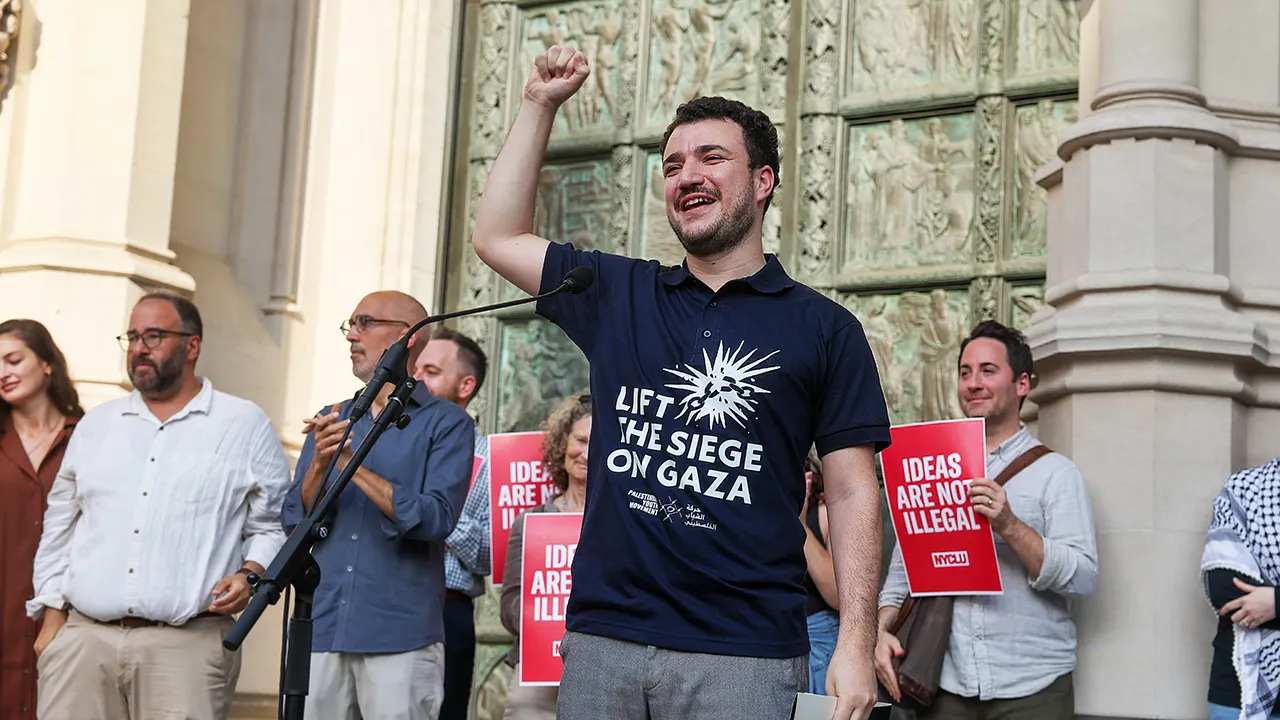
Then there is the lawsuit from Mahmoud Khalil, a Columbia University graduate student whose name is now attached to a legal complaint against the school itself. Khalil, a prominent voice in anti-Israel activism on campus, says the university’s administration has been deliberately indifferent to the harassment and marginalization of Palestinian students. The phrase “deliberate indifference” is legal shorthand, but for Khalil it is the description of a lived reality. He has walked through those famous gates every morning carrying the weight of his identity; he has listened to administrators speak of community and inclusivity while, in his telling, they looked past the repeated slights, the tense classroom interactions, the public confrontations that made daily life for Palestinian scholars feel increasingly unbearable. Why sue? Because there is violence in being invisible. When a student is forced to give up trying to be heard by the institution that accepted him, and must instead plead through a court document for his community to be treated as equal to any other, the American dream of higher education begins to crumble. Critics may point out that Khalil’s activism has been sharp, divisive, even militant in tone. That doesn’t change the underlying question: did Columbia fail to protect students from a hostile environment? A courtroom is a strange classroom for such a lesson, but it is the only one available when every other door feels locked. Khalil’s choice to sue is not a tantrum. It is a heartbreaking act of last resort from a young man who wants, more than anything, to matter to the institution he calls his own. And whether the suit wins or loses, it has already forced an uncomfortable conversation about whose pain deserves a university’s earnest attention. The administration’s response will be parsed for months, but the human being at the center of it just wants to be genuinely seen.
The final scene takes place in Texas, where a university rolled out the red carpet for Hasan Piker, the enormously popular progressive streamer whose audience spans millions of mostly young, mostly online viewers. The backlash began immediately, from expected corners: conservative pundits used Piker’s invitation to paint the university as a swamp of radical leftism. But it also came from unexpected ones—progressives who found Piker’s brand of commentary too aggressive, too divisive, too emblematic of the podcast-fed culture they themselves wanted to escape. The event, in other words, managed to disappoint everyone. And this is perhaps the most instructive moment of all: no matter what a university does, it cannot win. Invite a controversial conservative, the left objects. Invite a controversial progressive, the right erupts. Invite nobody, the campus is called dull and cowardly. The lesson of Texas is that the modern campus is pulled in every direction and given credit in none. The students who showed up weren’t looking to destroy anything; they wanted to be entertained, maybe informed, maybe to see their favorite meme-maker think in real time. They were pushed into the crossfire by adults who saw the evening only as an opportunity to score points. And so we return to the central human truth running through all five stories. Young people are not pawns. They are people navigating an impossible terrain, trying to figure out who they are while certain adults keep setting fires. The campuses themselves, though, are not irredeemable. The only way out of the spiral is to rediscover the radical act of treating someone different as a human being. That means the conservative student can join the debate club and test the liberal consensus. It means the liberal student can sit through a conservative speaker without feeling personally attacked. It means administrators must stop weaponizing investigations for political convenience. And it means all of us must stop watching a ten-second video and pretending we know the souls of the people in it. College should be where you learn to repair your own country’s broken civic fabric. Right now it is merely the place where we watch it tear.