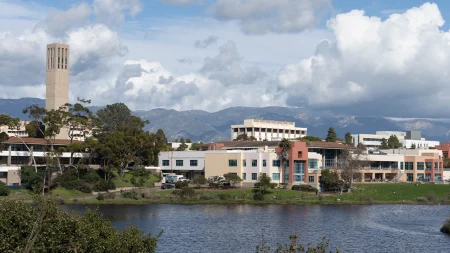




The modern academic landscape, once envisioned as a safe harbor of intellect and personal evolution, has increasingly come to resemble a chaotic arena of political proxy wars and raw, physical hostility. Behind the sterile legal terminology of recent lawsuits lies the deeply distressing reality experienced by Jewish students at the University of California, Los Angeles, who were subjected to coordinated intimidation, chemical irritants, and physical assaults with blunt instruments, culminating in some being knocked unconscious on their own campus. This is not merely a dry administrative statistic; it represents a terrifying erasure of basic safety for young adults who began their university journeys hoping to intellectualize and debate, only to find themselves running in physical terror from classmates turned aggressors. The trauma of being targeted solely because of one’s identity or heritage in an institution of higher learning is a visceral wound that ripples far beyond those who were physically struck, shattering the fundamental promise of educational institutions as sanctuaries for diverse minds. Compounding this tragedy is a broader cultural apathy that has commodified real-world violence into digital entertainment, illustrated vividly by a viral video of a young woman dancing casually near the targeted assassination site of political commentator Charlie Kirk. This bizarre, performative disconnect highlights a deeper societal pathology: the transformation of political differences into a cynical spectator sport, where the threat of human mortality is stripped of its gravity and repackaged as background content for social media clout. When we lose the ability to feel empathy for our political adversaries, or when we view their physical endangerment as a backdrop for a digital trend, we discard the very fabric of our shared humanity, signaling a dangerous drift toward a culture where human suffering is either weaponized or laughed away in pursuit of temporary online validation.
This erosion of empathy and shared civic values is perhaps most alarming when it manifests within the ranks of the very adults entrusted with guiding and nurturing the next generation of citizens. In Wisconsin, the firing of a teacher who publicly advocated on social media to “make Americans great assassins again” exposes a frightening current of radicalization among professional educators who have abandoned their role as neutral mentors in favor of naked, violent partisanship. When an individual tasked with cultivating the minds of impressionable young children yields to the temptation of inciting political violence, it represents a profound betrayal of the professional ethics that keep our schools safe, inclusive spaces for families of all political persuasions. This loss of community trust is mirrored in Fort Worth, Texas, where a school district’s leadership selection process devolved into intense scrutiny and public outcry after historical social media posts by a principal candidate appeared to defend extreme interpretations of Sharia law. These incidents are not isolated controversies; they represent a systemic crisis of vetting and values in American public education, leaving parents to wonder whether the schools they fund are staffed by individuals who respect pluralistic, democratic principles or by ideological zealots who harbor deep-seated disdain for the core tenets of Western liberty. For a parent, sending a child to school requires an immense leap of faith—an implicit, foundational agreement that the adults in the building will protect that child’s physical safety, mental well-being, and moral development. When administrators and teachers instead choose to use their personal and professional platforms to promote political violence or defend deeply oppressive ideological systems, that sacred contract is broken, replacing community cohesion with a toxic mixture of parental anxiety, administrative defensiveness, and a pervasive sense that our public educational institutions have lost their moral compass, leaving families to navigate these institutional betrayals entirely on their own.
Beneath the loud, sensationalized battles over political ideology lies a quieter, slow-burning tragedy that threatens the future of millions of children: the profound academic decline of the American student. In California, university professors have recently come forward with the shocking revelation that an alarming number of incoming college students are so fundamentally unprepared for higher education that they are being forced to undergo remedial instruction in basic middle-school mathematics. To realize that young adults, after twelve years of taxpayer-funded education, are entering prestigious universities unable to confidently perform simple arithmetic, manipulate fractions, or grasp elementary algebraic concepts is to witness a colossal, systemic failure of our public school system. This is not a reflection of a deficit in student intelligence, but rather a heartbreaking indictment of a system that has systematically abandoned academic rigor in favor of social promotion, standardized-test avoidance, and administrative convenience. These students are the human casualties of an educational philosophy that has prioritized bureaucratic metrics, grade inflation, and ideological experimentation over the foundational cognitive skills necessary for economic survival and personal autonomy in the modern world. Having navigated the isolating disruptions of pandemic-era remote learning and a fractured school culture, these young people find themselves cast adrift in adulthood, deeply indebted to higher education institutions yet intellectually crippled by an inability to perform the most basic quantitative reasoning. It is a cruel irony that in an era defined by rapid technological advancement and the rise of complex quantitative industries, our educational institutions are failing to teach children the very mathematical language required to navigate that world, leaving them structurally disadvantaged, deeply discouraged, and facing an uphill climb just to master the basic academic building blocks they should have learned a decade prior. This gap in learning does not just limit their academic opportunities; it closes the door to high-paying STEM careers, permanently stunts economic mobility, and breeds a deep sense of inadequacy and frustration among young people who were falsely told they were ready for the world.
The betrayal of the educational system’s foundational promise becomes even more acute and deeply personal when it touches the lives of the most vulnerable and defenseless among us: children with profound special needs. The recent, deeply disturbing investigation into a newly elected Seattle teachers union president over historical allegations of abusing an autistic child strikes at the very heart of this systemic vulnerability. For parents of neurodivergent, non-verbal, or highly sensitive children, sending their sons and daughters to school is an act of absolute vulnerability; these parents must rely entirely on the professional ethics, patience, and basic human decency of educators who are tasked with caring for kids who cannot go home and articulate what happened to them during the school day. When an individual who rises to the highest ranks of union leadership—becoming a powerful advocate for thousands of educators—carries a shadow of alleged physical abuse against a child who cannot self-advocate, it represents a terrifying failure of institutional safeguarding and accountability. This situation illustrates a broader, unsettling reality in which powerful educational unions and bureaucratic systems often appear more invested in protecting their own political structures, leadership rosters, and financial interests than in uncovering and rectifying abuses against the children in their care. The human cost of this institutional self-preservation is borne entirely by traumatized families who must fight exhausting, lopsided battles against massive public school apparatuses just to secure a basic level of safety, validation, and dignity for their children. Every child deserves to enter a classroom free from fear, and when the structures designed to protect them turn a blind eye to abuse in order to preserve their own political capital, they perpetrate a double betrayal that permanently scars the family unit and destroys the very credibility of public education. It raises fundamental questions about who our educational institutions truly serve, highlighting a desperate need to shift our collective focus away from organized political interests and back to the physical, emotional, and moral protection of the individual child who relies on us for survival.
This displacement of the primary educational mission is further compounded by the aggressive injection of national, highly polarized ideological agendas into local classrooms, a trend exposed by a blistering report detailing how a prominent national K-12 group’s Diversity, Equity, and Inclusion (DEI) program is trickling down to community schools. While proponents of these initiatives often frame them in the warm vocabulary of inclusivity, belonging, and social justice, the practical application of these heavily bureaucratic agendas often has a highly divisive effect, transforming local classrooms into ideological battlegrounds and distracting from the core academic mission. Parents across the nation are discovering that curricula are increasingly designed not to teach children how to think critically, but rather what to think politically, replacing classical instruction in history, literature, and science with complex, hyper-politicized conceptual frameworks. This top-down ideological pressure creates a profound sense of alienation among families who find that their deeply held personal, cultural, or religious values are being actively undermined by the very educational institutions they fund through their hard-earned tax dollars. The tragedy of this ideological mission creep is that it operates as a major distraction from the real, pressing needs of students; while administrators spend countless hours and substantial resources implementing complex DEI training, drafting institutional statements, and reorganizing curricula around identity politics, the basic reading, writing, and mathematics proficiency of their students continues to plummet. By prioritizing political indoctrination over academic competence, educational leaders are failing in their primary duty to prepare children for the complexities of the real world, leaving them ideologically polarized but practically unequipped to navigate a competitive global economy. In doing so, these national groups treat children as pawns in a cultural war rather than unique individuals with unique developmental needs, creating an atmosphere of division and mutual suspicion between teachers, students, and parents that stifles curiosity, discourages nuance, and replaces the joy of learning with rigid, dogmatic compliance.
Ultimately, these disparate crises—ranging from targeted physical violence on elite university campuses to the systematic academic neglect of elementary math students, and from the radicalization of individual educators to the institutional betrayal of special-needs children—are not merely isolated news items; they are the warning lights of a society that has lost its educational and moral anchor. If we are to rescue our schools and campuses from this spiral of hostility, polarization, and decline, we must intentionally pivot away from the divisive, performative outrage of the digital age and commit ourselves to a radical reclamation of empathy, academic excellence, and basic human accountability. We must rebuild an educational culture that fundamentally prioritizes the physical safety of every single student, ensuring that no young person ever has to face violence or intimidation because of their faith, identity, or beliefs, while simultaneously demanding a return to academic rigor that equips every child with the practical quantitative and literacy skills necessary to build a prosperous life. This requires courageous parents, dedicated educators, and responsible local leaders to stand up against both the ideological extremes that seek to weaponize classroom instruction and the administrative bureaucracies that protect corrupt or abusive figures at the expense of children. Education must be restored to its historic status as a sanctuary—a place where debate is welcomed but violence is rejected, where high expectations are maintained for all students, and where childhood innocence is protected with unyielding dedication. Only by stripping away the toxic, ideological noise and refocusing our resources on the academic mastery of the individual student can we hope to restore public trust, heal fractured communities, and construct an educational system worthy of the children we are raising to inherit our world. The path forward begins in local communities, when neighbors decide to look beyond national talking points and focus on the young minds placed in our care.