





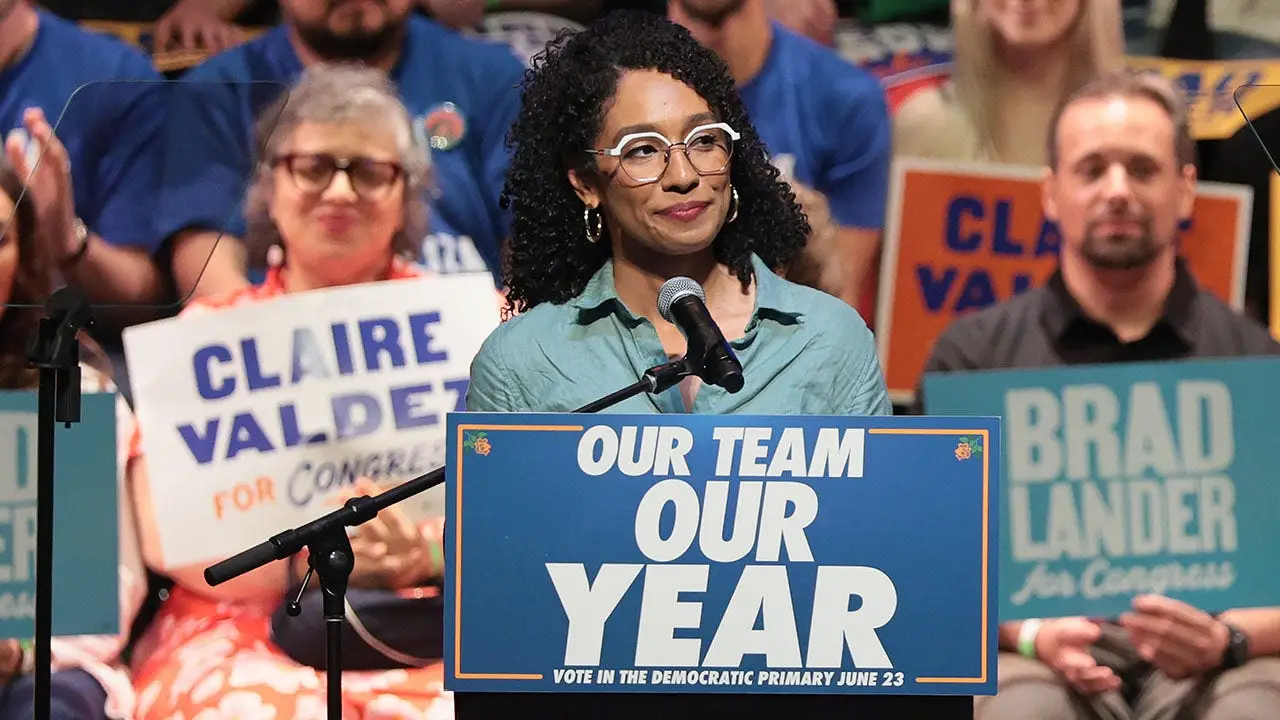
In an era defined by hyper-polarization and rapidly shifting social dynamics, the traditional landscape of American politics is undergoing a profound and often turbulent transformation. This volatility was recently put on full display in New York, where a shocking political upset sent ripples far beyond the borders of its congressional district. The epicenter of this controversy was Darializa Avila Chevalier, a newly minted, radical candidate backed by the Democratic Socialists of America (DSA). Chevalier’s campaign, which rode a wave of grassroots energy, became a lightning rod of national attention following a highly dramatic and contentious live-air radio interview. When pressed by radio hosts about controversial past social media posts that many deemed deeply offensive and anti-Dominican, Chevalier reportedly threw what critics described as a live-air tantrum. Instead of addressing the concerns of her potential constituents or defusing the tension with diplomatic dialogue, she abruptly walked out of the studio, refusing to face the difficult questions about her rhetoric. Yet, in a testament to the unpredictable nature of contemporary elections, the fallout from this dramatic exit did not derail her political aspirations. In fact, just hours after storming out of the interview, Chevalier pulled off a stunning and historic upset, defeating the five-term incumbent Representative Adriano Espaillat. In a district that traditionally aligns heavily with the Democratic ticket, this primary victory essentially guarantees her transition into the halls of Congress this coming November. This rapid escalation from controversy to electoral triumph illustrates a growing disconnect in modern politics, where ideological passion and online branding can override traditional expectations of media accountability and public vetting. It leaves a community deeply divided, raising critical questions about whether future leaders will seek to bridge cultural divides or continue to utilize polarizing rhetoric to bypass conventional political scrutiny.
At the same time, the battlegrounds of ideology and identity have extended far beyond election booths and into the venerable halls of America’s most prominent cultural and educational institutions. A poignant example of this institutional struggle has emerged around the Smithsonian National Museum of African American History and Culture (NMAAHC). The museum, designed to celebrate historical resilience and promote shared national understanding, recently found itself at the center of a brewing storm led by the North American Values Institute (NAVI), a prominent watchdog organization. NAVI has issued an urgent public appeal calling on the Smithsonian to immediately withdraw its participation from an upcoming academic retreat. The source of this intense concern centers on Ismael Jimenez, an educator scheduled to co-facilitate workshops at the event. Critics point to Jimenez’s controversial curriculum materials, his deep-seated ties to radical activist circles, and a series of highly polarizing public statements, which include explicitly labeling Israel a “terrorist state.” The watchdog group warns that by sharing a stage and collaborating with individuals who harbor such extreme, one-sided geopolitical biases, the Smithsonian risks lending its immense institutional prestige and tax-funded legitimacy to harmful antisemitic tropes and political extremism. This dispute highlights a delicate and agonizing challenge facing modern cultural institutions: how to foster diverse academic exploration without inadvertently endorsing rhetoric that alienates entire communities. In an environment where the line between education and activism has become increasingly blurred, the pressure on institutions like the Smithsonian to rigorously vet their affiliates has never been higher, as the public demands transparency, balance, and a steadfast refusal to normalize prejudice under the guise of intellectual discourse. When national museums, funded in part by taxpayers, are perceived as endorsing biased perspectives, they risk losing the trust of the very public they are sworn to serve, making the demand for neutrality and thorough vetting absolute.
The ripples of global geopolitical conflicts are not only reshaping major institutions and elections, but they are also bleeding into the mundane, everyday corners of local communities, turning routine neighborhood interactions into legal and moral battlegrounds. This painful reality was illuminated in Brooklyn, New York, where a popular neighborhood gathering spot, Poetica Coffee, suddenly became the subject of a federal civil rights investigation launched by the Department of Justice (DOJ). The controversy erupted after the coffee shop’s management targeted Representative Dan Goldman in a hostile, highly publicized social media post. Following a routine visit by the congressman, who has been a vocal supporter of Israel’s right to defend itself, the establishment took the extraordinary step of publicly refunding his purchase, accompanied by an online boast stating they would have happily turned him away at the door as a “genocide enabler.” This aggressive display of exclusion quickly drew the attention of federal authorities, who warned that denying services to individuals based on their political beliefs, national origin, or religious advocacy violates foundational federal anti-discrimination laws. For the residents of Brooklyn, the coffee shop ceased to be a neutral haven for morning routines and community connection, transforming instead into a symbol of modern ideological tribalism. The situation serves as a stark reminder of how easily public spaces can become weaponized, where business owners feel emboldened to enforce political purity tests on their patrons. By transforming simple transactions into acts of political warfare, such incidents erode the fragile social trust that binds diverse urban neighborhoods together, proving that when prejudice is allowed to dictate commerce, everyone in the community loses a sense of safety and belonging. It forces us to confront the dangerous precedent of a society where one must state their geopolitical alignments just to buy a daily beverage, threatening to isolate citizens based on ideological litmus tests.
While verbal hostility, institutional polarization, and social exclusion damage the social fabric, the most terrifying manifestation of rising prejudice is the physical danger posed by radicalized individuals seeking to translate online hatred into real-world violence. This chilling escalation was narrowly averted in Florida, where federal law enforcement agencies successfully thwarted a horrific mass casualty plot aimed at Jewish employees of the American Israel Public Affairs Committee (AIPAC). A local resident, Forrest Pemberton, was indicted after authorities uncovered his detailed, chilling plans to carry out a bloody shooting at the pro-Israel nonprofit’s offices. Equipped with an AR-15 rifle and a silencer, weapons designed for maximum lethality and stealth, Pemberton had reportedly gone so far as to physically stalk the empty facility, seeking to map out its layout and timing under the bizarre, disturbed delusion that committing this act of violence would help him “break the loop.” Fortunately, meticulous tracking of his cellphone data and swift intervention by federal agents allowed authorities to apprehend Pemberton before his plans could culminate in a tragedy. He now faces the prospect of spending the rest of his life behind bars for attempted hate crimes. The terrifying reality of this near-miss has sent shockwaves through Jewish communities across the United States, serving as a sobering reminder of the very real, mortal threat that antisemitic rhetoric poses when it is allowed to fester. The psychological impact of such threats cannot be understated; they force community centers, synagogues, and advocacy organizations to significantly increase security budgets, turning places of community and peace into fortified, fear-filled structures. It highlights the indispensable role of vigilant law enforcement in protecting vulnerable communities, while simultaneously emphasizing the urgent need for society to address the underlying radicalization that drives individuals to dehumanize others to the point of planning mass murder.
On the international stage, this ideological warfare manifests in high-stakes diplomatic arenas, where words are weaponized and historical grievances are constantly debated. Recently, a fierce diplomatic firestorm erupted at the United Nations following the release of a highly controversial report accusing Israel of the “deliberate targeting” of Palestinian children in conflict zones. The reaction from Israeli officials was swift and uncompromising, led by Israeli Ambassador to the UN Danny Danon, who vehemently condemned the document as a “political blood libel disguised as a UN document.” Danon and other critics argued that the commission responsible for the report arrived at its highly damaging conclusions long before examining the objective facts, systematically ignoring the well-documented atrocities committed by Hamas, including their strategic use of human shields and the severe psychological trauma inflicted on Israeli children. This explosive debate highlights a deep-seated frustration with international governing bodies, which critics argue have become echo chambers for selective outrage rather than forums for genuine peace building. Contrasting this narrative of endless hostility, however, are quieter, more constructive efforts aimed at fostering interfaith harmony and demonstrating the diverse internal reality of Israeli society. Ambassador George Deek has been working tirelessly to highlight these nuances, sharing that Israel’s Christian population has actually grown exponentially from 34,000 in 1948 to more than 180,000 today. Deek’s efforts to strengthen ties with Christian leaders globally serve as a powerful reminder that beneath the polarizing headlines of international conflict lies a much more complex, pluralistic reality, where diverse religious communities continue to live, grow, and pursue peaceful co-existence despite the surrounding geopolitical storms of the era. By shifting the spotlight toward these positive statistics and peaceful realities, Deek challenges the monolithic, conflict-driven narratives that dominate global media, offering a message of hope and interfaith solidarity.
Ultimately, navigating these complex modern challenges requires a shift away from performative outrage and toward pragmatic, thoughtful engagement. This sentiment lies at the heart of a powerful editorial by Loay Alshareef, an Arab Muslim peace advocate and senior fellow at the Macdonald-Laurier Institute, who argues that the popular Boycott, Divestment, and Sanctions (BDS) movement against Israel is deeply hypocritical and fundamentally counterproductive. Alshareef points out that true, consistent compliance with the demands of the BDS movement would require activists to completely abandon a vast array of essential modern innovations, ranging from groundbreaking, life-saving medical treatments to advanced technological microprocessors and revolutionary agricultural tools. By staging purely performative protests while continuing to benefit from the fruits of Israeli innovation, activists engage in a hollow virtue-signaling that does nothing to alleviate the suffering of Palestinians or foster genuine peace. Far from helping the region, Alshareef argues that rejecting these global advancements and cutting off pathways of cooperation ultimately harms Arab societies themselves, depriving them of the vital partnerships needed for technological and economic progress. His perspective serves as a vital call for a new paradigm—one that rejects the simplistic, exclusionary tactics of boycotts and instead embraces collaboration, mutual respect, and shared progress. In a world increasingly dominated by cancel culture and absolute polarization, the courage to advocate for shared prosperity and technological synergy offers a blueprint for how we can overcome modern tribalism. By choosing dialogue over division and acknowledging the shared humanity of all parties involved, communities around the world can begin the difficult but necessary work of dismantling prejudice, building lasting bridges of peace, and ensuring a safer, more inclusive future for everyone. Only through cooperative growth and a willingness to understand each other’s vulnerabilities can we hope to resolve conflicts that have spanned generations, transforming age-old bitter rivalries into constructive global partnerships.