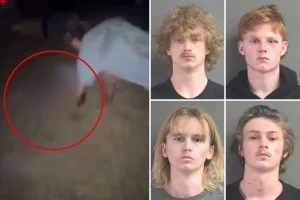


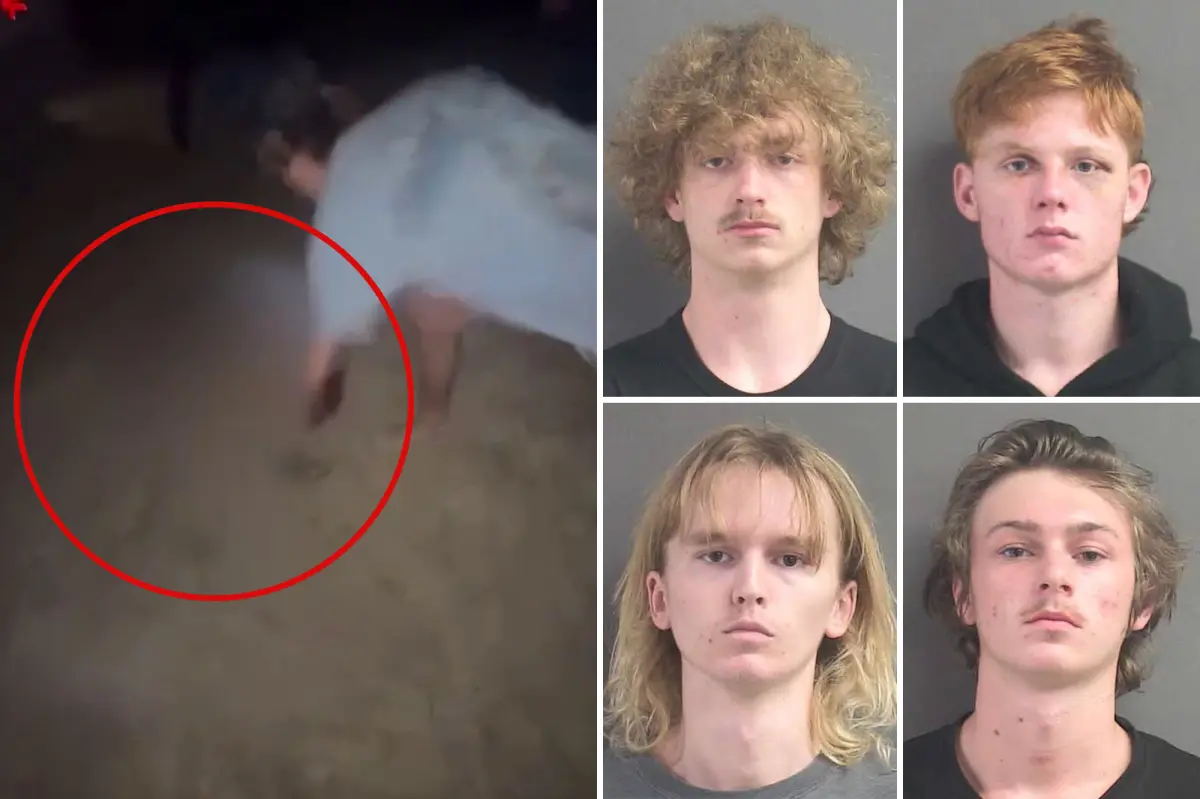
On a cool October night near Daytona Beach, what should have been a harmless gathering around a bonfire in Tiger Bay State Forest turned into a nightmare of senseless violence. Four young men—Cody Stripling, 18, Sebastian Bowers, 19, Logan Levesque, 18, and Casey Knight, 19—were arrested after allegedly beating a disabled 19-year-old for as long as forty minutes. The victim, a young man with limited use of one arm, had come to the bonfire with a friend. He was shy, hesitant, and not eager to join the crowd. According to Volusia County Sheriff Mike Chitwood, the attack was captured on video, and the footage was so disturbing that his first reaction was nausea. “When I first saw it, the first reaction was I want to throw up,” Chitwood said during a press conference. He did not hide his disgust, calling the suspects “morons” and dubbing them the “Scumbags of the Week.” The sheriff’s raw, emotional response reflected what many felt when they learned the details: this was not a fight, not a misunderstanding, and not self-defense. It was a group of young people choosing to brutalize someone who could not fight back, and then laughing about it.
The video footage painted a chilling picture of the assault. The victim was sitting in the back of a pickup truck when one of the attackers walked up and struck him in the head, knocking him to the ground. From there, the scene became a frenzy of cruelty. As the young man sat helplessly on the ground, unable to raise his arms in defense, the group surrounded him and began punching, kicking, and stomping him. At one point, he was put in a chokehold. The attackers could be heard laughing in the background, treating the violence as entertainment. Sheriff Chitwood described the victim’s utter vulnerability: “He couldn’t even throw a punch. He couldn’t do anything. He just walks up and gets sucker-punched and they’re piling on him, kicking him, stomping him, putting him in a chokehold.” The attack lasted up to forty minutes, an eternity of pain and terror for a young man who had done nothing to provoke such brutality. He suffered a concussion and several minor injuries, but the physical wounds may be the least of the damage. The emotional scars of being hunted, beaten, and mocked by a group of strangers will likely stay with him for a lifetime.
When the suspects were finally arrested, they offered a defense that only made the crime more disturbing. They claimed the disabled man had made an inappropriate comment about a woman at the party and allegedly touched her leg. They said they were “defending the woman’s honor.” But Sheriff Chitwood was not buying it, and neither should anyone else. Even if the victim had said something awkward or made a mistake, the response was grotesquely disproportionate. This was not chivalry; it was mob violence. The victim had limited use of one arm, and the attackers knew it. They did not challenge him to a fair fight or ask him to leave. They ambushed him, knocked him down, and then took turns hurting him while he sat defenseless on the ground. “You’re beating an individual that basically has one arm is what you’re doing and some other issues. And you think it’s cool. I don’t—I don’t—I don’t get it,” Chitwood said. The sheriff’s words cut through the flimsy excuses. There was no honor in what they did. There was only cowardice, cruelty, and a complete failure of empathy. The victim’s friend eventually managed to pull him away from the group and get him to safety, but the damage was already done. His mother did not contact authorities until the following day, perhaps in shock, perhaps unsure of what to do. But when she did, the investigation quickly led to the four suspects.
The legal consequences are now severe. The four teens are facing enhanced felony charges, including battery on a disabled adult, a charge that reflects the victim’s vulnerability and the particularly vicious nature of the attack. Stripling and Bowers were the first two suspects arrested, followed by Levesque and Knight. All four are being held in jail without bond, meaning they will not be going home anytime soon. Casey Knight, in particular, faces additional scrutiny because he is accused of recording the attack and sharing the footage on Snapchat. In an age where people document everything, the video became evidence of both the crime and the callousness of the attackers. Sheriff Chitwood had harsh words for Knight and anyone who films violence instead of stopping it. “If you’re gonna stand there and film this stuff, and then post it, your ass is getting locked up, OK?” he said. “You have a duty to intervene but you want to be a cameraman and get clicks and you want to film your punk coward ass friends, you’re going to get the same treatment that they’re going to get.” The sheriff’s message was clear: being a bystander who records and shares an attack is not a neutral act. It is participation. It is choosing to prioritize likes and views over another human being’s safety.
Beyond the legal details, this story forces us to confront something deeply uncomfortable about human nature. How does a group of young people, barely out of childhood themselves, become so cruel? How do they see a vulnerable person and decide he is an acceptable target? The answer lies in a toxic mix of group dynamics, dehumanization, and a culture that too often rewards aggression and humiliation. The victim was shy and reluctant to join the party. He was an outsider, an easy target. The attackers may have felt powerful in the moment, but their actions reveal the opposite. They were insecure, cowardly, and desperate to prove something to each other. They chose a victim who could not fight back because they knew they would win. That is not strength; it is the opposite. The victim, meanwhile, did nothing wrong. He went to a bonfire with a friend, hoping for a normal night. Instead, he was ambushed, beaten, and mocked for the crime of being different. His life will be forever divided into before and after that night. He will carry the memory of those laughing faces, those boots, those fists, and the feeling of being completely powerless. No conviction can erase that. No sentence can undo the terror he experienced.
As the four suspects sit in jail, awaiting their day in court, the community around Daytona Beach is left to grapple with the meaning of this attack. Sheriff Chitwood, who has seen more than his share of violence, did not hide his anger. “They should be known for what they did. You want to be a big man? Well, now they’re going to be treated like big men,” he said. His words are a reminder that justice is not just about punishment; it is about accountability. It is about telling victims that they matter and telling perpetrators that their cruelty will not be ignored. But justice alone cannot heal the deeper wounds. We need to ask ourselves how we can prevent such attacks from happening again. We need to teach our children that strength is not measured by how hard you can hit someone who cannot hit back. We need to teach them that standing by and filming an attack is not cool, and that intervening, even when it is difficult, is the only moral choice. We need to create a world where a disabled young man can sit by a bonfire without fear, where shyness is not mistaken for weakness, and where difference is not treated as a target. The victim in this story deserved better. He deserved friends who protected him, a society that values him, and a justice system that defends him. In the end, the four suspects may be locked up, but the real work begins with all of us—choosing kindness over cruelty, courage over complicity, and humanity over hate.