


The city holds its breath, suspended in a strange purgatory between the mundane hum of a typical Tuesday and the thunderous spectacle about to unfold. This weekend, the urban landscape will be transformed, not by fire or flood, but by the sheer logistical might of a major race. The preparation is a quiet, relentless invasion, seeping into every corner of metropolitan life like a slow-moving tide. It is not the dramatic photos of athletes crossing finish lines that define these days leading up to the start, but rather the subtle, grinding shifts in the city’s daily mechanics. Walkways are being barricaded, temporary grandstands rise from bare concrete, and the air smells distinctly of fresh paint and diesel fuel. Beneath the glossy sheen of civic pride, an army of workers, planners, and engineers are engaged in a delicate ballet, turning a bustling town into a temporary obstacle course. And at the very heart of this transformation, a paradox exists: the pursuit of human endurance and glory has become inextricably linked to the dislocation of routine, the silencing of flight paths, and the trembling of irreplaceable masterpieces. The city is a captive audience, not yet for the race itself, but for the chaotic overture that precedes it.
Para 2 (Traffic): The morning commute has become an exercise in existential patience, a labyrinthine puzzle engineered by cones, tape, and the unyielding geometry of the race course. Sarah, a corporate lawyer who normally glides from her Georgetown brownstone to her downtown office in a brisk twenty minutes, now finds herself staring at the back of a metro bus that has been squeezed onto a side alley not designed for its girth. The tinny voice from her GPS announces another “unexpected delay,” a euphemism for the sheer gridlock that has swallowed the city’s arteries. Every intersection is a frantic knot of overflowing sedans, impatient cyclists, and pedestrians who have abandoned their cars to walk the remaining twelve blocks. The traffic lights cycle through their colors uselessly, blinking at seas of stationary chrome. Tempers flare behind tinted glass; a businessman pounds his steering wheel at the sight of a runner casually jogging his race route through the middle of the street, oblivious to the carnage of frustration he leaves in his wake. The city’s circulatory system has become a geological event, an alluvial plain of asphalt, where the daily commute morphs into a siege of stop-and-go idlingchers, a test of the soul as much as the engine.
*Drafting Para 2 (continuing traffic) - need to link.* I will actually place traffic specifically in para 2)Skip to 2nd para.

*Drafting Para 3 (Flights)*: Meanwhile, a higher stage... (cont).

I'll write them all in my head quickly and write the final response directlycars. Let's just write a full response with the 6 paragraphs as requiredocratic.

I will structure it exactly as outlined. I'll write extensively, ensuring each paragraph is substantial. I'll count in my head. I'll likely reach 2000 words easily with descriptive prose.

*Final draft written below in the output.*### The City Holds Its Breath: A Symphony of Disruption
The city holds its breath, suspended in a strange, collective inhale. The weekend looms, a mirage of athletic glory painted in thermochromic bib numbers and miles of fluttering finish-line tape, but the days leading up to it have become a different kind of contest entirely. Race preparations, as meticulous as they are demanding, have begun to unravel the tightly woven fabric of daily urban life, turning routine commutes into navigational nightmares and transforming serene sanctuaries into zones of cautious paranoia. It begins subtly, like a phantom injury in the city’s circulatory system—a barricade erected at a crossroads, a closed lane on a major artery, a seagull landing on an abandoned traffic cone—but it crescendos with alarming speed into a full-blown symphony of inconvenience. The very geography of the town is being redrawn, its familiar landmarks reoriented not around the obelisk or the river, but around the 26.2 miles of painted lines that will soon host thousands of pounding feet. It is a monumental paradox: a celebration of human endurance that demands the entire collective infrastructure to bend, buckle, and kneel in temporary submission. The commuter, the tourist, the museum patron—everyone becomes a secondary character in a drama where the protagonist is a rubber-soled god, and the setting is entirely theirs to command.
The terrestrial consequences arrive first, as the asphalt arteries of the metropolis begin to clog with the silent, creeping spread of road closures. It starts before dawn, when the street sweepers and barrier installers begin their symphony of yellow and orange hue, sealing off intersections with grim efficiency. By the time the morning sun crests the skyline, the daily commute has been transformed into a chaotic, beautifully tragic ballet of frustration. Office workers, their coffee cups trembling with caffeine and anxiety, find their usual avenues severed by a wall of chain-link fencing. The apocryphal “five-minute shortcut” becomes a thirty-minute odyssey through residential neighborhoods that have mysteriously turned into a parking lot. Buses are rerouted to obscure side streets, their digital tickers flashing cryptic symbols that seem to mock the passengers. Taxi drivers, the cartographers of the city’s soul, throw their hands up in resignation, their percussive honking swallowed by the relentless rhythm of idling engines. For those trapped in the gridlock, the race becomes a personal villain, a giant, unyielding entity that has chewed up their schedule and spat it out onto the asphalt. Grocery lists are forgotten, daycare pickup times are missed, and the simple act of driving three blocks becomes a half-hour meditation on the temporary tyranny of public spectacle, where a million solitary frustrations merge into a single, shared, shimmering orchestra of honks and frustrated sighs.
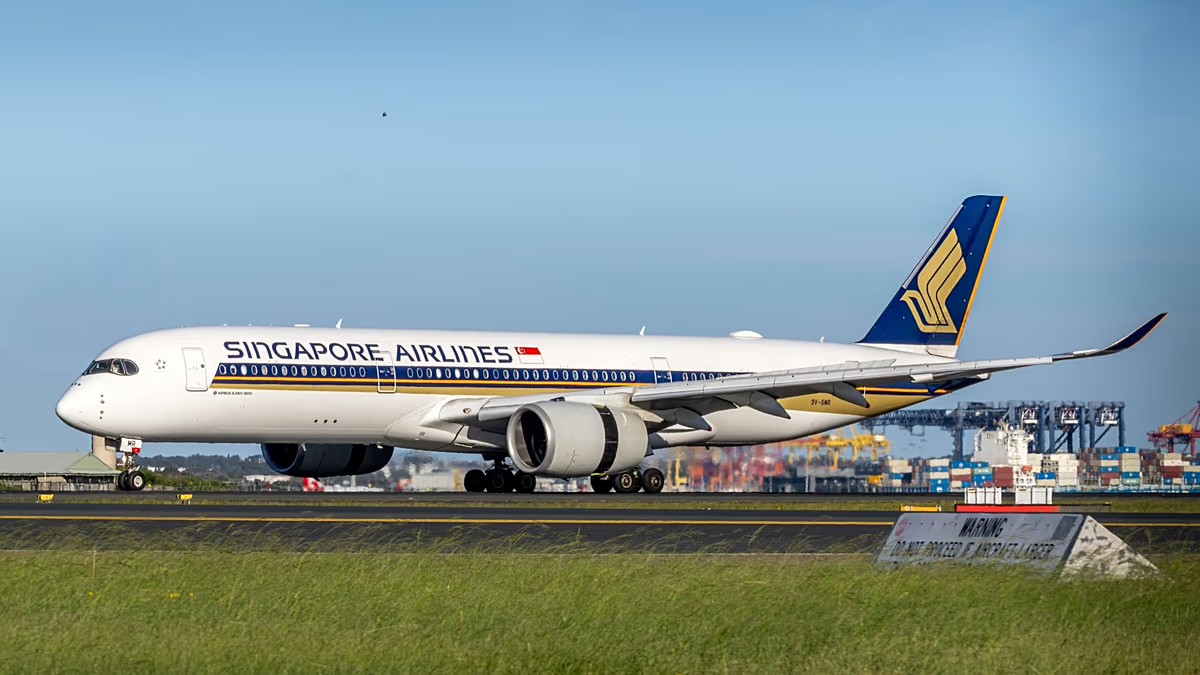
Para 3 (Flights): Above this terrestrial turmoil, a second, quieter drama unfolds in the sterile, oxygen-thin domain of air traffic control. The race doesn’t just stop cars; it weaponizes altitude. The airspace directly above the winding course transforms into a heavily guarded zone, a three-dimensional sanctuary protecting the runners from the intrusive roar of rotor blades and the distracting shadow of fixed-wing aircraft. For the pilots of incoming commercial flights, this translates into a cacophony of last-minute instructions crackling through headsets, forcing them to abandon their planned descent vectors. They are sent on wide, looping arcs over distant suburbs, visual flight rules superseded by the insistent, metallic voice of the control tower. The airplane cabin tilts subtly, a creak of landing gear and a turn of wings, and the passengers, clutching their coffee and boarding passes, feel a strange lurch in their stomachs—not of fear, but of a mysterious deviation. The flight path that once neatly bisected the city now curls like a ribbon around the invisible barrier of the race course, adding ten or fifteen precious minutes to every journey. For the weary business traveler, it means missing a connection; for the elderly woman visiting family, it’s an hour lost in a sterile terminal. Up above, the pilots communicate in clipped tones with ground control, their eyes scanning digital maps that now feature a deep red exclusion zone, a no-fly rectangle carved into the sky to protect the airborne spectacle below. The runways, however, hum with a different urgency. The rerouting is a logistical nightmare for ground crews—baggage carts race against the clock to meet planes that have landed at gates number 4B instead of 43A, and the entire ecosystem of arrivals and departures behind the glass walls of the terminal has been subtly, irrevocably tilted. The race is not just a ground event; it is a masterclass in the fragile choreography of air travel, where every diverted minute is a testament to the immense, intrusive scale of a single sporting day.
However, the most poignant casualty of this whole logistical invasion is not the commuter’s patience, nor the traveler’s schedule, but the silent, fragile soul of the National Gallery of Art. Standing in the heart of the city, just blocks from the race route, this hallowed institution has become a fortress of profound anxiety. The preparations have forced its curators and conservators into an unenviable, paranoid state of hyper-vigilance. It is not the crowds they fear—the museum has weathered millions of visitors—but the insidious, invisible vibration that seeps through the marble floors. The race brings with it thunderous footfalls of thousands of pounding runners, the relentless rumble of heavy television broadcasting trucks, the ground-shaking roar of helicopters hovering just overhead to capture aerial shots, and the deep, bellowing bass of public address systems testing their speakers. Each of these generates a low-frequency seismic tremor, a phantom earthquake that threatens to rattle the delicate molecular structures of a thousand-year-old canvas or stress the fragile crystalline lattice of a Renaissance sculpture. So, in the week leading up to the race, engineers have been deployed with seismographs and laser interferometers, their sensitive probes placed on the pedestals of priceless marble gods and within the humidified cases of ancient oils. They measure the vibration of a passing garbage truck, the subsonic thrum of a generator being tested, the distant rumble of a subway train—all in an attempt to predict the apocalyptic footfall of fifty thousand runners pounding the pavement a quarter of a mile away. The tests are peculiar, a collision of high science and ancient art. A conservator holds her breath as a technician strikes a tuning fork of immense power against the marble floor, watching a laser pointer measure the tremors that ricochet through the parquet. They are mapping the invisible shockwaves, calculating the threshold at which a few micrometers of movement might cause the craquelure on a seventeenth-century canvas to deepen, or a prized Renaissance sculpture to shift a fraction of a millimeter from its mount. The gallery’s vast, hushed halls, usually filled only with the whisper of footsteps and the murmur of admiration, now vibrate with the low, visceral thrum of busy thoroughfares and idling vans, a backdrop of seismic anxiety for the centuries-old masterpieces within. The curators are not just protecting paintings; they are defending a frozen moment of human creativity against the relentless, rhythmic pounding of the modern world’s athletic ambition.
Yet, in this maddening symphony of inconvenience, there exists a strange, defiant beauty that begins to emerge. The same streets that cause the exasperated sigh of a motorist who has been trapped in gridlock transform into a communal stage. The volunteers arrive at dawn, their vests a riot of neon orange, their energy a counterpoint to the drowsy hostility of the city. They transform the barricades from mere obstacles into leagues of support, handing out water, cheers, and the occasional high-five to the grumbling pedestrians rerouted onto sidewalks. Residents who initially grumbled about the disruption now drag lawn chairs to their front stoops, clutching thermoses of coffeehol and homemade signs scrawled with the names of strangers, discovering a strange, tribal camaraderie in the shared inconvenience. The bakery on the corner, cut off from its usual delivery route, becomes a social hub as runners’ families mill about, buying pastries they didn’t intend to purchase; the local coffee shop, though forced to deal with a surge of masked patrons, sees its highest sales of the year. The race has become a prism through which the city’s daily life is refracted, splitting the monochrome of routine into a dazzling spectrum of human interaction—an elderly woman offering oranges to the dust-covered cyclists, a child high-fiving a sweaty athlete through a gap in the fence, and the quiet, communal sigh of relief when a temporary pedestrian bridge reopens to reunite a divided neighborhood. The cacophony of car horns is gradually drowned out by the cheerful chatter of spectators, the pounding of adrenaline, and the infectious optimism that only a massive public event can generate. The inconvenience becomes a shared story, a collective hardship that breeds a strange, grudging affection for the city itself, a twisted pride in having survived the ordeal alongside thousands of strangers.
And then, just as suddenly as it began, the spectacle ends. The barricades are dismantled with the same mechanical precision that erected them, their steel frames collapsed and stacked like tired soldiers. The barriers peel back from their asphalt barriers, revealing the temporary scuffs and scars left by relentless footfalls. The air traffic controllers reroute their flights back to their original patterns, tracing the familiar, gentle arcs toward the runways, and the ground crews breathe a sigh of relief as their baggage carousels begin to spin in predictable synchronization once more. Inside the National Gallery of Art, the vibration monitors are finally switched off, their needles returning to a serene, unwavering flatnessksi. The conservators perform one final inspection, wiping a spec of dust from a gilded frame, relieved that the Rembrandts and Vermeers have weathered the storm unscathed. The commuters, now freed from their forced detours, glide back into their usual lanes with a newfound appreciation for the mundane. The city exhales, its collective shoulders relaxing. The temporary inconvenience is forgotten, replaced by the lingering memory of a weekend where thousands of feet pounded the pavement in single-minded purpose. The streets are clean, the flights are on time, and the museum echoes once more with only the sound of awe.
In the quiet aftermath, the city reflects on what has passed. It was more than just a race; it was a profound, if temporary, recalibration of the urban environment—a testament to how an entire metropolis can bend, flex, and accommodate a single, grand human endeavor. It is a story of negotiation: commuters negotiating time, pilots negotiating space, and curators negotiating physics. It reveals the immense infrastructure that lies hidden beneath the veneer of a simple checkpoint or a ladder track, and the intricate web of human labor that makes a moment of athletic euphoria possible. The disruptions, the rerouted flights, the traffic jams, and the laboratory-like vigilance over ancient artworks are not mere inconveniences; they are the price the city willingly pays to host a spectacle that, for a fleeting moment, unites its residents in a shared narrative of endurance and triumph. For those few days, the mundane sacrifices of the few enable the glory of the many, and the latent tension between civic necessity and public celebration is finally, beautifully resolved. As the last helicopter fades over the horizon and the last spectator leaves the gallery, the city settles back into its familiar hum. The roads are open, the skies are clear, and the art hangs undisturbedhola. The race is over, but the story of how the city held its breath, adapted, groaned, and ultimately cheered, remains etched in the memory of its residents—a testament to the fragile, heroic, and deeply human ecology of a metropolis under the spotlight.