


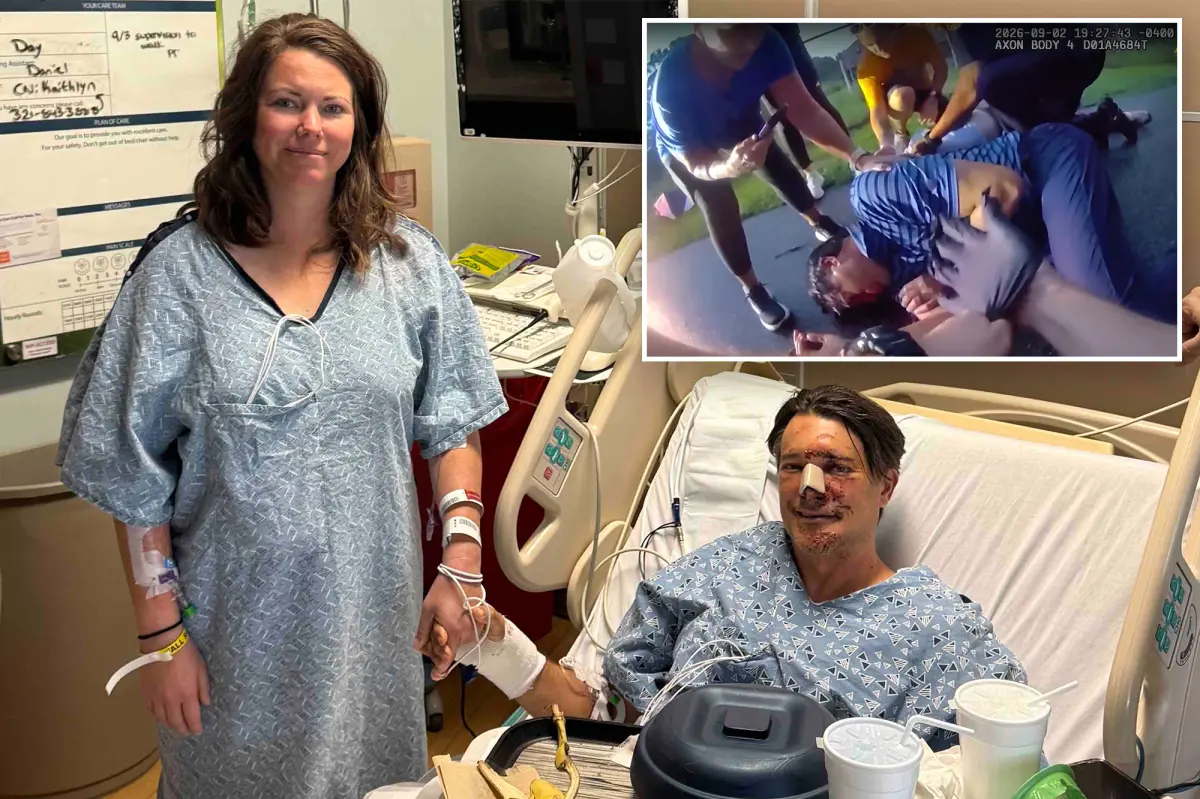
On a warm September morning in central Florida, Aaron and Clare Walenga set out for what should have been an ordinary moment of connection. They had just dropped their children off at church, and now, with the morning still fresh around them, they decided to take a walk together along the West Orange Trail, a beloved paved path near their home in Apopka. Aaron, 48, and Clare, 43, had been married for seventeen years, and they were still the kind of couple who reached for each other’s hands when they walked. They talked about the day ahead, breathed in the warm air, and had no reason to believe that anything out of the ordinary was about to happen. There was no crack of thunder in the distance, no dark wall of clouds rolling in, no sudden shift in the wind that warned them of danger. Lightning, however, does not always announce itself. It can leap from the sky when the weather seems harmless, traveling far ahead of the rain that created it. In the span of a single heartbeat, the world around the Walengas turned violent. A bolt struck them as they walked hand in hand, and in an instant, their quiet morning became a fight for survival. Aaron was thrown by the force of the strike, his body surging with pain unlike anything he had ever known. Clare collapsed beside him, motionless. The trail, which had been peaceful just moments before, suddenly became a scene of chaos and fear.
For Aaron, the first feeling was not confusion but raw, overwhelming pain. Later, when he tried to describe it, he would call it the worst pain of his life. His body felt as though it had been turned inside out, and every muscle resisted the simplest movement. He wanted to crawl to Clare. He wanted to hold her, to see if she was breathing, to do something. But his body would not obey him. The lightning had stolen his ability to move, and all he could do was lie there in agony, watching the world blur around him. Clare was still. Her skin had taken on a blue tint, a color that no one who saw it would ever forget. She was not breathing. She was, for all practical purposes, gone. What the Walengas could not know in that terrible moment was that help was already nearby. Four friends, part of a weekly running club, were making their way along the trail. They had no medical training, no equipment, no expectation of running into an emergency. But when they saw the couple on the ground, they did not hesitate. Charlotte Sachetti Weyand and Amber McManus reached for their phones and called 911, giving the dispatcher the location while their minds raced. Michael Weyand saw Clare’s blue skin and knew immediately that something was profoundly wrong. He checked for breath. There was none. Later, he would say that he had never seen a human being that color in his life. He had never performed CPR before, either. But in that moment, instinct took over. He lowered himself to the ground and began chest compressions, pressing against the unknown, against the silence, against the possibility that he was too late.
The seconds stretched into what felt like hours. Charlotte and Amber stayed on the phone with emergency services, relaying information while the rest of the group worked to keep Clare alive. Michael kept going, his movements steady, driven by a primal certainty that he could not stop, that stopping would mean losing her. Nearby, Aaron remained on the ground, desperate to help his wife but powerless to do anything except watch. He kept saying her name. He kept trying to will himself to his feet. But his body was not yet ready, and so he stayed where he was, surrounded by strangers who had become his wife’s only chance. Tiffany Roby, another member of the running group, was there as well. She saw the fear in the faces around her, felt the weight of the moment pressing down on everyone. Then, just as the group was preparing to attempt mouth-to-mouth, Clare took a breath. It was not a faint, uncertain gasp. It was a massive breath, a sudden full return of life that seemed to push back against the silence and the fear. Tiffany would later say she did not know how to describe the feeling. It was relief so profound that it left no room for words. Clare was not fully conscious, but she was breathing. Her heart was beating again. The color would slowly return to her skin. By the time the paramedics arrived, the running club had done what no training could have guaranteed: they had built a bridge between death and life, and they had refused to let go.
Both Aaron and Clare were rushed to the hospital, their bodies bearing physical evidence of the electrical force that had passed through them. Clare had suffered a concussion; Aaron had bruises on his face. The road ahead would not be easy. Lightning injuries are not always visible, and the effects on the body and mind can linger long after the external wounds heal. But even in those first difficult days, there was hope. On September 4, just two days after the strike, relatives reported that Clare had made significant progress. “We have seen God answer so many prayers,” they said, “and Clare and Aaron have come a long way in such a short amount of time.” Those words carried the weight of everything the family had feared and everything they now believed possible. In the quiet of the hospital, small victories became enormous milestones: a word spoken, a hand squeezed, a breath taken without assistance. Meanwhile, the larger community began to rally around the Walengas. A fundraising page was created to help with medical expenses and the time they would need to recover. More than $65,000 was raised, a testament to the depth of compassion that followed this story. But the money, as meaningful as it was, almost seemed secondary. What mattered more was the feeling that the Walengas were not alone. They had been saved by four strangers on a running trail, and now they were being carried by an even wider circle of people who believed in second chances.
When Aaron and Clare finally had the strength to speak publicly about what had happened, gratitude filled every word. Aaron addressed the four runners directly, his voice thick with emotion. “There were so many miracles that we witnessed—from Clare being brought back to life, to the four of you being there on that trail at that time.” For him, the timing of their presence was not luck. It was grace. It was the kind of blessing that cannot be planned or explained, only received. Clare, still processing the enormity of the moment, offered a simpler and equally powerful reflection. “The gift of life that we have is just so beautiful,” she said. The words were quiet, but they carried a truth that only those who have come close to losing everything can fully understand. The Walengas had started their day with a casual walk, holding hands without knowing how close they were to being separated forever. They had walked a familiar trail without suspecting that it might break them. And they had been saved by people who happened to be nearby, people who used their hands and voices and presence to pull a life back from the edge. The gratitude the couple felt was not abstract. It had names and faces. It had the image of a woman turning blue, the sound of chest compressions, and the moment when breath finally returned. It had the knowledge that being alive is not something to take for granted.
Their story is remarkable, but it also exists against a backdrop of real danger. According to the CDC, the odds of being struck by lightning in any given year are less than one in a million, and almost ninety percent of lightning strike victims survive. Yet the statistics cannot fully capture the devastation that lightning can cause. In the weeks surrounding the Walengas’ ordeal, there were painful reminders of how deadly these strikes can be. Matthew Jenkins, a 20-year-old who had just moved to Florida to participate in the Disney College Program, died after being struck by lightning. Steve Matheson, a Utah father, was struck while helping Florida boaters who had gotten into trouble at sea; he later died from his injuries. And in a heartbreaking loss that made national headlines, Kenya Glasgow, 31, and her two-year-old daughter Kennedi were struck and killed in front of their husband and father. Each of these stories is a reminder that lightning does not discriminate. It can find a person on the water, in a parking lot, on a golf course, or on a beautiful rail trail in the middle of a peaceful morning. The Walengas know how close they came to becoming another tragedy. Instead, they are going home. They are healing, learning to walk through the world again, and holding their children a little tighter. Their survival was the result of luck, timing, and the extraordinary actions of four ordinary people who stopped, turned around, and chose to fight for a stranger’s life. It is a story about the fragility of existence and the resilience of the human spirit. It is a story about a couple walking hand in hand, a bolt of lightning, and the runners who refused to let death win.