





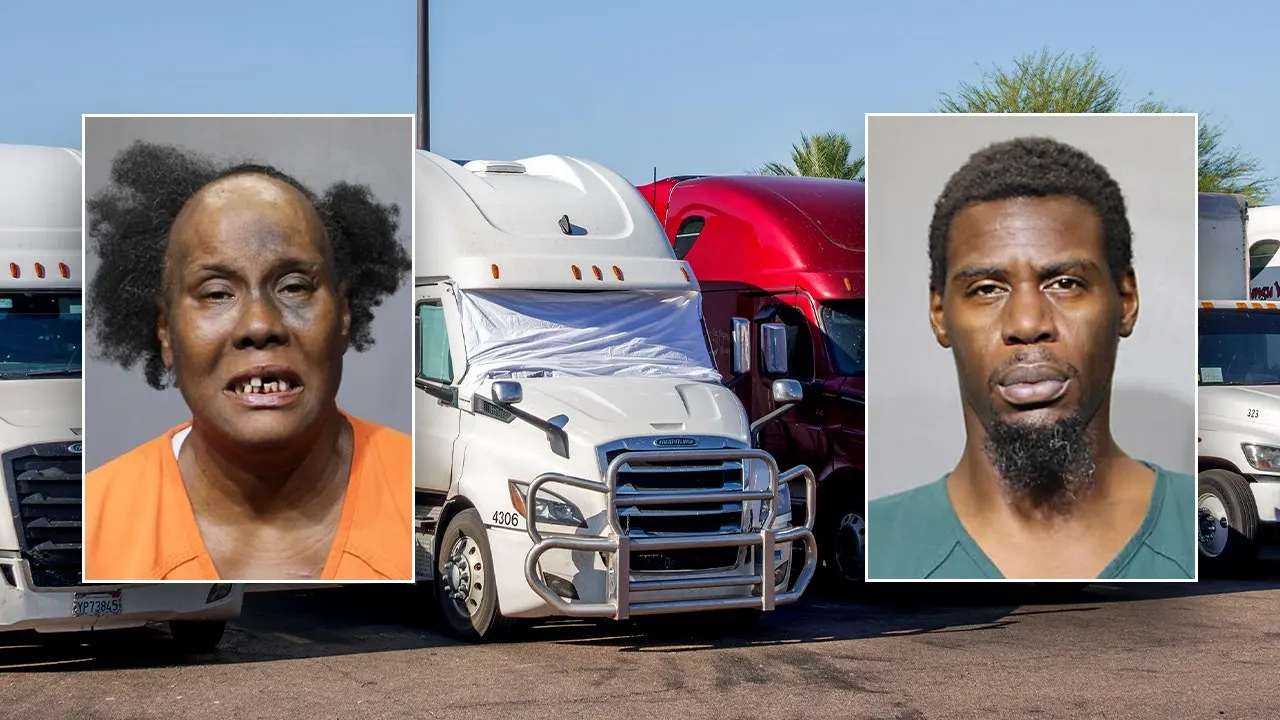
In the ceaseless, droning hum of America’s interstate highways—where massive eighteen-wheelers barrel through the night as anonymous metal ghosts, cutting through state lines and weather systems with mechanical indifference—a sinister and deeply hidden secret was unfolding within the cramped, suffocating confines of a single tractor-trailer cab. The Jacksonville Sheriff’s Office, in a stark and heartbreakingly matter-of-fact arrest report, peeled back the curtain on what can only be described as a living nightmare, a mobile prison that traveled back and forth between the sultry heat of Miami and the sprawling bustle of Atlanta. Keisha Epps, a 51-year-old woman, and her fiancé, 37-year-old Tamra Marshon Stewart, are now facing the cold, unforgiving glare of the Florida justice system, charged with four counts of child neglect—one for each of the children who were allegedly robbed of their childhood, their health, and their fundamental dignity for nearly six years. When law enforcement finally encountered these children, the initial observations were jarring and profoundly disturbing. The detective on the case noted that the children were “walking with an unnatural gait from being confined to the cab,” a physical manifestation of a profound betrayal that had warped their very bodies. These were not children who had played in the sun, run across schoolyards, or scraped their knees on asphalt; they were souls whose entire world had shrunk to the width of a truck seat, and their bodies bore the undeniable, tragic evidence of that confinement.
The timeline of this tragedy stretches back to December 2019, a period of almost six years in which the children were kept inside the vehicle “for the majority of their days.” The logistics of their daily existence are almost too horrendous to comprehend: they were denied the most basic and primal of human physical necessities—the time to take showers, the privacy to use a restroom, and the simple, liberating ability to exercise or even step outside into the open air. As the truck rolled along its monotonous route, the children were effectively entombed in a metal box, listening to the constant drone of the engine, feeling the vibrations of the pavement beneath them, and watching the world pass by through a window they could never open to escape. Perhaps most devastating of all, the children “have not been allowed to attend school for approximately five years,” a detail that reveals a calculated and willful severing of their connection to the outside world. School is not merely a place of academic learning; it is the primary socializing institution of childhood, where children learn to make friends, to trust adults, to find their voice, and to imagine futures beyond their immediate surroundings. By denying them this fundamental right, Epps and Stewart ensured not only that they would remain physically hidden but also that they would remain intellectually and emotionally stunted, entirely dependent on their captors. The interview at a child advocacy center must have been a surreal and terrifying experience for these children, who likely had no frame of reference for interacting with authority figures, no vocabulary for their own suffering, and no understanding that the world outside the truck could offer them safety. Their testimonies painted a picture of a moving prison, where the American landscape was just a blurry backdrop to a life of extreme deprivation and profound neglect.
The physical toll of this imprisonment was staggering, a testament to the cruel indifference of the adults who were supposed to be their protectors. The children were “fed poorly,” a vague but chilling description that suggests a perpetual state of hunger and nutritional deficiency. They never received medical or dental care—even for emergencies—which speaks to a complete abdication of parental responsibility. The most poignant and heart-wrenching detail to emerge from the interviews involved one of the children recalling an incident where she “burned herself badly with cooked noodles.” In that moment, the chaos of a tiny, cramped living space turned into a scene of agony, a child screaming in pain as scalding food adhered to her skin, causing severe burns that blistered and bled. “There was a lot of blood,” she said, her words echoing the sheer terror and helplessness of that moment. Yet, despite witnessing this horrific injury, neither Stewart nor Epps took her to get medical treatment. The child now carries a “permanent scar” from the burn, a physical tattoo of her parents’ callousness that she will carry for the rest of her life. This incident is not just a story of an accident; it is a harrowing glimpse into the absolute absence of care, where a child’s pain is dismissed, where a medical emergency is ignored, and where the priority is not the child’s well-being but the preservation of their secret. The neglect extended beyond visible injuries; one of the children was found to have an untreated sexually transmitted infection—a horrifying detail that simultaneously reveals the depths of the physical abuse occurring within the cab and the complete failure to provide even the most basic medical screenings or interventions. These children did not just miss routine check-ups; they were suffering from acute, painful, and dangerous conditions that were left to fester, both physically and psychologically.
Beyond the physical deprivation, the emotional and psychological landscape of that truck was one of terror and violence, orchestrated primarily by Stewart. The children recounted that Stewart “would watch” them when Epps was sleeping, showering, or driving the truck, placing him in a position of absolute authority and unchecked power. This power was brutally wielded. When the children witnessed sexual abuse and confronted Stewart—a moment of incredible bravery for children in such a powerless position—he retaliated with violence, “beat[ing] them by punching them in their heads,” according to reports. This is a chilling cycle of abuse: the children see a terrible wrong occurring, they voice their distress, and they are physically punished for it, effectively being taught that their voices mean nothing, that their safety is worthless, and that the only safe course of action is silence. Perhaps even more damning is the complicity of Keisha Epps, the children’s mother. The children said they told Epps about the sexual abuse and that she witnessed it herself. Instead of acting as a fierce protector, a mother bear driven by rage and maternal instinct, she called one of them “derogatory names” and continued to leave the children alone with Stewart. This deliberate turning of a blind eye is a betrayal that cuts deeper than any physical blow. Epps had the power to intervene, to drive the truck to the nearest police station, to shield her children from a monster, but she chose instead to prioritize her relationship with her fiancé over the lives and safety of her own flesh and blood. Her actions—or rather, her inaction—transformed an unspeakable tragedy into a sustained, six-year-long holocaust of suffering, making her an active participant in the abuse through her willful neglect and profound emotional abandonment of her children.
The legal aftermath has been swift and severe, though it can never undo the years of damage. Both Epps and Stewart were arrested on August 6, as detailed in a heavily redacted report filed with the court by the Jacksonville Sheriff’s Office. The redactions are a poignant reminder that the true victims of this case remain anonymous, their identities shielded from public scrutiny but their experiences now a matter of public record. Both were charged with four counts of child neglect—one count for each child—which under Florida law constitutes a third-degree felony. Each count carries a potential penalty of up to five years in prison, up to five years of probation, and a fine of up to $5,000. Investigators characterized their actions as a “committed, willful failure or omission to provide a child with the care, supervision, and services necessary to maintain the child’s physical and mental health, including but not limited to, food, nutrition, clothing, shelter, supervision, medicine and medical services that a prudent person would consider essential to the wellbeing of the child.” This legal definition, while precise, feels clinical compared to the horrific reality it describes. Even more staggering are the future charges looming over Stewart. According to court documents, “capital sexual battery charges” against him will be filed in the “9th Judicial District by the Statewide Prosecutor.” Under Florida law, anyone convicted of sexual battery of a child younger than 12 years old can face the death penalty or life in prison without parole. The fact that prosecutors are pursuing this highest level of charge indicates the presence of evidence of devastating, serial sexual abuse of the most vulnerable victims. Bond was set at $400,012 for Epps, a substantial sum that reflects the gravity of her alleged complicity, while Stewart is being held without bond, a clear indication that he is considered a severe flight risk and a profound danger to the community.
The story of these four children is a story of unimaginable endurance in the face of relentless cruelty. They all shared a single bunk in the cab so small that they had to lie “curled up side by side because they could not fit,” a physical image that evokes the deepest sense of human vulnerability—four small bodies, wrapped around each other in a desperate attempt to fit into a space never designed for human habitation, seeking warmth and minimal comfort in a world that had given them nothing but pain. They were denied the right to run, to laugh, to learn, to be children. They were stripped of their autonomy, their trust, and their innocence. While we do not know their ages, their sexes, or their relationships to one another, their shared suffering has bound them together in a way that only fellow survivors of trauma can understand. As they now begin the long, arduous journey through the foster care system, courts, and therapeutic rehabilitation, the scars on their bodies—the burn mark, the untreated infections, the malformed gaits—will slowly heal, but the psychological wounds may never fully closes. The challenge now lies with the community, social services, and therapists to gently guide them out of the shadows of that truck and into the light of a world that is safe, nurturing, and free. This case serves as a soul-crushing reminder that the American open road, often romanticized as a symbol of freedom and opportunity, can also serve as a hidden prison for the most vulnerable among us. We must look closer at the closed doors of truck cabs, the quiet vehicles in parking lots, and the isolated corners of our communities, for the silent suffering of children can be hidden in the most ordinary of places, and their small, curled-up bodies are a call to action that we cannot afford to ignore.