




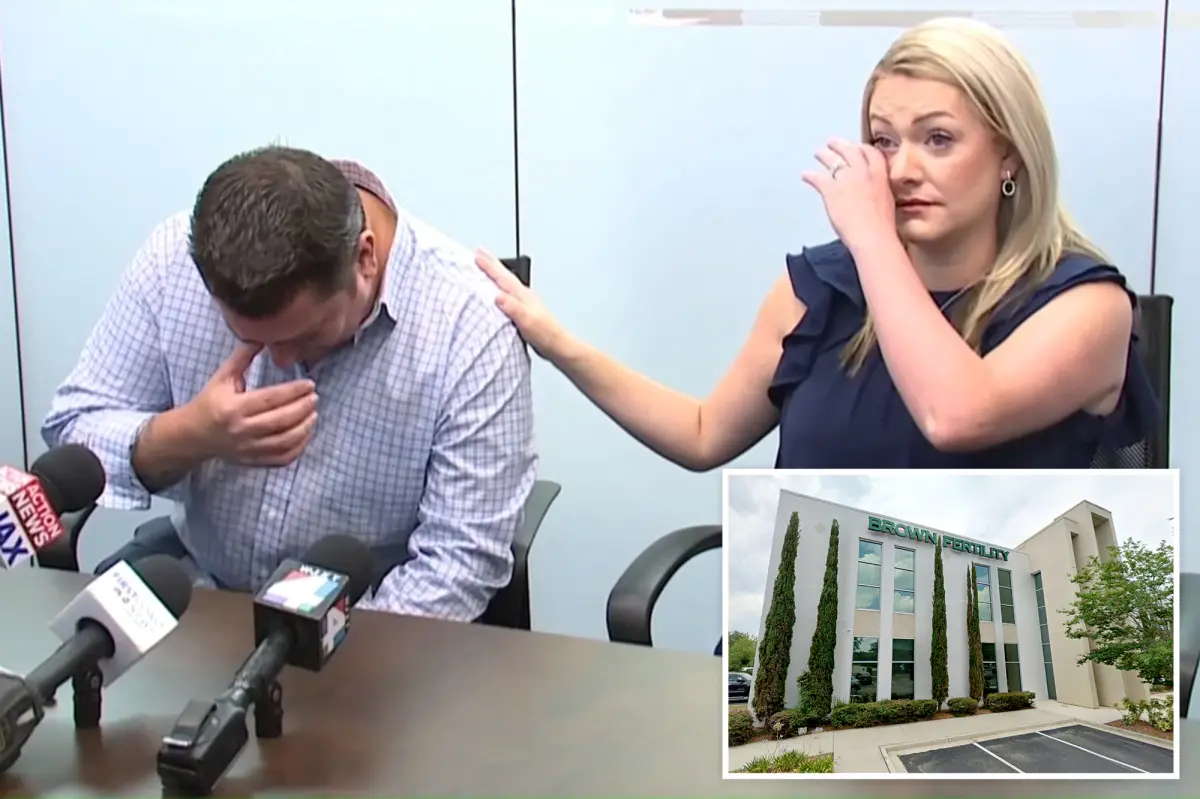
They went to Brown Fertility as people go to any trusted medical place—with hope, with fear, with the vulnerable belief that the experts in the room would honor the promise they had been given. Joshua and Natalie Strong had spent years imagining the sound of a child’s laugh in their home, the weight of a small hand in theirs, the quiet miracle of a family that was finally theirs. After a long and emotional journey, the Jacksonville couple chose Brown Fertility, a clinic that had been named one of “America’s Best Fertility Clinics” in 2025. They placed more than their money into that decision; they placed their entire future. According to a lawsuit filed in Duval County Circuit Court, that trust was not just betrayed—it was shattered. The Strongs allege that Brown Fertility, its medical director Dr. Samuel Brown, and ten other defendants used another man’s sperm to create the embryo that became their daughter. It was not supposed to be this way. Joshua, who had undergone a vasectomy earlier in life, had endured an invasive surgical sperm retrieval to make their dream possible. That procedure produced four vials of sperm—vials that were handed over under very specific terms: fertilize Natalie’s eggs with Joshua’s sperm, create embryos, and transfer them to Natalie. The couple paid tens of thousands of dollars for that service. They could not have imagined that the clinic would lose their most precious biological material—or worse, use someone else’s in its place. The lawsuit describes a deeply personal betrayal disguised as a clinical error. “They trusted Brown Fertility, as well as its founder and owner, Samuel E. Brown, M.D., with the family they hoped to build,” the couple said in their filing. “That trust was betrayed.”
The Strongs’ journey into IVF was not their first attempt to build a family, and it was never casual. In mid-2024, Natalie became pregnant after their first round of treatment, only to suffer a miscarriage about a month in. The loss was devastating, but they found the courage to try again. They returned to the same clinic, which meant they had to believe in the process despite their grief. When Natalie became pregnant a second time, the joy was overwhelming. She was carrying her first child. Every kick, every ultrasound, every moment of anticipation felt like redemption after so much heartache. In June 2025, Natalie gave birth to a baby girl. The couple should have experienced only pure ecstasy—the kind of once-in-a-lifetime euphoria that makes all the pain worth it. Instead, within the first twenty-four hours of their daughter’s life, something went terribly wrong. Routine newborn blood typing revealed that the baby had Type B Positive blood. To most new parents, that would mean nothing more than a note in a hospital file. But for the Strongs, it was a red flag that could not be ignored. Natalie’s blood type is O Negative. Joshua’s blood type is A Negative. Biologically, a child born from their union could not have Type B Positive blood. The medical result was not just unusual—it was impossible. The quiet, ordinary moment of checking a newborn’s blood type became the first crack in the foundation of their family’s story. The hospital staff may have seemed calm, but for Natalie and Joshua, the world tilted. The result “did not fit,” as the lawsuit put it, and it didn’t take long for them to understand what that might mean.
Still, they needed more than suspicion. Additional DNA testing was ordered, and the results came back with devastating clarity: there was a zero percent probability that Joshua was the biological father of their daughter. Zero. Not a fraction, not a doubt, but a complete and total biological impossibility. The child Natalie had carried, given birth to, and held in her arms had been conceived using the sperm of a stranger. The daughter they had named and loved, the baby they had dreamed of, was not Joshua’s biological child. For Joshua, the blow was deeply personal. He had already made sacrifices to reach this moment—a vasectomy, an invasive retrieval, the vulnerability of giving his body and his future to a clinic he believed was worthy of that trust. Now, his paternity had been erased by a mix-up no one was explaining. For Natalie, the violation was both physical and emotional. She had carried a child, gone through the enormous demands of pregnancy, and given birth—all while believing she was completing their family together. Instead, she learned that her body had twice been used as part of an IVF process that allegedly involved someone else’s sperm. The first pregnancy, which ended in miscarriage, may also have been affected. The lawsuit alleges that Brown Fertility used the wrong sperm for that first attempt as well, meaning the loss she had grieved may not have been Joshua’s child either. “It took away the euphoria of having a baby,” Natalie told Jacksonville’s First Coast News. “It was my first child, I was in heaven. It was the best day of my life and then when that hit us, it took all the happiness away, which we should have had for a very long time.” Her voice captures the heartbreaking reality that this is not simply a legal case—it is the theft of a memory they can never get back.
The hardest part may be the silence that followed. The Strongs reached out to Brown Fertility with their DNA results, hoping for some kind of explanation, some apology, some acknowledgment of the devastating mistake that had changed their lives. Instead, they were met with refusal. According to the lawsuit, the clinic and Dr. Brown have refused to admit what happened, refused to explain how Joshua’s sperm went missing, and refused to take responsibility. The couple is left with horrifying questions that have no answers. Where is Joshua’s sperm? Was it misplaced? Discarded accidentally? Or, more disturbingly, was it used to create embryos for other couples who have no idea that they are carrying the biological child of a man who never consented to be their father? The lawsuit raises this possibility in stark terms: “The Strongs do not know whether Joshua has biological children, fathered without his knowledge, being raised today by other Brown Fertility patients who have no idea.” It is an almost unbearable thought. Somewhere out there, there could be children who share Joshua’s DNA, living lives shaped by a medical error that was never disclosed. There could be families who, like the Strongs, believe they are raising their own biological children—unaware that the genetic story is entirely different. And there is nothing the Strongs can do to resolve that unknown. They are left with dangling threads, unanswered calls, and the emotional weight of not knowing whether Joshua is a father to children he has never met. The clinic’s silence makes everything worse. It is one thing to suffer a tragic accident with transparency and regret; it is another to be met with denial and defiance. The Strongs say they have given the clinic irrefutable evidence, but the clinic has chosen to look away.
Faced with that silence, the couple has turned to the courts. Their lawsuit names Dr. Samuel Brown, as medical director, and ten other defendants, seeking damages in excess of $50,000 and a trial by jury. But the money is only a small part of the story. The lawsuit lays out, in painful detail, the human cost of the clinic’s alleged actions. “Natalie suffers the daily knowledge that her body was used, twice, to carry a stranger’s child,” the filing says. “Joshua suffers the daily knowledge that the daughter he is raising bears no biological connection to him, the loss of the irreplaceable genetic future he believed he was building with his wife, and the unending question of what became of his cryopreserved sperm.” Those words are clinical, but they describe a suffering that is impossible to quantify. Every day, Natalie wakes up with the memory of a pregnancy that was supposed to be sacred but was, in her eyes, violated by a clinic’s error. Every day, Joshua looks at his daughter and feels the complicated ache of loving a child who is both his and not his in the way he had always imagined. The lawsuit acknowledges that they are raising their daughter—she is their child in every way that matters emotionally, and they are not seeking to give her up. But the situation is not simple. They are experiencing joy and love, but also sadness and anger, often in the same day. Joshua told First Coast News that it is a daily struggle. That is the reality of medical negligence when it crosses into the most intimate parts of human life: there is no clean outcome, no easy resolution. Even a successful lawsuit cannot erase the uncertainty, the grief, or the sense of violation.
The Strongs’ story is more than a headline. It is a reminder of the profound vulnerability that comes with assisted reproduction. Millions of people turn to fertility clinics every year, giving doctors and laboratories the materials of life itself—eggs, sperm, embryos, hopes. They do so because they want children, because they have no other way to build a family, because they believe that the professionals in charge will treat those materials with reverence. When a clinic fails in that sacred duty, the consequences are not just physical or legal; they are deeply human. The Strongs lost something that can never be restored: the genetic future they imagined with their daughter. They also lost the simple, uncomplicated joy of bringing a child into the world. Instead of looking back at their daughter’s birth with pure happiness, they will always remember the blood type, the DNA test, the phone call that changed everything. They are still parents, still loving and caring for their daughter, still trying to give her the best life they can. But they are also victims of a betrayal that no courtroom verdict can fully heal. What they want, beyond the damages they are seeking, is accountability. They want Brown Fertility to tell them the truth, to own what happened, and to ensure it never happens to another family. They want to know what happened to Joshua’s sperm, and whether other children or parents are living under the same false assumptions. Their fight is for themselves, but it is also for every person who has ever placed their future in the hands of a medical provider and trusted that their dreams would be protected. In telling their story, they remind us that behind every fertility clinic success story, behind every birth announcement and newborn blood test, there is a fragile trust that must never be taken lightly. And when that trust is broken, the pain rarely ends with a legal settlement—it lives on in every quiet moment, every family gathering, every unanswered question.