






Paragraph 1: The Sudden Silence Over San Diego
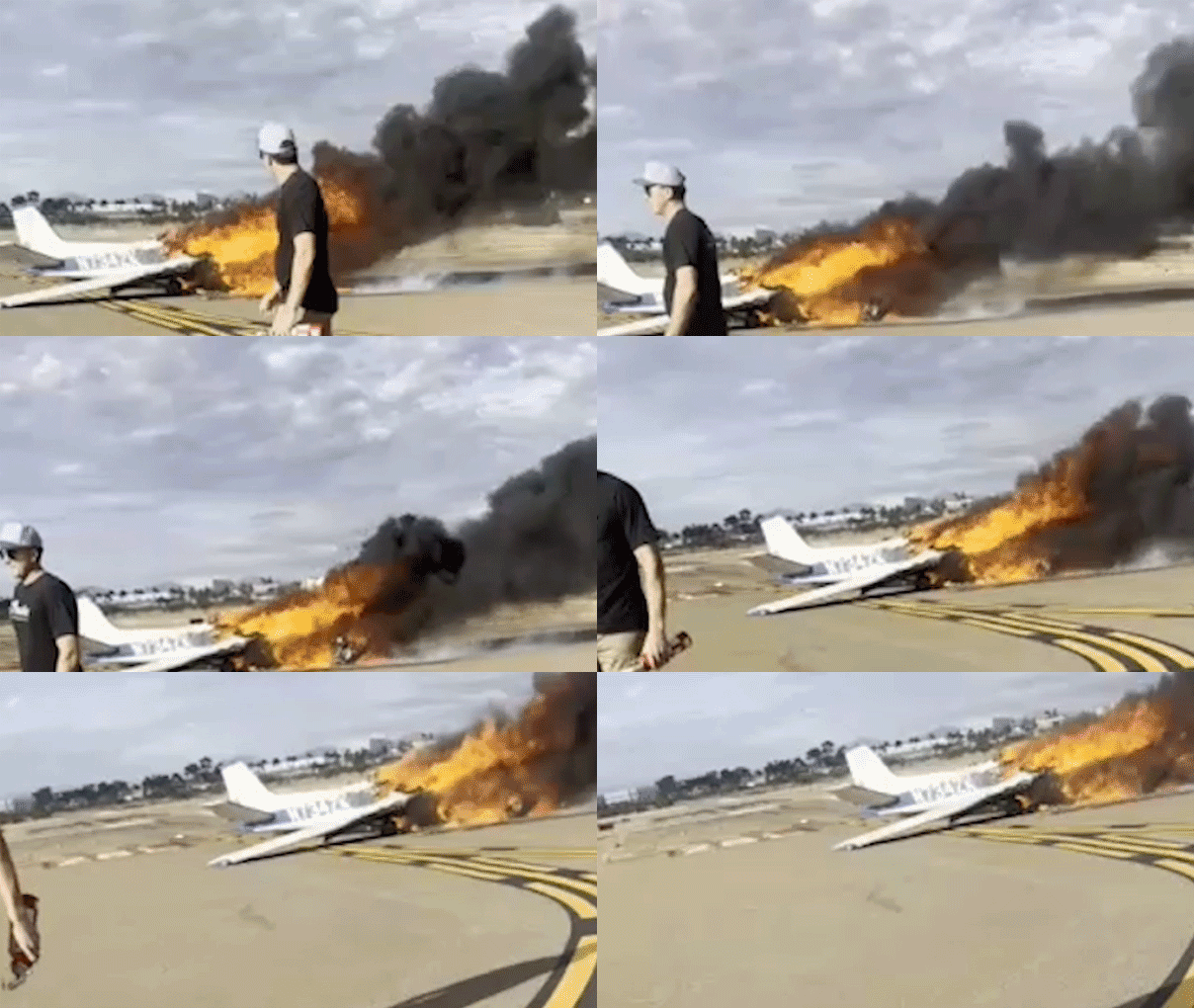
On a seemingly ordinary Monday afternoon, the sky over San Diego became the backdrop for a tragedy that would leave a community in mourning. It was just after five o’clock, a time when the day should have been winding down, when the hum of everyday life was abruptly interrupted by the roar of an engine and then, all too quickly, the unforgiving sound of impact. A small Cessna 172, a workhorse of the skies known for its reliability and simplicity, was coming home to the Montgomery-Gibbs Executive Airport. But the landing never happened as intended. Instead, witnesses and surveillance cameras captured a terrifying sequence: the aircraft, in its final moments, seemed to falter, its left wing dropping dangerously before it spun toward the earth. The crash claimed the lives of the two people on board, turning a routine flight into a final one. The immediate aftermath was a scene of chaos and heartbreak—a thick, black plume of smoke rising into the air, visible for miles, a stark and sobering marker of the disaster below. Fire crews and emergency responders rushed to the scene, their sirens wailing against the backdrop of a city that had suddenly stopped to pay attention. The aircraft, heavily damaged and consumed by flames, left little hope for survival, and rescue efforts quickly transitioned into a different, more somber mission: containing the fire, investigating the wreckage, and trying to understand how a flight that began with promise had ended so catastrophically. For those who saw the smoke, for the families waiting for a loved one to call, and for the first responders who would carry the weight of this day for years to come, the crash was more than a news headline. It was a profound loss, a reminder of the fragility of life and the thin margins that separate a safe landing from an unthinkable tragedy. The city of San Diego, no stranger to aviation history, now had a new scar—a quiet airport runway near a busy neighborhood, forever marked by the events of that afternoon.
Paragraph 2: A Routine Flight Turned Tragic
The aircraft involved in the devastating crash was a Cessna 172, one of the most popular and widely flown airplanes in the world. For decades, this model has been a symbol of general aviation, used for flight training, personal travel, and recreational flying. It is a forgiving aircraft, designed to be stable and manageable, which is why it is often the first plane a student pilot learns to fly. That familiarity makes the news of this crash all the more shocking. The flight was heading to Montgomery-Gibbs Executive Airport, a facility nestled within the city limits of San Diego, surrounded by residential neighborhoods and commercial areas. The airport is a hub for private aviation, a place where pilots and aircraft come and go throughout the day. Around 5:15 p.m. local time on Monday, September 7, the Cessna was in the process of landing. According to preliminary information from the Federal Aviation Administration (FAA), the aircraft crashed while on approach. But something went wrong. The initial data suggests that the pilot attempted a go-around, a maneuver in which the pilot aborts the landing and applies full power to climb back into the air for another attempt. This is not an unusual procedure; pilots are trained to do this whenever a landing approach is unstable, if the runway is blocked, or if something feels unsafe. It is a decision that requires calm and skill, a moment where the pilot must quickly assess the situation and act. In this case, however, the go-around did not save the aircraft. The NTSB later reported that the plane “impacted terrain on airport property” during this maneuver, and a post-impact fire ensued. The flames consumed the wreckage, leaving little room for doubt about the fate of the two occupants. The identities of the victims were not immediately released to the public, but the loss was no less real to the people who knew them, to the aviation community that shares a deep bond, and to the investigators who would soon begin the painstaking process of piecing together the final seconds of the flight.
Paragraph 3: Understanding the Mechanics of the Crash
To truly grasp what happened in those final, harrowing moments, it helps to understand the technical aspects of the incident, even as the full picture remains incomplete. A go-around is a critical safety procedure in aviation, designed to give pilots a second chance when an approach is not working out. In practice, it involves advancing the throttle to full power, pitching the aircraft up to climb, and retracting flaps in a coordinated sequence. But this maneuver also places increased demands on the pilot, especially if the aircraft is low to the ground, slow, or in a configuration that makes it vulnerable. The FAA’s preliminary notice offered a chilling glimpse into the chain of events: the aircraft’s left wing dipped, and the plane appeared to stall and spin into the ground. In aviation terms, a stall refers to a loss of lift, not necessarily a failure of the engine. When an aircraft’s wing exceeds its critical angle of attack, the smooth airflow over the wing is disrupted, causing lift to rapidly decrease. At low altitude, a stall can be catastrophic because there is simply not enough time to recover. If the wing dips during a stall, the aircraft can enter a spin, which is even more difficult to overcome. For the two people aboard that Cessna, the margin for error was tragically slim. The sequence—go-around, wing dip, stall, spin—paints a picture of a flight that was fighting against physics and circumstances, ultimately losing that battle just moments from safety. The National Transportation Safety Board, or NTSB, is leading the investigation. They have the authority to examine every aspect of the crash: the aircraft’s maintenance history, the pilot’s experience and training, weather conditions, air traffic control communications, and the physical wreckage itself. An NTSB investigator was dispatched to the scene, arriving the following afternoon to begin documenting the site, examining the aircraft, and eventually recovering the wreckage to a secure facility for a thorough evaluation. This process takes time, often months, and the goal is not just to assign blame but to understand what happened so that similar accidents can be prevented in the future. Every crash leaves behind lessons, and it is the solemn duty of investigators to find them.
Paragraph 4: The Human Toll and the Heroic Response
Behind the clinical details of the investigation lies the deeply human story of the crash, a story that unfolded in real time for the people of San Diego. The immediate response was swift and courageous. Firefighters and emergency medical personnel from the San Diego Fire-Rescue Department arrived at Montgomery-Gibbs Executive Airport to find a scene of intense heat and destruction. The aircraft had been “heavily damaged,” according to Brian Raines, a public information officer for the department. The flames were raging, and the priority was to bring the fire under control, even as it became clear that there were no survivors to save. Raines acknowledged that responders were unable to extract the victims from the wreckage because of the severity of the damage and the intensity of the fire. For the men and women on the scene, this was not just another call. It was a day that would linger in their memories, a reminder that their jobs sometimes involve the heartbreaking task of recovery rather than rescue. The smoke, thick and black, was visible as a grim column against the San Diego skyline, a silent announcement to the surrounding community that something terrible had happened. Neighbors near the airport likely heard the roar of the engine, felt the thud of impact, or saw the smoke rising from behind their fences. In a city where aviation is woven into the fabric of life, from the military bases to the general aviation airports, the crash struck a chord. A single moment of tragedy at a local airport is a loss for everyone, from the pilots who fly out of Montgomery-Gibbs every day to the families living below the flight paths. The victims were not just statistics or witnesses on a report; they were people with names, stories, families, and dreams. They left behind loved ones who will now have to navigate a world without them, a reality that no amount of investigation can ever fully address. As the fire was extinguished and the wreckage cooled, the focus shifted from rescue to remembrance, and the community began to grapple with the weight of what had been lost.
Paragraph 5: The Broader Context of Aviation Safety
While every aviation accident is a unique tragedy, it also exists within a broader context of risks, regulation, and the relentless pursuit of safety. General aviation, which includes flights by small planes like the Cessna 172, is an essential part of American life, connecting communities, supporting businesses, and enabling recreation. But it also carries an inherent risk that is often overlooked in daily life. The NTSB and FAA investigate accidents not only to determine what happened but to improve safety for future flights. This crash in San Diego echoes other recent incidents that have drawn public attention, reminders that even the most experienced pilots and the most well-maintained aircraft can face unexpected challenges. The NTSB will likely spend months analyzing the data, pulling the aircraft’s flight recorder if one exists, interviewing witnesses, and studying the weather at the time of the crash. They will also examine whether fatigue, mechanical failure, or pilot error played a role. The outcome of this investigation will be more than a final report; it will potentially lead to new training requirements, updated procedures, or design changes that could make the skies safer for everyone. But in the days immediately following the crash, those long-term lessons feel distant. For the airport community, the impact is immediate. The runway where the crash occurred may be closed for a time, a symbol of the tragedy that unfolded there. Pilots who fly out of Montgomery-Gibbs will see the site of the crash and be reminded of their own mortality, of the delicate balance between confidence and caution that every aviator knows. The broader public, too, may pause to reflect on the safety of the skies. In a world where commercial aviation has become remarkably safe, it is easy to forget that flying a small plane is a vastly different experience, one that demands split-second decisions and constant vigilance. The crash in San Diego is a sobering reminder that even in an era of advanced technology, there are limits to what machinery and skill can overcome. The aviation community mourns with the families, but it also commits itself to learning, to ensuring that the victims’ deaths are not in vain but become part of an ongoing effort to protect future souls in the air.
Paragraph 6: Reflection on Loss and the Road Ahead
As the sun set over San Diego on that Monday evening, the wreckage of the Cessna lay silent beneath the smoke-stained sky. The emergency lights flickered, investigators prepared to begin their work, and across the city, people who had never known the victims felt a quiet sense of sorrow. In a world that often moves too fast, a tragedy like this forces a moment of stillness, a chance to reflect on the preciousness of life and the unpredictability of existence. The two people who perished in this crash did not board their plane expecting it to be their last flight. They were likely looking forward to landing, to greeting someone, to returning to the normal rhythms of their lives. That their journey ended in a fiery collision on a runway is a tragedy of profound dimensions. The investigation will go on, with the NTSB working methodically to uncover the truth in the weeks and months ahead. Families will grieve, and the community will slowly heal, even as the memories of that smoke-filled afternoon remain. But perhaps the most human response to such a loss is to hold our loved ones a little closer, to appreciate the routine moments we take for granted, and to remember that every plane that takes off is a story waiting to unfold. The airport at Montgomery-Gibbs will reopen, planes will fly again, and life will continue in the way it always does after tragedy. But the names and faces of the two individuals lost will not be forgotten by those who witnessed the crash, those who responded with courage, and those who will forever carry the weight of their memory. In six paragraphs, we cannot do justice to a life, a flight, or a loss. But we can pause, acknowledge the sorrow, and remember that behind every news story is a human story. Today, that story is one of grief and reflection, a reminder that the sky, for all its beauty and promise, sometimes takes as much as it gives. And so, San Diego mourns, the aviation community stands united, and the search for answers continues—a search driven not by curiosity alone, but by the hope that from this tragedy, something good, something safer, and something more compassionate will emerge.