

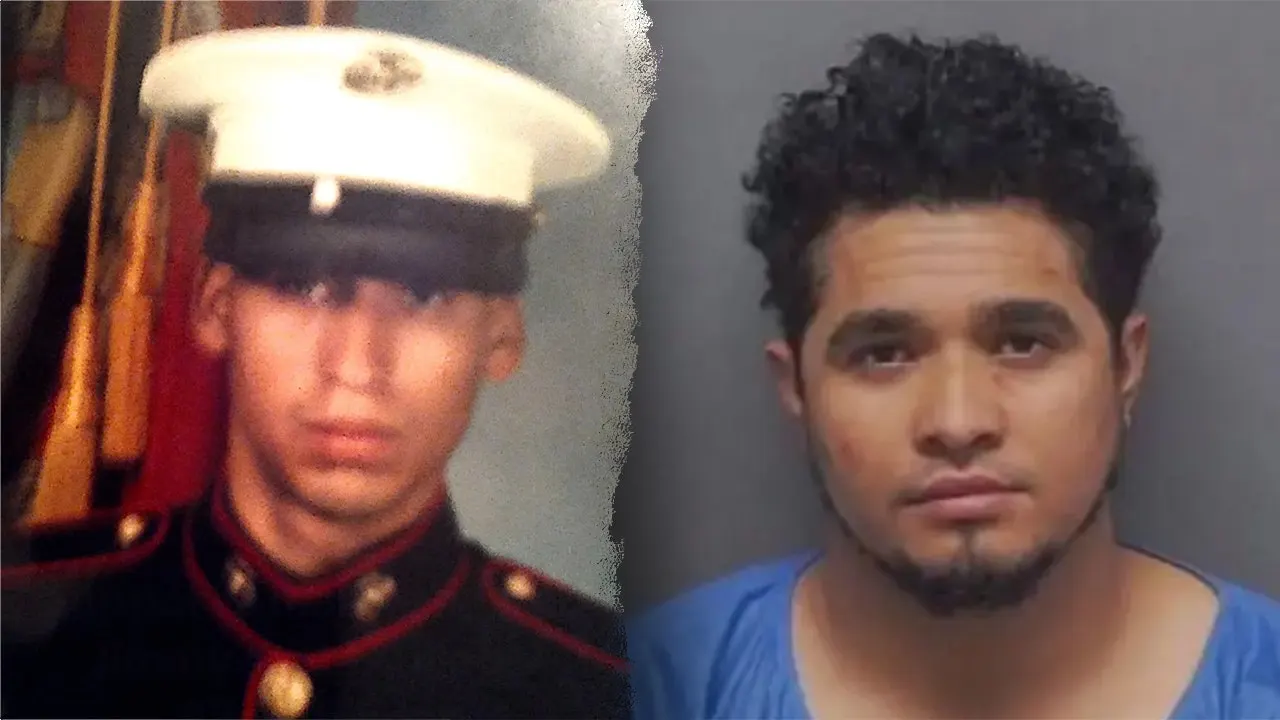
For Jimmy Friesenhahn, the road to a court date was never going to be easy. A Marine combat veteran who had served multiple tours overseas, he had seen danger before, but nothing could have prepared him for the violence that would forever alter his life in the unlikeliest of places: a San Antonio sports bar. On May 4, 2025, Friesenhahn was working as a security guard at El Patio Sports Bar when he noticed a man approaching the entrance with a gun in his pocket. His instincts as a protector kicked in. He stepped forward to stop the man from entering the crowded venue, and in that moment, a struggle erupted. The confrontation turned deadly in seconds: the man, later identified as Wilmer Vladimir Ruiz Ortega, allegedly fired multiple rounds. Two bullets were stopped by Friesenhahn’s ballistic vest, but a third found its way to his neck. That single round rewrote the script of his life in a way no overseas deployment ever had. It left him paralyzed, unable to speak, and dependent on round-the-clock medical care. The courtroom, though, was supposed to be a place where he could finally confront his alleged attacker, to have his presence tell the story his voice no longer could. That moment was scheduled for next week, until a sudden and severe medical crisis pulled him away once again.
Friesenhahn’s sister, Becky Borjon, told Fox News Digital that her brother has been hospitalized for at least a week due to complications stemming from a blood clot that emerged after a surgery he underwent on August 28. The surgery itself was already part of an arduous road—he had spent three weeks in inpatient rehabilitation afterward, fighting through the grueling, exhausting work of trying to gain back anything his body had lost. But just when it seemed like he might be strong enough to take the stand, his body turned on him. “We encountered some medical setbacks, and he’s been hospitalized for a week now,” Borjon said. The timing could not be more devastating. Trial is scheduled to begin on September 20 in a Bexar County courtroom, with jury selection expected to kick off the proceedings. Friesenhahn was slated to appear and testify on his own behalf, a moment of profound importance for a man who has been robbed of the ability to speak. His family is still holding on to hope that he will be able to make it, but they also understand the fragility of his condition. “Jimmy was expected to appear and testify on his own behalf, and we are still hoping he will be able to do that,” Borjon said. But hope, for this family, has become a complicated word. They are not hoping for a recovery that will never come. They are hoping for small victories: a stable day, a successful testimony, a verdict that finally acknowledges the weight of what was taken.
The man accused of shattering Friesenhahn’s life is Wilmer Vladimir Ruiz Ortega, a 29-year-old Honduran national. He faces charges of aggravated assault against a security officer and illegal entry into the United States, and he is also the subject of federal immigration proceedings. Authorities say Ortega was the man Friesenhahn confronted at the bar, the man who allegedly pulled the trigger and left a decorated veteran fighting for every breath. But for Friesenhahn’s family, the tragedy is made even harder to accept by the details of Ortega’s past. Court records show that this was not a man who simply slipped through the cracks; he had been arrested repeatedly in Texas. In October 2020, he was arrested for driving while intoxicated. In August 2023, he was arrested again for a probation violation. Then came two more arrests for failing to appear in court, including one in November 2024. His last court appearance was in March 2025—just weeks before Friesenhahn was shot. For Borjon, the pattern is a damning sequence of missed opportunities. “I’m not opposed to immigration, but there is a process set in place for a reason,” she said. “This guy was arrested multiple times, released on bond and never reported. He had active warrants for repeated offenses while missing court appearances.” She wonders aloud, as any family member would, whether her brother’s fate could have been prevented. “Those warrants should have been acted upon, and maybe we wouldn’t be here today. This guy should have been returned to his country.”
The family’s anger is not aimed at immigration itself, but at a system they believe failed to enforce its own rules. Emmanuel Martinez, Friesenhahn’s brother-in-law, put it bluntly: “His last court appearance was in March 2025, and Jimmy was shot on May 4, 2025. At that point, the DA’s office should have complied with removal orders and turned him over to Immigration and Customs Enforcement.” The implication is a crushing one—that Ortega was allowed to remain in the community despite a string of arrests and missed court dates, and that it was only a matter of time before his alleged criminal conduct escalated to something catastrophic. For the family, every detail of Ortega’s history reads like a warning sign that was ignored. The repeated arrests, the failures to appear, the active warrants—all of it should have led to law enforcement taking action, Borjon argued. Instead, a man with a gun walked into a bar, and a Marine veteran who tried to protect others paid the ultimate price. The Bexar County District Attorney’s Office has declined to comment on the status of the case, leaving family members to wonder what happened between those March court proceedings and the spring morning when their lives changed forever. They are not asking for revenge, they say, but they are asking for answers—and for a legal process that treats the loss of a life, even a life that continues, with the seriousness it deserves.
This is not a story about politics, although it touches on one of the most divisive issues of the day. It is not a story about statistics, although immigration enforcement numbers and recidivism rates hover in the background. It is a story about a man, a family, and the very real cost of a bullet fired on a Texas evening. Friesenhahn served his country overseas, putting himself in harm’s way in ways most civilians will never know. He came home and continued to serve, standing guard at a local business to protect patrons who were just looking to have a good time. On that May night, he saw a gun and made a split-second decision to act. That decision likely saved lives inside the bar. It also cost him nearly everything else. The fact that he was scheduled to testify next week is itself a testament to his willpower. Even in a hospital bed, tethered to machines, unable to speak, he was preparing to do one more hard thing: to show up in court and face the man who took his future. The road to that courtroom has been littered with surgeries, rehabilitation, setbacks, and moments of profound despair. And now, a blood clot has thrown the plan into chaos. Yet his family is not wavering. They will be there, with him or for him, through jury selection, testimony, and every stage of a trial they hope will deliver a measure of justice, even if it cannot deliver healing.
The reality, the family acknowledges, is that there is no going back. “Unfortunately, we don’t see this as a road to recovery because there is no recovering from an injury like this,” Borjon said. “We see it as the beginning of a lifelong fight.” Those words carry the weight of truth. Friesenhahn will never walk again. He will never marry, never raise children, never experience the quiet joys that most people take for granted. His life will be defined by caregivers, appointments, and the relentless management of a body that no longer obeys his commands. The trial, when it happens, will not restore any of that. But it matters. It matters because Jimmy deserves to be more than a victim in a police report. It matters because the community needs to see that a man who once wore the uniform of this country is not forgotten. It matters because the system that failed him should also be the system that, however imperfectly, seeks to hold his alleged attacker accountable. So the family waits, prays, and watches over a hospital bed, hoping that the next update is good news, hoping that he will rally one more time. In the meantime, they carry his story forward—the story of a Marine, a brother, a son, a protector who gave everything and asked for nothing in return. It is a story that deserves to be heard, in full, in every detail, not just as a case number or a headline, but as a human life forever changed by a moment of violence that should never have happened.