



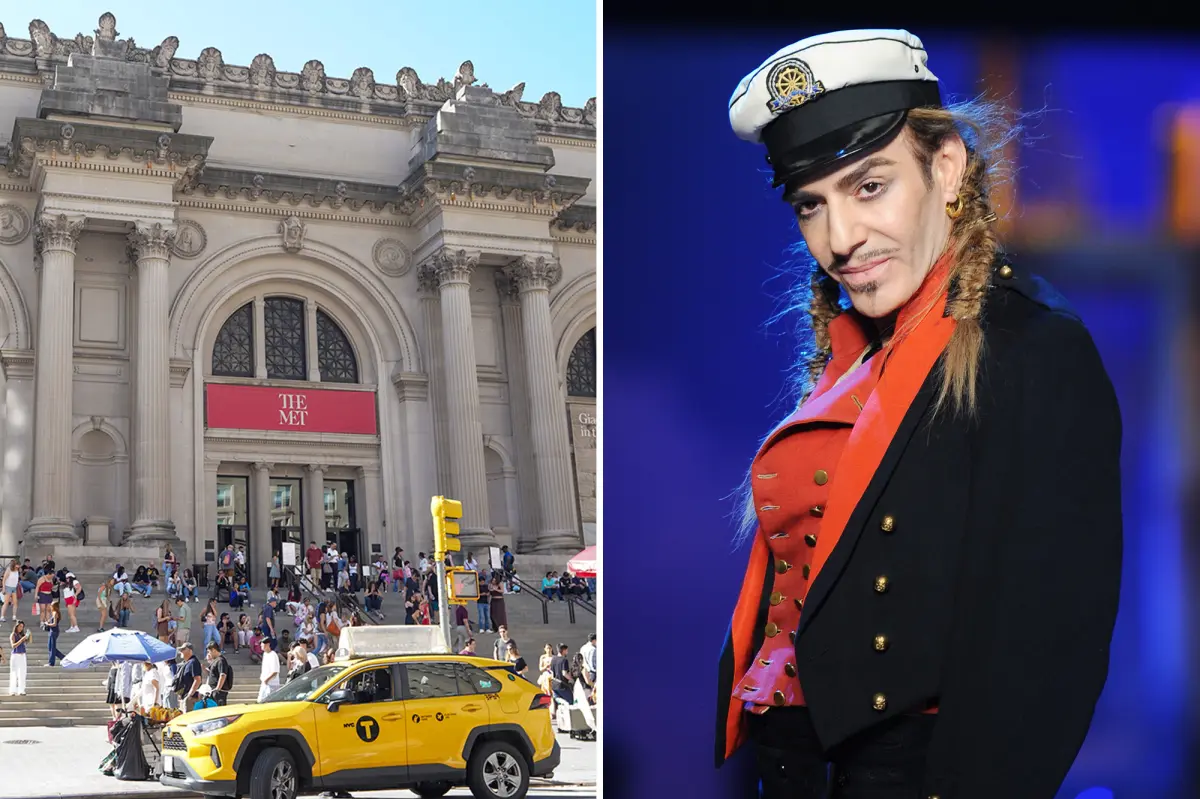
It was one of those moments when an enormous institution suddenly seemed very small. On a Monday evening, with phone lines and video boxes glowing, the leadership of the Metropolitan Museum of Art in New York convened an emergency Zoom meeting with its wealthiest and most influential trustees. The atmosphere, according to people who were in the room, was thick with embarrassment and something close to shame. Chief executive Max Hollein and billionaire board co-chair Tony James essentially surrendered. They said plainly that the museum had made a mistake in choosing John Galliano to be honored at the upcoming Met Gala and in the costume exhibition attached to it. They did not try to spin the selection or defend it as daring. They admitted that the process had failed, and that the wrong decision had been made. The timing only made the sting sharper. Galliano had already announced that he would withdraw from the ball and from the specially curated exhibition, but his withdrawal did not erase the institutional wound. The Met is not just a collection of galleries; it is a moral brand, a cultural arbiter, and a fundraising machine. The gala is its most visible night, the evening when fashion, celebrity, and finance come together to polish the museum’s image and fill its coffers. To have that glittering pageant transformed into a national argument about antisemitism was a failure of staggering proportions. The trustees in the meeting were described as fuming, and the leadership’s red faces were visible even through a screen.
During the hour-long discussion, Tony James went further than a simple apology. He reportedly acknowledged that Galliano, now 65, was the wrong person at the wrong time, especially because antisemitism is surging in the city and across the country. That concession mattered because it placed the scandal in a moral context, rather than reducing it to a matter of taste. This was not a debate about an edgy fashion figure or an unconventional choice. This was about a museum choosing to celebrate a man with a French criminal conviction for antisemitic insults, a man who had once been heard on camera saying that he loved Hitler. New York City Council Speaker Julie Menin, an ex officio trustee who had become one of the most persistent voices against the plan, spoke during the meeting and made the same case. But the session had a strange asymmetry. While the leaders were willing to call their own decision-making into question, they were not willing to question Anna Wintour, the Vogue editor who has long controlled the gala and who remained loyal to Galliano. In fact, sources said people were complimentary of her. The leadership felt grateful that Galliano had bowed out on his own, sparing the museum the awkwardness of having to rescind the honor. No replacement theme for the gala was chosen. No new artist was proposed. Instead, the conversation drifted into broader soul-searching about what the Met values. That may sound noble, but at the moment it had the quality of improvisation. The institution was inventing its response as it went along, reacting to public anger rather than leading with conviction.
To understand the fury, one has to remember why Galliano’s name is so charged. In his prime, he was a fashion magician, the creative force behind Dior, famous for shows that were less presentations than theatrical dreams. But in 2011, a video surfaced showing him in a Paris cafe, spewing antisemitic abuse at patrons who happened to be nearby. One of the most damaging images from that incident was his shouted declaration that he loved Hitler. The remark was not a private joke; it became part of a criminal case, and he was convicted in France. Galliano later explained that he had been drowning in alcohol and drugs, that he was not in control of himself, that he had no real memory of parts of the period. He went to rehab, issued public apologies, met with Jewish leaders, and slowly attempted to reenter the world. Some people accepted his explanations. But years later, in 2019, a fashion publicist recounted an encounter in which Galliano allegedly sneered at her friend for speaking Hebrew, a story he strongly denied. That allegation was never resolved in court, and perhaps never will be. But it meant that when the Met decided to honor him, it was not embracing someone with one isolated mistake. It was embracing someone with a pattern of accusations and a public history of antisemitic speech. The museum’s own curators would never have mounted an exhibition around such a figure without rigorous debate. The gala selection process, by contrast, appeared to have bypassed that debate entirely.
To understand why no one challenged Wintour in the meeting, one has to understand her singular position. She is the person who transformed the Met gala from a fundraising dinner into a global media spectacle. With her bob, her sunglasses, and her ruthless efficiency, she has become a symbol of fashion’s power structure. When Galliano fell, Wintour did not behave the way most corporate executives would. She stood by him. She kept him in the conversation, helped him find work, and watched him produce some of the most discussed collections of his late career. Perhaps she saw him as a wounded genius; perhaps she believed in redemption. When he withdrew from the Met honor, Wintour called the decision courageous. That single word irritated critics who pointed out that there was nothing brave about withdrawing from an honor that should never have been offered in the first place. But inside the trustees’ meeting, no one challenged her. Sources said people were complimentary of Anna. It was as if the institution had decided that its own top executives could be held accountable, but the unofficial queen of fashion could not. That is not a sustainable system. It preserves Wintour’s authority and Galliano’s access, but it leaves the museum without a meaningful process. The question is not whether Anna Wintour is a good or bad person. The question is whether one unelected person should be able to make a decision of this magnitude without oversight. After Monday’s meeting, that question remains unresolved.
Alice Tisch, a Met donor who does not sit on the board but who clearly loves the institution, captured the wider meaning of the scandal in an interview after Galliano stepped away. She called it a two-part problem. The first was Jewish. At a moment when antisemitic incidents are rising on streets, on campuses, and online, the Met chose to put a man convicted of antisemitic insults on a pedestal. The great Jewish collections at the Met—the Lehman, the Gelman, the Annenberk—are not decorative footnotes. They are load-bearing walls in the museum’s history and identity. A significant share of the museum’s donors, curators, and audience members are Jewish. To honor Galliano was, in Tisch’s words, a problem as Jewish as it was institutional. But the second part, she said, was governance. She insisted that donor influence and curatorial judgment must be kept separate. “You can’t have one donor to the museum, whether they’re a trustee or not, saying ‘We’re going to do this show, this is an artist we need to promote,’” she argued. “It’s got to come from curatorial. There’s got to be church and state.” She also noted that the Met was showing Lee Krasner and Jackson Pollock at the same time, and she posed a question that seemed to haunt the entire affair: what would Lee Krasner, a Jewish artist and a woman of political conscience, say to a museum that had planned to honor Galliano? It is a question the museum has not yet answered with the seriousness it deserves.
In the days ahead, the Met will have to do more than schedule another meeting. The gala will probably proceed, because the machinery is too large to stop, but it will proceed under a shadow. The institution’s relationships with Jewish donors, with Jewish artists, and with the wider public have been damaged. An admission made in a private Zoom call is not the same as accountability to the public. The museum needs to demonstrate that it has learned the difference between process and publicity. It needs to broaden the groups that choose honorees and themes. It needs to restore curatorial independence. It needs to make clear that no single powerful figure, however essential to the fund-raising ecology, can override the institution’s values. And it needs to do something visible for the Jewish community—not as performance, but as genuine commitment. Perhaps that means a major exhibition of Jewish art, or a scholarly series on antisemitism, or a transparent public process for future honorees. The question Alice Tisch raised—what would Lee Krasner do?—is the right one. Krasner was a Jewish artist who believed that art and conscience were inseparable. She would not have accepted a private apology. She would have insisted on reform. The Met is one of the greatest museums in the world. It holds works that testify to the beauty of Jewish culture and to the horrors of hatred. By choosing Galliano, it betrayed its own collection. By admitting the mistake, it began to make amends. But the road back to trust is long. Whether the museum walks that road, or merely talks about it, will determine whether this scandal is remembered as a failure or as the moment the Met remembered what it was for.