





The Unraveling of a Neighborhood Sanctuary: When Chaos Claims a Children’s Playground
In the heart of Manhattan’s fashionable Meatpacking District, where luxury condominiums command millions and celebrities call the neighborhood home, an alarming crisis has taken root at the Gansevoort Peninsula—a $73 million, 5.5-acre waterfront park that was envisioned as a pristine escape for families and their children. Instead, this once-idyllic sanctuary has become a stage for disturbing behavior that has left parents terrified and searching for answers. The park, which opened its doors to the public just two years ago with promises of providing a green oasis complete with sports fields, sandy beaches, and scenic boardwalks, has instead become a haunting backdrop where young soccer players as young as five years old find themselves sharing space with individuals displaying increasingly erratic and threatening behavior.
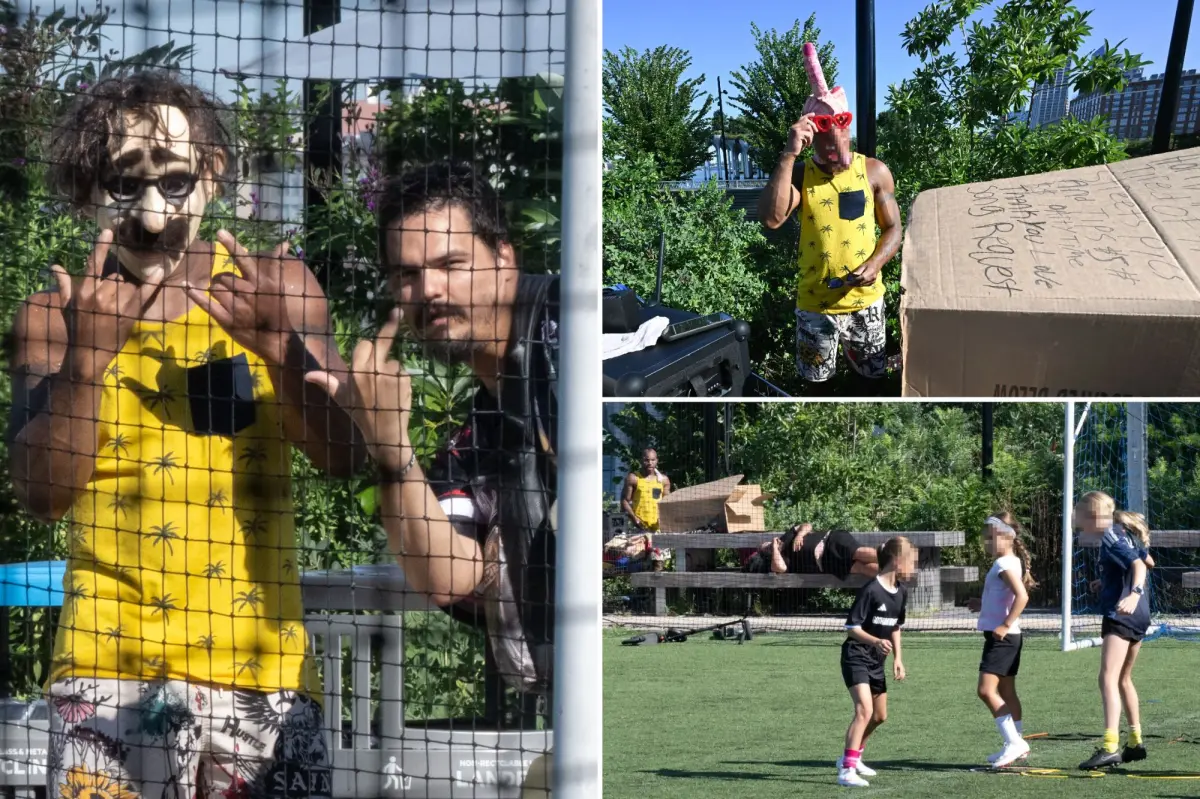
The situation reached a fever pitch this week when an eyewitness reported seeing a man wearing a grotesque mask—featuring a protruding penis shape where his nose should be—positioned less than twenty feet from where young girls were practicing their soccer drills. The individual, who appeared agitated and unpredictable, stripped off his shirt, exposing a “thug life” tattoo across his stomach and additional markings depicting pistols and skulls on his back, before erupting into a screaming fit that shattered the morning peace. The chaos began around nine in the morning, a time when families typically feel safest in public spaces, and the man’s unprovoked outburst left both children and their watching parents shaken. When he finally removed the disturbing mask, what remained was perhaps even more unsettling—a face adorned with thirty piercings, including a metal ring between his eyes and clusters of studs encircling his mouth, eyebrows, and eyes, creating an appearance that witnesses described as genuinely frightening.
The scene that unfolded represents just one snapshot of an ongoing nightmare that local families have been enduring for months. The group of vagrants, whose numbers fluctuate but can swell to a dozen or more, have established a troubling routine that begins with drinking at a nearby Mobil gas station on Eighth Avenue before making their way to the park, where they have effectively claimed the space as their own personal domain. Their activities range from the merely obnoxious to the deeply disturbing—public intoxication, aggressive panhandling, threats against park workers, and behavior that no child should ever witness, including one incident where two individuals engaged in graphic sexual activity on a park bench in broad daylight, completely indifferent to their surroundings and the families nearby who were forced to witness the spectacle.
Jason Fernández, a father whose daughter practices with the Gotham Girls Football Club, expressed the collective anguish of the parent community when he spoke about the deteriorating conditions. “It’s extremely concerning,” he said, his voice carrying the weight of frustration and fear. “Nothing is being done.” His words echo the sentiment of countless other parents who have watched helplessly as their children’s safe haven has been slowly eroded by chaos and neglect. Fernández recounted how the man in the penis mask began waving at the girls during practice, a moment that sent a chill down his spine and prompted him to return to the field out of an instinctual protective urge. “When it comes to the kids, something has to happen,” he emphasized, his frustration palpable. “These men need help, but obviously they’re not getting it and because of that everyone else has to suffer.”
The situation highlights a broader societal failure that extends far beyond this single park, raising uncomfortable questions about how cities balance compassion for the homeless and mentally ill with the fundamental right of families to feel safe in public spaces. The Gansevoort Peninsula, situated across the West Side Highway from the prestigious Whitney Museum in a neighborhood where a penthouse recently sold for $18 million, has become a stark symbol of urban disparity and the challenges communities face when struggling with homelessness and mental health crises. Parents like Fernández find themselves caught between empathy for those clearly in need of help and the instinctive drive to protect their children from exposure to behavior that is not only inappropriate but potentially dangerous.
The incidents at the park have created an atmosphere of constant vigilance and anxiety among the families who use the facilities. Soccer coach Saad Afif, who operates Manhattan Football Training and conducts regular practices at the location, has become all too familiar with the disruptive presence. “Gansevoort is the worst one because you get crazy homeless people around the field,” he explained, describing how the open design of the park makes it impossible to create distance or barriers between the children and the unwanted interlopers. “Here it’s out in the open and you can just walk up,” he continued, recounting multiple instances where he had to intervene to remove individuals who had wandered too close to the young athletes. The constant need for vigilance, the repeated interruptions to practices, and the psychological toll on both children and coaches has created an unsustainable situation that parents feel powerless to change.
Perhaps most disturbing of all is the pattern of behavior that has emerged around the park’s facilities, where vagrants have been observed using the public bathrooms in ways that expose children to inappropriate sights and situations. A frustrated parks worker, who spoke on condition of anonymity, described a recurring problem where individuals would wash up naked in the restrooms even as children were trying to use the facilities. “There’s a lot of things the kids see that they shouldn’t be seeing,” the worker lamented, highlighting the impossible position that parks employees find themselves in. Despite being called repeatedly to address these situations, the workers feel they lack the authority and resources to permanently solve the problem, while the city agencies theoretically responsible—the Department of Homeless Services for providing assistance and the NYPD for addressing public intoxication and disorderly conduct—appear to be either unaware of the severity of the situation or unwilling to intervene effectively.
The disconnect between the reality on the ground and the official response is stark. When contacted about the situation, the Department of Homeless Services claimed that the park was “not a known hotspot” but pledged to “monitor this location and offer shelter and services to any vulnerable individuals” encountered. However, this commitment rings hollow to the parents and workers who face these disturbances daily and have watched the situation deteriorate despite multiple calls for help. The NYPD, for its part, reported no incidents at the location this year and no 311 complaints had been filed, suggesting either a failure of reporting mechanisms or a lack of follow-through on those reports that were made. Meanwhile, the homeless encampments that were twice dismantled last summer have apparently reformed, with the individuals becoming increasingly bold in their behavior, as if emboldened by the lack of meaningful consequences for their actions.
The situation has not only affected park users but has also put local business owners and workers on edge. A 26-year-old food kiosk worker described being regularly threatened by the same individuals who harass park visitors. “They get aggressive and start threatening and intimidating,” he said, recounting how they would claim to have weapons in their bags or make explicit threats of violence. “It happens about twice a week almost always the same people. They want free food and unfortunately, it’s a business we can’t,” he explained, caught between the desire to help those in need and the reality of running a business where giving away merchandise freely would be unsustainable. The threat of violence, he suggested, was always present, creating an atmosphere of constant fear and tension.
As the chaos unfolds, parents find themselves resigned to a cycle that seems impossible to break. Lee, another parent whose daughter plays for the Gotham Girls Football Club, summed up the shared sense of frustration and helplessness. “The parks people come around every now and then, but the homeless just leave and come back 10 minutes later,” she observed, capturing the maddening reality that temporary solutions achieve nothing in the face of an ongoing crisis. The pattern is clear—security personnel arrive, the vagrants scatter, and they return as soon as the threat of authority has passed, only to resume their disruptive behavior with what appears to be growing confidence. For the children who simply want to play soccer, for the parents who want nothing more than to watch their daughters enjoy a game in safety, and for the workers who must navigate this minefield daily, the situation has become an unacceptable new normal. The question remains: how much longer will the community have to endure before meaningful action is taken to address the root causes of this crisis and restore this public space to the families it was designed to serve?