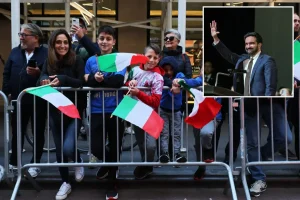


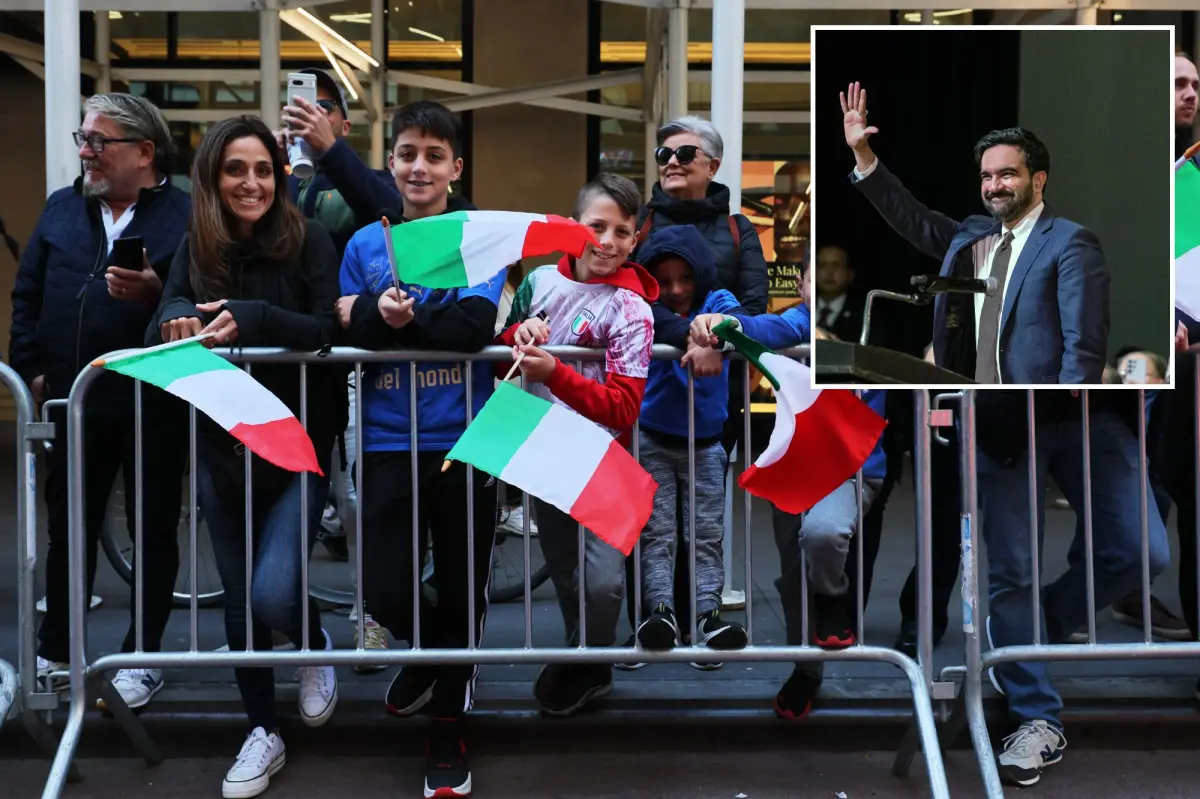
On a crisp October morning, Fifth Avenue in Manhattan is supposed to look like a moving postcard of Italian-American pride. Bands tune their instruments, floats are polished, and families in red, white, and green line the curbs, waving flags and waiting for the sounds of “O Sole Mio” to drift through the air. The Columbus Day parade has been a New York institution for nearly a century, a day when the city’s Italian-American community steps out of the shadows and into the sunlight, claiming its place in a city that once looked down on it. But this year, there is a conspicuous absence. Mayor Zohran Mamdani has decided not to attend. The news came not as an explosion, but as a quiet confirmation of something many in the Italian-American community already felt deep in their bones: this mayor does not see them, does not honor them, and will not show up for them. The phrase “no amore lost” barely captures the frost between City Hall and the proud descendants of Sicilian fishermen, Neapolitan bakers, and Calabrian stonemasons. The relationship is not just cold; it has been simmering with hurt, resentment, and a painful sense of being pushed aside in the city their grandparents helped build. The parade snub is the latest wound, and it is one that many will not forget easily.
To understand why this absence cuts so deeply, one has to understand the complicated history of Columbus himself in the Italian-American imagination. For many people today, especially younger progressives, Christopher Columbus is not a hero but a colonizer, a man whose arrival in the Americas set off centuries of displacement, enslavement, and violence against Indigenous peoples. Mayor Mamdani has been vocal on this point, once going so far as to give the middle finger to a statue of Columbus in Astoria, Queens, in a June 2020 social media post with the blunt command: “Take it down.” That image is seared into the memories of Italian-American civic leaders. To them, it was not merely a critique of a historical figure; it was a slap at a symbol that their ancestors embraced as a badge of survival. In the late nineteenth and early twentieth centuries, Italians were not warmly welcomed in America. They were called racial slurs, excluded from jobs, sometimes lynched in the South, and subjected to nativist suspicion in the cities. They were Catholics in a Protestant country, dark-haired and olive-skinned in an era that preferred Northern European stock. In response, Italian immigrants rallied around Christopher Columbus as a way of saying: We are not the other. We have a hero too. He discovered your America. We are part of this nation’s origin story. For generations, the statue on Columbus Circle and the parade up Fifth Avenue were not just celebrations of a man; they were declarations of belonging. When the mayor flips off that statue, the gesture hurls more than anger at history. It dismisses the very scaffolding upon which a community built its claim to full American citizenship.
The community’s leaders did not mince words when told of the mayor’s decision to skip the parade. Angelo Vivolo, chairman of the Columbus Heritage Coalition, an umbrella group representing more than fifty Italian-American organizations, spoke with a mixture of fatigue and fury. “He’s disrespectful to the Italian-American community and not coming to the Columbus Day parade confirms it,” Vivolo said. He acknowledged that Mamdani has never hidden his disdain for Columbus, but he stressed that the parade is not solely about the explorer. “We know he hates Columbus. But the parade celebrates the rich culture and heritage of Italian-Americans.” That is the essential misunderstanding at the heart of this conflict. To the outside world, the parade is about a controversial explorer; to the Italian-American community, it is about grandmothers rolling meatballs, grandfathers laying brick and concrete, and the millions of small, uncelebrated contributions that helped make New York City the greatest city on earth. Italian-Americans served in the police and fire departments, built the bridges, sewed the garments, opened bakeries, and started labor unions. They fought in America’s wars and came home to neighborhoods like Bensonhurst, East Harlem, and Belmont. To hear that the city’s mayor cannot stand beside them for a few hours feels like a public announcement that their sacrifices no longer matter. It is one thing to disagree with a historical symbol; it is another thing entirely to signal that the people who revere that symbol are beneath your presence.
The hurt deepened earlier this year when Mamdani’s office released an ethnic enclave map meant to celebrate the city’s diverse communities. The map highlighted little-known cultural pockets across the five boroughs, but conspicuously left out two of the most famous Italian neighborhoods in America: Manhattan’s Little Italy and Arthur Avenue in the Bronx. For the Italian-American community, this omission was not an innocent oversight. It felt deliberate, a bureaucratic death by erasure. Little Italy may be smaller than it once was, but it remains a pilgrimage site for Italian-American identity from around the world. Arthur Avenue is even more sacred. Often called the “real Little Italy,” it is the Bronx street where butchers still hang prosciutto, bakeries still sell pignoli cookies, and residents still greet each other in dialects that trace back to the old country. To leave both out of a map designed to celebrate ethnic enclaves is to say, in the clearest possible terms, that Italian-American culture no longer counts. And to make matters more confusing, Mamdani did release a nearly three-minute video statement celebrating Italian Heritage Month. In the video, he paid tribute to Italian immigrants who helped build the city, and he specifically honored East Harlem Representative Vito Marcantonio, a passionate advocate for Social Security, unemployment benefits, and civil rights. It was a thoughtful and historically accurate tribute, and it only made the community angrier. How can the mayor praise Italian heroes like Marcantonio in one breath and refuse to attend the community’s biggest civic celebration in the next? How can he celebrate Italian heritage at all when he has spent years trying to tear down its most visible symbol? To many, the video felt like a corporate apology letter: read aloud, unchosen, and quickly forgotten. It did not heal the fracture. It widened it.
The mayor’s decision to skip the Columbus Day parade is also part of a broader pattern that worries many New Yorkers. Mamdani, a staunch critic of Israel who has accused the Jewish state of genocide, also boycotted the Israel Day parade in May. His supporters see this as principled consistency: he will not march in celebrations that he believes honor oppressive systems. But his critics see something more troubling: a mayor who only shows up for communities whose politics align with his own, and who treats public spectacles as political endorsements rather than civic duties. The mayor is not an activist writing a social media post; he is the chief executive of a city of more than eight million people. In New York, a parade is not a moral judgment on the mayor’s personal beliefs. It is an acknowledgment that this group, this culture, this history, is part of the city’s fabric. When he skips these events, he tells thousands of citizens that their joy, their pride, and their pain are not worth his time. For Italian-American leaders, the pain is particularly acute because they remember a time when their community was the outsider, when being Italian in America meant being mocked as a gangster, a buffoon, or a cheap laborer. The parade is their once-a-year opportunity to stand tall and be counted. The mayor’s absence is therefore not merely ceremonial. It is a message, and the message is heard loud and clear: the old white ethnic communities of the city no longer matter in the new coalition politics of New York. They feel discarded, not because they have disappeared, but because their neighborhoods, their traditions, and their symbols are considered inconvenient to a modern progressive agenda.
And yet, the deepest human truth of this story is that both sides are living in different emotional worlds. The mayor, for his part, sees Columbus and the parade as symbols of a painful legacy of colonialism and Indigenous suffering. He could not in good conscience stand before a statue of a man he regards as a mass murderer and pretend to celebrate. That is an honest position, and there is something respectable about his refusal to be a hypocrite. But what he and many of his supporters fail to understand is that the Italian-American community is not standing on Fifth Avenue to honor slavery or violence. They are standing there to honor the courage of their ancestors, many of whom were themselves poor, despised, and marginalized. Columbus, for them, has become a vessel for their own story of survival. When the mayor assaults that symbol, he is not challenging a history of oppression; he is wounding a living people who have spent a hundred years fighting for dignity. The challenge for New York, then, is whether this city can find a way to honor Italian-American heritage without requiring everyone to praise Columbus, and to acknowledge Columbus’s crimes without wounding the people who adopted him as their standard. Perhaps the parade could expand its name and scope to embrace all who came after the explorer, or perhaps Italian-American organizations could themselves lead a conversation about their own reckoning with history. But that kind of growth requires trust, and trust requires showing up. A mayor does not have to agree with every group to attend their celebration. He only has to respect them. On Monday, as the bands play and the flags wave on Fifth Avenue, the crowd will notice the empty space. Some will call it a welcome absence, others a betrayal. Both sides will walk away feeling unheard. And beneath the politics, there is simply a human longing that every New Yorker knows too well: the desire to be seen, to be honored, and to know that your family’s history matters in the city your grandfather helped raise. Until the mayor can deliver even that, the amore between him and the Italian-American community will remain lost.