


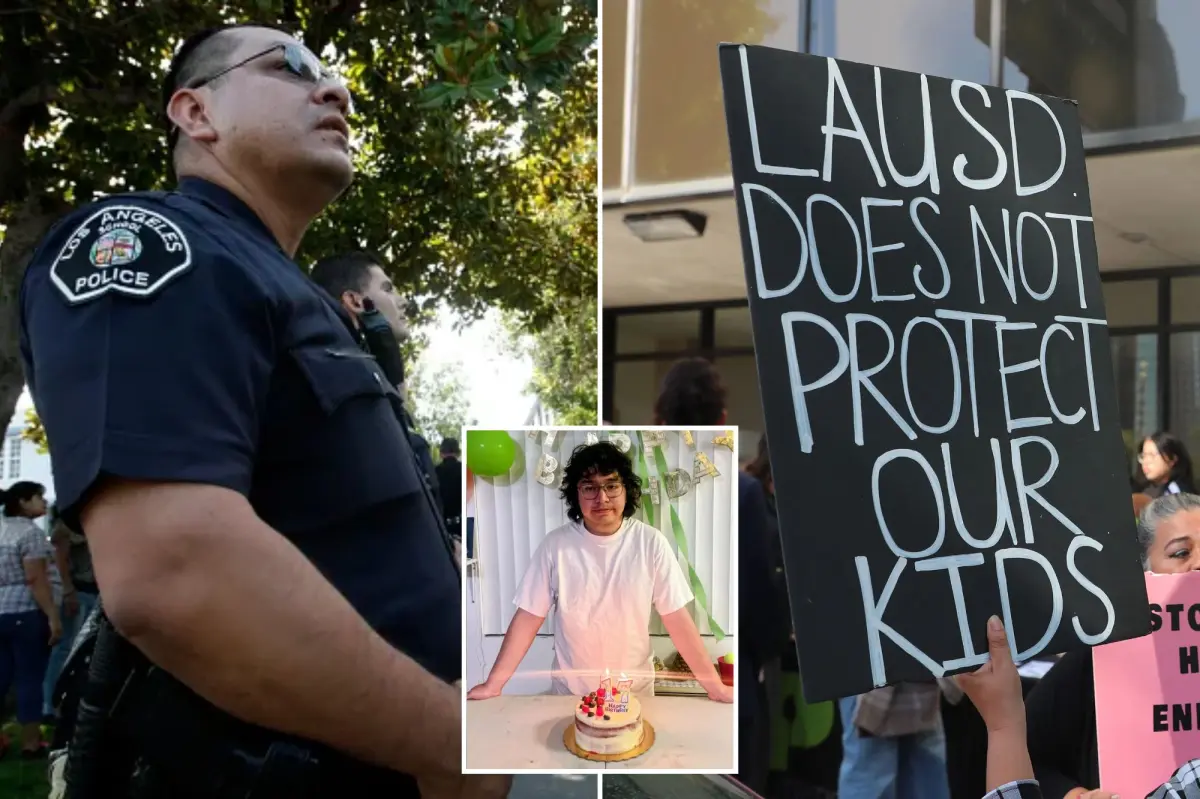
The morning air at Franklin High School in Highland Park still carries the weight of a loss that has shaken an entire community. On September 30, Xavier Nungaray-Martinez, a 17-year-old junior, walked out of a classroom after a fight caught on cellphone video, made his way to a fourth-floor corridor, and climbed over the railing. He jumped, sustaining blunt traumatic injuries to his head and torso that would take his life. The Los Angeles County Medical Examiner ruled the death a suicide, but Xavier’s family refuses to accept that explanation. They describe a teenager who was not suicidal, who loved music and his friends, and who had been struggling with bullying at school. His father, William Amaya, a 40-year-old alumnus of Franklin High, told reporters that no one in their right mind would leap from the fourth floor, and he believes the tragedy could have been prevented if police officers had been stationed on campus. That raw, aching conviction has set off an urgent movement among parents, police unions, and even students who are demanding that the Los Angeles Unified School District reverse its controversial decision to remove full-time school police officers from campuses and replace them with what are called “climate coaches.” The loss of Xavier has become the breaking point for a community that has watched school safety erode, fights become more violent, and bullying numbers climb year after year.
Five years ago, LAUSD made a seismic shift in how it approached school safety. In February 2021, amid nationwide protests and demands for racial justice, the district cut $25 million from its school police budget, eliminating 133 sworn positions—roughly 28 percent of the force. The money was redirected to a $36.5 million Black Student Achievement Plan that funded the hiring of “climate coaches,” staff members trained to manage student behavior through restorative practices rather than law enforcement. Activist groups, including Black Lives Matter and the California Association of Black School Educators, had pushed for the change, arguing that police on campus criminalized Black students and perpetuated systemic racism. The district framed the move as a reimagining of school safety, one that emphasized mental health and conflict resolution over handcuffs and citations. But the effect on the ground was dramatic: the district still has 262 sworn officers, but they are no longer assigned to individual schools. Instead, they patrol clusters of campuses, forced to divide their time among multiple sites. Schools that once had a familiar officer in the hallway now have none, and many parents say they did not learn about this change until it was too late. The police union, the Los Angeles School Police Management Association, is now loudly supporting the calls from parents to bring officers back full-time. Anthony Stafford, the association’s president, put it bluntly: recent tragedies involving violence, self-harm, and weapons make the need for stronger school safety resources urgent. He argued that every family deserves the peace of mind that their child will return home safely at the end of each school day—a simple promise that now feels broken.
The statistics paint a troubling picture of life in LAUSD classrooms. In the district’s most recent student survey, 17 percent of students said they had been bullied—the highest level since the 2021-22 school year. Reports of physical bullying, defined as shoving, hitting, or kicking, jumped dramatically from 6 percent in the 2024-25 school year to 15 percent in 2025-26, according to figures provided to the California Post. At Franklin High specifically, 11 percent of students reported being bullied, and among seniors, the rate was 8 percent, with 5 percent saying they had experienced physical bullying. Overall, the district documented 5,636 fights and other acts of aggression during the 2024-25 school year—a number that, while slightly below the 5,707 incidents recorded the year before, remains staggeringly high for a learning environment. Behind each of these numbers is a young person who felt unsafe, who endured humiliation or violence, who may have been afraid to walk into school. Parents and school resource officers argue that the absence of visible authority has emboldened bullies and escalated conflicts that could have been broken up early. Without an officer nearby, a shoving match can turn into a brawl, and a brawl can turn into a weapon being drawn. When asked for updated figures, LAUSD did not respond to the Post’s request. A spokesperson instead issued a statement saying the district remains “committed” to engaging students, families, staff, and community partners as it addresses broader fiscal challenges while maintaining safe and supportive schools. The spokesperson acknowledged that the district has proposed further reductions as part of its fiscal stabilization efforts, but insisted decisions about specific positions are made through a careful budget and operational planning process. For grieving parents, that language feels cold and bureaucratic.
Xavier’s family is channeling their grief into action. They have launched a Change.org petition demanding tougher security at Franklin High and across the district. The petition calls for campus police, security cameras, better-trained staff, and safer railings on upper floors. Video from the September 30 incident shows another student striking Xavier inside a classroom while a teacher tries to intervene. After that confrontation, Xavier went into the fourth-floor corridor, where he jumped from the railing. His family says he was assaulted without timely intervention from security staff, and that students filmed both the attack and his fall—turning one of the worst moments of their lives into social media fodder. Xavier’s father, William Amaya, stood outside the school with a trembling voice, recalling his own days as a Franklin student in the early 2000s. Back then, he said, things were different. At least two police officers were on duty at the school, breaking up fights, handcuffing students, and enforcing discipline. He remembered feeling safe because consequences were real and immediate. He said conditions at Franklin have deteriorated badly since his time, and he wants that level of police presence restored. His sister, Stephanie Amaya, 37, went further: “Right now it’s not just bring back the police, it’s bring back the police and have them be on campus every time our kids are on campus right now.” She wants every moment of the school day covered, no gaps, no patrols shared between schools. She wants officers who know the students by name, who can spot trouble before it erupts, who are physically present when a fight begins. Police officers, she argues, are trained to de-escalate, to protect, and to act. The absence of that authority was a slow-moving disaster, and now her nephew is dead.
The debate over school police is not one-sided, and even in the midst of grief, the district is facing a complex set of demands. On one side, parents like Norma Chávez, a mother of two LAUSD students, see Xavier’s death as the final warning. “Police officers represent authority,” she said. “They are reminders of what is not permissible. Most people behave better when they see an officer, even adults. I support campus police. There has definitely been more violence since school police were removed from campus. What is worse is that fights have become more dangerous because they involve knives and guns.” She also expressed deep resentment at the district’s lack of transparency. “We, the parents, did not vote to remove school police. We weren’t even asked,” she said. And the police union is warning of another round of cuts: the LAUSD board is expected to vote on a proposed additional $3.5 million cut to the school police budget for fiscal year 2027-28, with a potential $7 million reduction the following year. “We have not recovered from those cuts and now face even more cuts. Yet, the demand for our services has increased exponentially over the last 5-6 years—even as our resources (training, equipment, personnel) continue to be decreased,” Stafford said. But not every parent organization agrees. Nancy Villarreal, executive director of the Parent Organization Network, a public schools advocacy group, acknowledged that families are right to be concerned, but insisted that increasing police presence alone does not address the deeper issues affecting school safety. Her group supports some security measures but wants more investments in mental health services, conflict resolution, parental involvement, and student input. The tension between those two visions—one calling for order and enforcement, the other for healing and structural change—lies at the heart of the debate.
As the district moves toward what could be yet another reduction in school police staffing, the human toll becomes impossible to ignore. Xavier Nungaray-Martinez was not a statistic; he was a son, a nephew, a student with a future that now will never be realized. His family will never stop grieving, and they will never stop pushing for changes that might save another child. The police union, parents, and even some students are uniting around a simple plea: do not cut safety again. They argue that every day without a full-time officer on campus is a gamble with young lives. At the same time, the district is wrestling with fiscal realities and the legacy of a reform movement that sought to end the over-policing of Black students. The challenge is finding a balance—one that keeps schools safe without turning them into prisons, and that addresses the mental health crises that fuel bullying and violence. Anthony Stafford offered a final warning that cuts through the politics: “School safety is the foundation of student attendance, achievement, and success. Cutting the very personnel and programs designed to protect our children is an unnecessary and preventable risk we simply cannot afford to take.” For the community at Franklin High, that warning has already become a nightmare. A memorial of flowers and candles grows near the campus walkway, and students walk through the halls carrying a grief that no budget meeting can quantify. They want to learn, they want to feel safe, and they want to know that the adults in charge will do whatever it takes to ensure no family has to bury a child again. The question now is whether the district will listen before the next tragedy.