


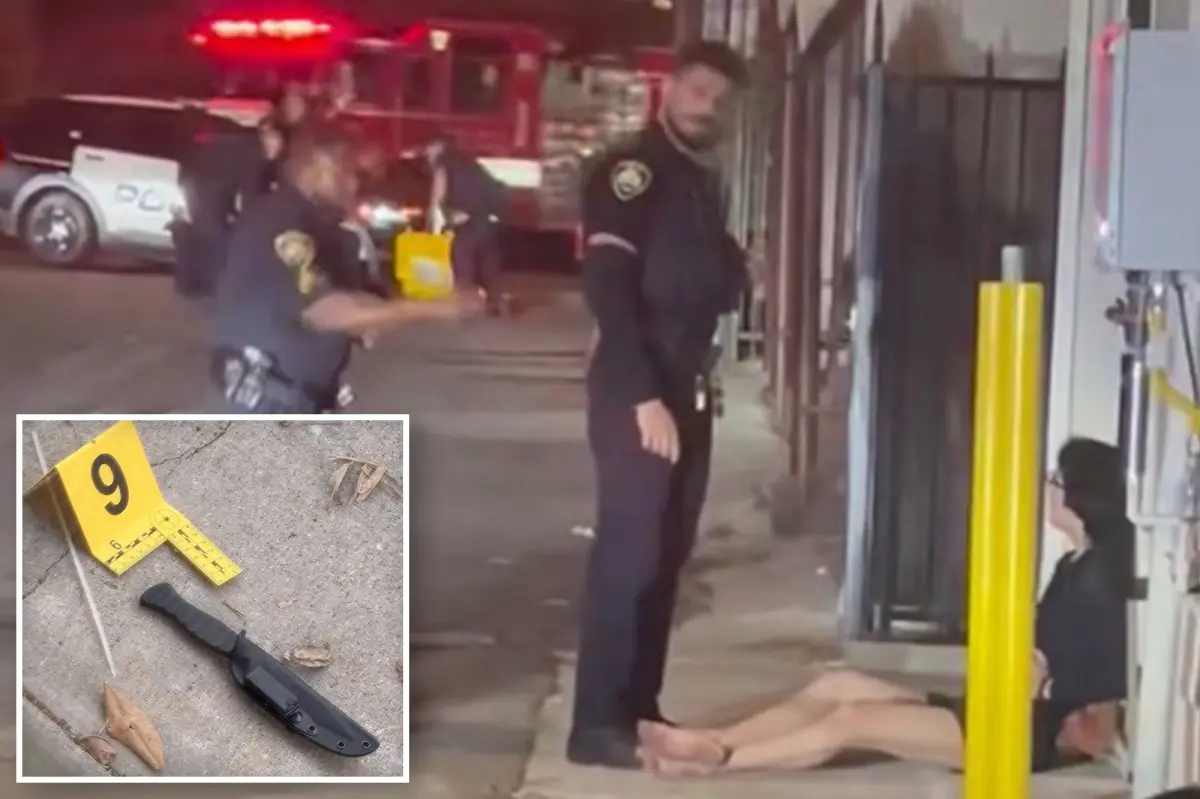
In the quiet, postcard-perfect heart of Beverly Hills, where manicured hedges and pastel-colored apartment buildings line streets that most people only ever see in movies, a brutal and deeply unsettling act of violence has shattered the peace of an upscale neighborhood. A 19-year-old man, Conoray Lawantara, now sits in custody, accused of murdering a homeless man in a narrow alleyway just behind a luxury apartment building on the 400 block of North Palm Drive. The victim, whose name has not yet been released, was found bleeding profusely from a stab wound to the neck, and despite the frantic efforts of paramedics and police officers at the scene, he later died at a local hospital. For the residents of this exclusive enclave, where homes routinely sell for more than two million dollars, the idea of such violence happening so close to their doorsteps is almost incomprehensible. But what has made the case even more disturbing are the videos that have emerged from the scene, showing the accused teenager calmly explaining his actions to police while the man he allegedly stabbed lies nearby, groaning in agony. The juxtaposition of those two images — a young man in handcuffs offering a justification, and a dying man’s last moans — captures the tragedy in all its raw, uncomfortable complexity.
The night began quietly enough, as most nights do in this part of Los Angeles, but just before midnight, a report of a fight involving two men in the alleyway sent Beverly Hills police officers racing toward the scene. It was 11:39 p.m. when dispatchers received the call, and the officers who arrived moments later were met with a chaotic and bloody tableau. There, in the dimly lit alley behind the apartment building, they found Lawantara and an unidentified homeless man, both injured and in need of urgent medical attention. The older man was suffering from a serious knife wound to the neck, an injury so severe that it would ultimately prove fatal. Emergency medical personnel worked quickly to stabilize him at the scene before rushing him to a nearby hospital, but despite their best efforts, he was pronounced dead shortly after arrival. Lawantara was also taken to a hospital, where he remains, being treated for injuries sustained during the altercation. The exact nature of his injuries has not been disclosed, but his hospitalization has kept him under police guard while investigators work to piece together what exactly happened in that dark alley. What began as a quiet neighborhood disturbance had suddenly become a homicide investigation, and the city’s upscale facade had been stripped away, revealing a far more painful and complicated reality.
In the hours after the attack, multiple videos taken at the scene began to circulate, offering a chilling glimpse into the immediate aftermath and giving voice to the accused teenager’s version of events. In one clip, Lawantara is seen sitting on the ground, his hands cuffed behind his back, speaking with detectives in a surprisingly composed manner. He describes the homeless man as the aggressor, claiming that the victim reached for him first and that he acted in self-defense. “He reached for me and at that time I produced a CCW — it’s a 3.9 inch knife,” Lawantara can be heard telling the officers. He insists that he tried to disengage, telling the man to let go of him, but that the man refused and kept pulling at him. In another video, the teenager tells investigators that he attempted to push the man away and walk off, saying, “He kept going after me. I tried going away.” His words paint a picture of a young man who felt cornered, frightened, and left with no choice but to defend himself. But those same videos also capture a far more haunting image: the homeless man lying on the pavement, barely moving, moaning in pain as his life slips away. There is no voiceover, no interpretation, just the visceral sound of a human being in mortal agony. It is that sound, perhaps more than anything else, that humanizes the victim and complicates the neat self-defense narrative, reminding everyone that behind the legal arguments and police reports lies a man whose life ended violently and alone in an alley.
The neighborhood, still reeling from the shock, has begun to piece together the story of the days and weeks leading up to the fatal encounter. Residents say that the alleyway behind North Palm Drive is a place where homeless people frequently pass through, often looking through trash cans for food, bottles, or anything of value. For the most part, neighbors say, they cause little trouble and are simply trying to survive on the margins of a city that often ignores them. On the night of the killing, the victim was reportedly doing just that — going through some trash cans in the alley when Lawantara confronted him. The confrontation, whatever its cause, escalated quickly and violently. What is perhaps most striking to residents is that Lawantara and his girlfriend had only moved into the upscale apartment a few weeks earlier. They were newcomers to the area, young and just starting out, and now their lives have been irrevocably altered by this single act of violence. The tragedy is a collision of two very different worlds: a privileged young man with a knife he describes as a concealed carry weapon, and a homeless man with nothing but the clothes on his back and the contents of a trash can. In the aftermath, neighbors described the scene as something out of a crime television show, with “pools of blood all around” and police desperately trying to revive the victim. “The police were trying to revive this poor man that was lying there with blood, like it was in CSI,” one neighbor said, the disbelief still audible in their voice.
This killing, however, is not just a local tragedy; it is a stark reminder of the deep and growing fault lines in American life. On one side is a city of unimaginable wealth, where the streets are immaculate and the houses are gated, where residents pay premium prices for the privilege of safety and beauty. On the other side is a visible and growing homeless population, people who sleep in alleys and sift through garbage, who are so often dehumanized by passersby that their deaths barely register in the public consciousness. Yet here, in this Beverly Hills alley, the two worlds collided with deadly consequences, and the result is a case that forces uncomfortable questions. Was Lawantara genuinely acting in self-defense, a young man terrified by an aggressive stranger in a vulnerable moment? Or was this an overreaction, a tragic escalation driven by fear, prejudice, and a weapon too easily accessible? The fact that he described a knife as his “concealed carry weapon” is itself a chilling reminder of how normalized violence has become, even among teenagers. In a society where self-defense is celebrated and the right to carry weapons is fiercely protected, the line between protection and aggression can become dangerously blurred. And in a city where homelessness is often treated as a nuisance rather than a humanitarian crisis, it is all too easy for a desperate person to be viewed as a threat rather than a fellow human being.
As the Beverly Hills Police Department continues its investigation, the legal and moral questions surrounding this case will only grow more complex. Lawantara has been arrested on suspicion of murder, but his account of the altercation, if believed, could support a claim of self-defense. The district attorney’s office will have to weigh the videos, the forensic evidence, and the testimony of witnesses before deciding whether to file formal charges. In the meantime, the community is left to mourn a man whose name may never be widely known, a man who died in the shadows of one of the world’s most glamorous cities, killed by a teenager who had only just arrived. There is no easy answer, no simple villain, and no clean resolution. There is only the pain of two families and two lives forever altered: one ended far too soon, and one facing a future of legal battles and uncertain consequences. What happened in that alleyway on North Palm Drive is a tragedy in every sense of the word, and it serves as a sobering reminder that violence can erupt anywhere, at any time, and that the people we walk past every day — whether they live in mansions or on the streets — are all carrying stories of fear, struggle, and desperation. Justice, whatever form it takes, must be guided by truth, compassion, and a deep respect for the dignity of every human life.