







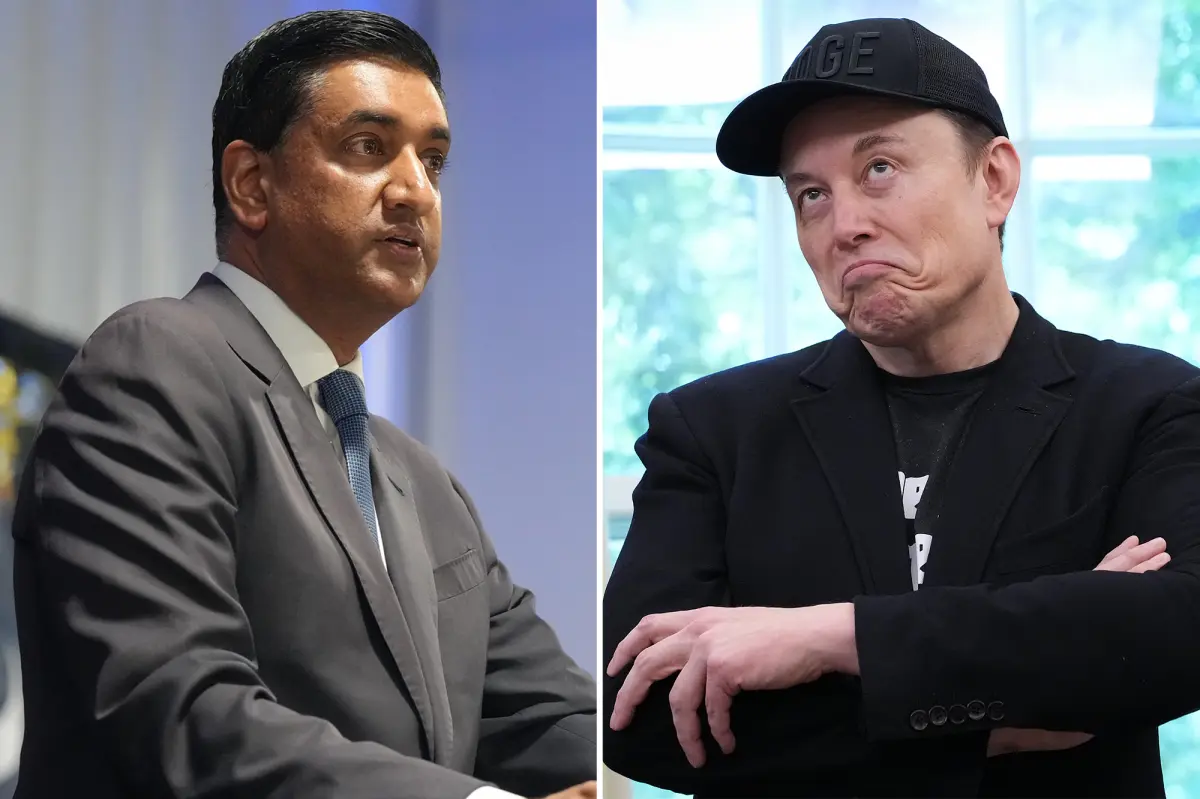
The contemporary American political arena has rapidly evolved into a fierce ideological battleground where the fundamental values of governance, wealth accumulation, and basic human empathy are being radically redefined. At the very center of this storm is Elon Musk, the visionary yet highly divisive CEO of Tesla and SpaceX, whose newly acquired role as a chief architect of federal government spending has drawn intense fire from progressive lawmakers. In a striking escalation of political rhetoric, California Democratic Representative Ro Khanna recently utilized an appearance on the popular “I’ve Had It” podcast to demand a sweeping, formal investigation into the billionaire’s actions. Khanna argued with passion that should the Democratic Party or progressive coalitions regain control of the legislative branch, they must immediately deploy their subpoena powers to hold Musk thoroughly accountable. The heart of Khanna’s grievance lies in the staggering humanitarian toll he associates with Musk’s drastic, corporatized cost-cutting measures. In a quote that quickly reverberated across the political landscape, Khanna declared that while Musk and his allies are actively celebrating his ability to mint thousands of new millionaires, they are choosing to ignore the estimated 4.5 million children across the globe whom Musk has “possibly sentenced to death” by dismantle-and-slash operations targeted at critical foreign aid initiatives. This explosive narrative transforms a dry debate over federal budget spreadsheets into an urgent, high-stakes moral crisis, signaling that the battle over wealth and power in America is no longer just about fiscal policy, but about the literal survival of the world’s most vulnerable populations.
To fully comprehend the weight of Khanna’s devastating allegations, one must look past the immediate political theater and examine the real-world humanitarian systems currently hanging in the balance. The United States Agency for International Development (USAID) has historically functioned as a lifeline for millions of impoverished families globally, delivering vital resources such as clean drinking water, life-saving immunizations, maternal healthcare, and agricultural development aid to regions ravaged by famine, disease, and war. Under the banner of the newly established Department of Government Efficiency (DOGE), Musk has championed a hyper-efficient, corporate-style slashing of federal expenditures, treating public institutions with the same aggressive downsizing tactics he notoriously applied to his private ventures. However, critics argue that applying a venture capitalist’s red pen to global humanitarian programs completely dehumanizes the foreign policy process. For a child living in a drought-devastated community in the Global South, a percentage reduction in an agency budget is not an abstract exercise in fiscal conservatism; it is a direct reduction in the availability of therapeutic food, malaria medication, and clean water wells. By drawing a direct, uncompromising line between Musk’s efficiency mandates and the preventable deaths of millions of children, Khanna and his allies are attempting to force a national conversation on the ethical boundaries of applying raw capitalist disruption to programs designed to preserve fragile human lives.
This bitter clash also exposes a deep, structural hypocrisy that progressive critics argue lies at the very heart of the modern conservative movement. During the podcast discussion, host Jennifer Welch passionately echoed Khanna’s sentiments, pointing out the jarring moral contradiction of a political coalition—namely the MAGA movement—that proudly self-identifies as “pro-life” while simultaneously cheering on the wholesale dismantling of aid that keeps the world’s poorest children alive. Welch noted that the mainstream attempt to frame Musk as a heroic, wealth-generating innovator is a deeply flawed messaging strategy that must be actively dismantled. The narrative that we should celebrate the economic windfall of a few thousand newly minted corporate millionaires, while ignoring the systemic deprivation of millions of suffering children, highlights a profound ethical disconnect. By reframing the conversation around the preservation of life, progressives are turning the conservative movement’s own moral language against them, insisting that a true commitment to human life cannot stop at national borders or end where corporate profit margins begin. This rhetorical strategy aims to humanize policy debates by forcing everyday citizens to confront the human faces behind the abstract economic triumphs celebrated by tech elites and their political defenders.
The political urgency surrounding these calls for accountability has reached a fever pitch, primarily because Musk’s power has expanded to a level unprecedented in modern history. Following a historic, record-breaking initial public offering for his aerospace company SpaceX, Musk officially cemented his position as the world’s very first trillionaire. This astronomical accumulation of wealth has ignited widespread public anxiety and media scrutiny, as citizens and policy analysts alike grapple with the implications of a single private individual possessing more economic leverage than entire sovereign nations. From controlling the satellite communication networks vital to global defense, to dictating the transition to electric vehicles, and now directly advising on the restructuring of the United States federal government, Musk represents a new breed of global oligarch who operates largely outside the conventional democratic process. Progressive critics argue that when an unelected individual wields this much systemic influence, the traditional democratic checks and balances designed to protect the public interest begin to erode. The push to investigate Musk is therefore not merely a personal vendetta, but a systemic effort to reassert democratic authority over an ultra-wealthy elite class that many fear has become entirely insulated from the laws, taxes, and moral standards that govern the rest of humanity.
Seeking to translate this moral outrage into concrete, systemic change, Representative Khanna has been a leading advocate for landmark legislative reforms aimed at redistributing concentrated wealth and leveling the playing field for working-class families. Central to this agenda is his sponsorship of the “Make Billionaires Pay Their Fair Share Act,” an ambitious tax proposal that directly targets the massive asset portfolios of individuals like Musk. Unlike traditional income taxes, which the ultra-wealthy easily bypass through loans and stock options, Khanna’s proposed legislation would implement a direct 5% annual wealth tax on all assets exceeding $1 billion. In introducing the bill, Khanna highlighted the profound economic chasm that divides contemporary America, pointing out that while elite technology hubs like Silicon Valley enjoy unimaginable, runaway prosperity, millions of ordinary families throughout the rest of the country are struggling to afford the rising costs of housing, basic healthcare, and grocery bills. Khanna maintains that taxing billionaires a modest fraction of their gargantuan wealth is not an act of hostility, but a necessary correction to ensure that the American dream remains viable for everyone and that the country’s innovation engine is used to uplift the entire population rather than entrenching a permanent financial aristocracy.
Ultimately, the brewing battle between Ro Khanna and Elon Musk serves as a powerful microcosm of the defining conflict of our era: the struggle to determine whether the future of human society will be dictated by the unrestrained, bottom-line-driven whims of billionaire tech monopolists or by the collective, democratic will of the people. The call to subpoena Musk and launch a sweeping congressional inquiry into the human impact of his budget cuts is a passionate assertion that great wealth must never equal immunity from moral and social responsibility. As this historic debate unfolds, it challenges citizens to look past technological spectacle and corporate glamour, and to evaluate society’s progress by its capacity to care for its absolute poorest and most vulnerable members. The true metric of a nation’s greatness cannot be found in the soaring stock valuations of its elite class or the birth of a trillionaire, but in its unwavering commitment to protect human life, preserve dignity, and ensure that the pursuit of technological progress is always guided by a deep and abiding sense of shared humanity. By demanding answers for the millions of children whose lives are impacted by these sweeping federal cuts, lawmakers like Khanna are striving to ensure that the human element is never completely erased from the halls of power and profit.