



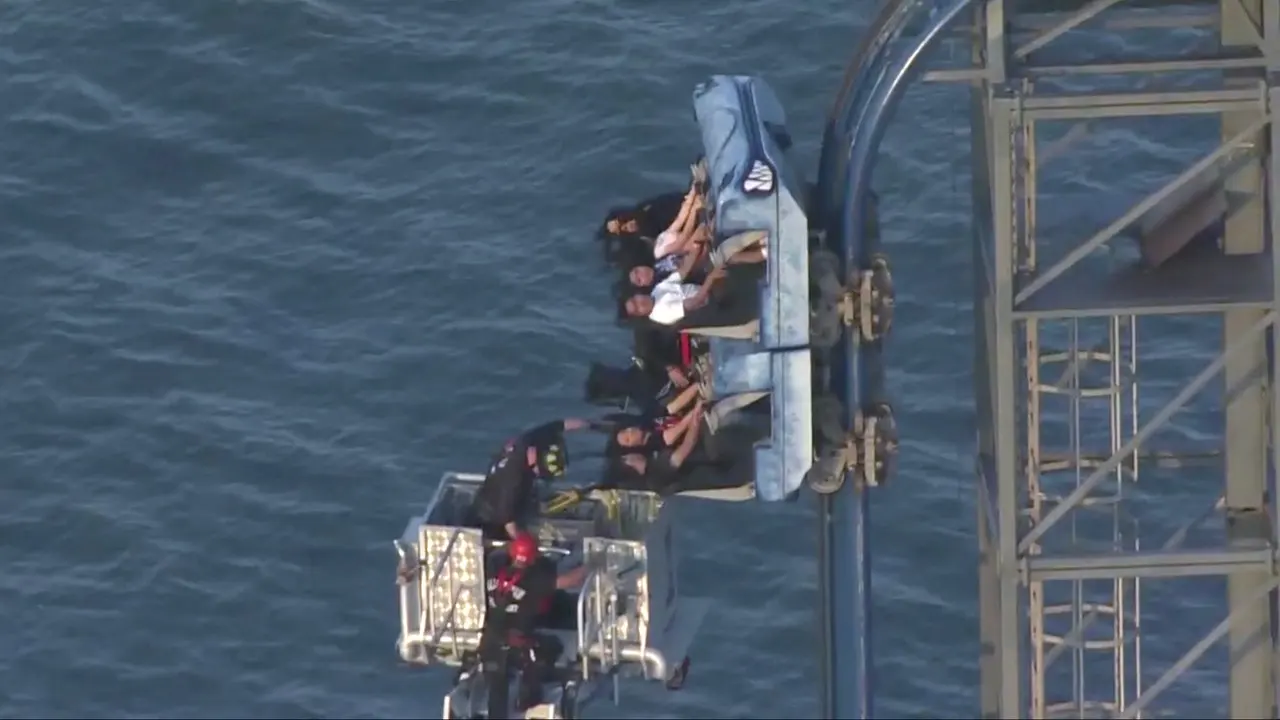
The sun was beginning its slow descent over the Gulf of Mexico, casting a warm, golden hue across the wooden planks of Galveston’s historic Pleasure Pier, when a day of coastal thrills took an unexpected and heart-stopping turn. On any typical Thursday afternoon, the air at the pier is thick with the sweet aroma of funnel cakes, the rhythmic crash of ocean waves, and the joyous, adrenaline-fueled screams of thrill-seekers braving the park’s premier attractions. Among those attractions, the Iron Shark roller coaster stands as a towering monument to modern engineering, boasting a vertical lift hill that pulls riders one hundred feet straight up into the Texas sky before plunging them into a series of dizzying twists and turns over the water. But at approximately 5:35 p.m., the familiar mechanical hum of the roller coaster ground to a sudden, eerie halt. Suspended high above the ocean breeze, eight passengers—who had expected nothing more than a momentary thrill—found themselves trapped near the very peak of the vertical ascent, clinging to their seats as the reality of their precarious situation began to set in. Among the stranded riders were several middle and high school students from Houston, enjoying what was supposed to be a memorable school field trip, now suddenly transformed into a test of endurance and courage silhouetted against the darkening sky.
For the eight riders suspended at a near-vertical angle, the next three and a half hours would stretch on like an eternity. Hanging one hundred feet in the air, the physical discomfort of being held tightly against safety harnesses was quickly joined by the psychological toll of looking down at the distant pier and the churning ocean below. The ocean winds, which usually offer a pleasant reprieve from the Texas heat, now felt cold and mocking as they buffeted the stationary coaster car. Among the passengers, a quiet solidarity quickly formed; students from the Energized for STEM Academy Middle and High Schools, alongside their chaperones and fellow riders, had to rely on sheer mental fortitude to keep panic at bay. On the ground, a crowd of park-goers, concerned onlookers, and local news crews gathered, their eyes locked on the tiny figures silhouetted against the sunset. The live television broadcasts capturing the scene from hovering helicopters painted a stark picture of human vulnerability against the backdrop of massive steel machinery, making the viewers at home hold their collective breath as they watched the stranded riders attempt to comfort one another while waiting for help to arrive from the heavens.
The true heroes of the evening emerged in the form of the Galveston Fire Department, whose first responders arrived on the scene with a mix of urgent focus and practiced calm. Rescuing eight individuals from a near-vertical vertical lift hill on a pier over water is a logistical nightmare that requires absolute precision, leaving zero margin for error. Firefighters promptly deployed a massive ladder truck, extending its mechanical arm high into the coastal breeze to reach the stranded passengers. One by one, firefighters ascended the ladder, navigating the gusty heights to personally secure each passenger into a specialized safety harness before guiding them down to solid ground. This meticulous process required not only mechanical skill but immense empathy; the rescue workers had to look into the terrified eyes of teenagers and adults alike, speaking in soothing tones, assuring them of their safety, and patiently coaxing them through the terrifying transition from the coaster car to the rescue ladder. For three and a half grueling hours, this high-stakes dance between gravity and human resolve unfolded, with first responders refusing to rush, prioritizing the physical and emotional safety of every single individual until all eight passengers were warm, safe, and back on solid ground.
Back in Houston, the news of the coaster malfunction sent shockwaves through the community, particularly within the Houston Independent School District (HISD) family. The field trip organized by the Energized for STEM Academy schools was meant to be a joyous celebration of academic effort and scientific curiosity, making the sudden news of the emergency deeply distressing for parents waiting miles away. However, the school district and park administration moved swiftly to maintain open channels of communication, keeping anxious families informed every step of the way. When the rescue was finally completed without a single injury, a profound wave of relief washed over the entire community. In an emotional statement, the school district expressed its deep gratitude, stating they were incredibly thankful that all students, staff, and chaperones returned safely, praising both the courageous first responders who engineered the rescue and the park personnel who assisted throughout the evening. The event highlighted the resilient bond of the school community, turning a terrifying ordeal into a testament to the strength, maturity, and calm demeanor demonstrated by the young students under unimaginable pressure.
To those watching from afar, the incident might have looked like a catastrophic failure of amusement park safety, but amusement park officials and engineering experts point out a deeper, ironically reassuring truth about the anatomy of modern thrill rides. According to Terry Turney, the Chief Operating Officer of Pleasure Pier, the Iron Shark did not break down in a way that compromised safe operation; rather, it stopped exactly as it was designed to do. Modern roller coasters are built with highly sophisticated computer systems and fail-safe block zones equipped with countless sensors designed to detect even the slightest anomaly—be it a minor electrical fluctuation, a sensor misalignment, or a shifting wind threshold. When the Iron Shark experienced a minor malfunction during its initial ascent, the computer system instantly engaged the safety brakes to prevent the ride from proceeding into a potentially unsafe situation, prioritizing absolute stillness over motion. While being stuck a hundred feet in the air for hours is undeniably terrifying for riders, it serves as a stark reminder that modern ride design is built on a philosophy of default safety, choosing to strand riders safely in place rather than risk operating under less-than-perfect mechanical conditions.
In the days following the incident, the Iron Shark remained closed to the public, slated for an exhaustive, top-to-bottom inspection by internal engineers and state regulatory authorities to guarantee its absolute safety before its gears are allowed to turn again. For the eight individuals who lived through those three and a half hours in the sky, the memories of that Thursday evening will likely linger for a lifetime, serving as a reminder of both human fragility and the incredible power of community. As Pleasure Pier continues to welcome families to the Galveston coast, the story of the rescue remains a remarkable example of grace under pressure—from the brave students who kept their composure, to the families who trusted the process, to the heroic firefighters who climbed into the sky to bring them home. Ultimately, the towering steel of the Iron Shark stands not as a symbol of fear, but as a monument to the silent engineering systems that protect us, the dedicated first responders who watch over us, and the enduring human spirit that keeps us looking upward, even when the ride of life comes to an unexpected halt.