



Here is a humanized and expanded exploration of that news snippet, broken down into six rich paragraphs, bringing the dry numbers to life while unpacking the human and political drama beneath the surface.
1. The Headline That Shook the Fiscal World
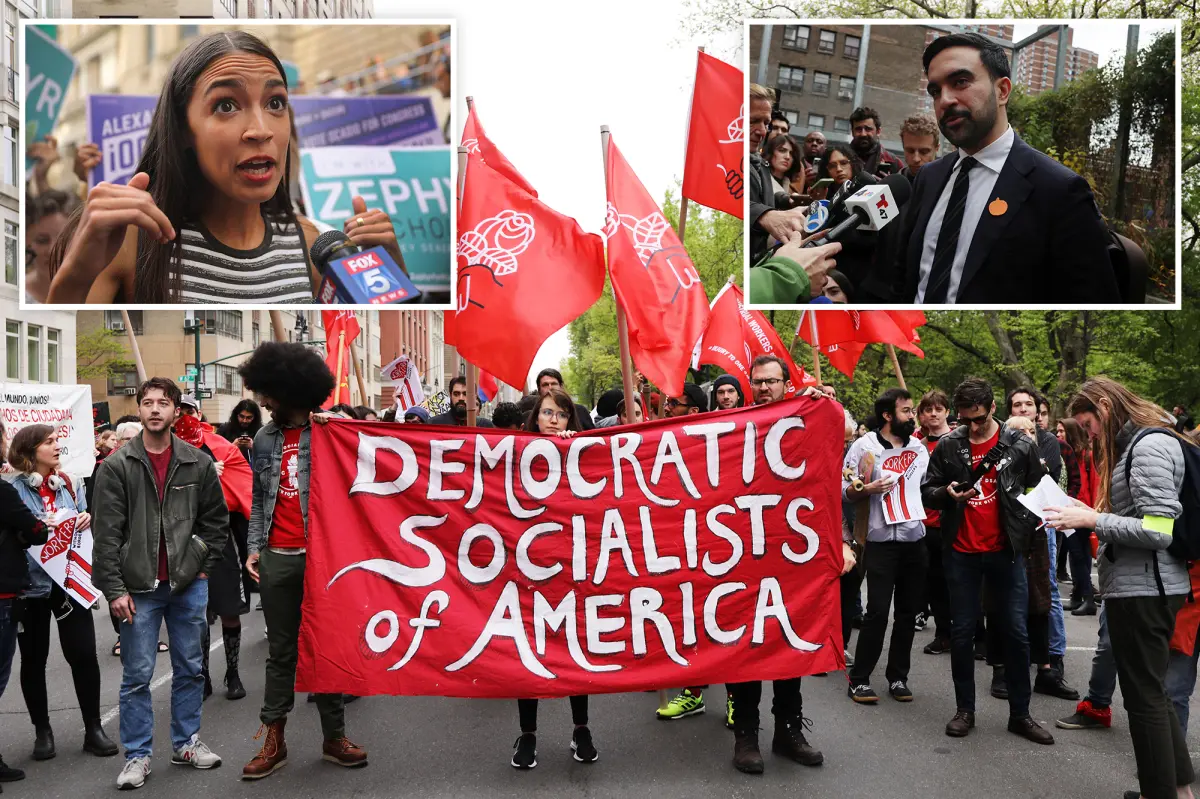
Imagine waking up to a headline that claims your government is planning to spend more money than the entire global economy produces in two and a half years. That is the staggering reality being painted by a new and explosive report from the libertarian Cato Institute, which has taken aim at the legislative wish-list of the Democratic Socialists of America (DSA). According to Cato, if the DSA were to successfully enact its most ambitious agenda—from sweeping universal healthcare to massive reparations and a federal jobs guarantee—the cumulative cost could balloon to a jaw-dropping $200 trillion over the next decade. To put that in perspective, that is roughly 57% of America’s annual Gross Domestic Product dedicated to government spending, a massive leap from the already hefty 33.8% share the government swallowed just last year. The report frames this not as a modest expansion of the social safety net, but as a fundamental transformation of the American economy, one where the state becomes the dominant force in every citizen’s life. For the DSA, however, this is not a number on a calculator; it is a promise of dignity, security, and the radical reshaping of a capitalist system they believe has failed millions of working families.
2. The Human Faces Behind the Astronomical Price Tags
To understand the passion behind the DSA’s platform, one must look beyond the spreadsheets and see the human stories that drive these proposals. The single largest item, a universal, single-payer healthcare system often branded as “Medicare for All,” carries a price tag estimated between $39.9 trillion and $75.4 trillion. For a single mother in Ohio who hesitates before taking her child to the emergency room because of a $500 copay, the abstract cost becomes tangible relief. Similarly, the proposal for slavery reparations, estimated at $13.5 trillion to $28 trillion, addresses a generational wound that has never truly healed. It speaks to African American families who watched their grandparents build wealth that was stripped away, leaving them permanently behind in the race for financial stability. Finally, the federal jobs guarantee—costing a wild $4.4 trillion to $60 trillion—offers a lifeline to the displaced coal miner in West Virginia or the warehouse worker replaced by automation, promising that the government will be the employer of last resort, ensuring no one has to beg for a paycheck. For DSA members, these are not just policy proposals; they are the pillars of a moral society, a direct answer to the pain, anxiety, and inequality that has metastasized across the heartland.
3. The Libertarian Counter-Attack and the Role of Adam Michel
Standing opposite this progressive dreamscape is Adam N. Michel, a policy analyst at the Cato Institute and the author of this bracing report. Michel is not a villain in a cartoon; he is a man deeply concerned with the preservation of individual liberty, and he views the DSA’s plans as a one-way ticket to economic serfdom. When he looks at the math, he sees a disaster. He points out that even at the lower bound of the DSA’s cost estimates, the government would swallow an unprecedented 57% of the nation’s economic output. At the higher bound—92% of GDP—we approach the fiscal territory of a totalitarian command economy, where the government essentially owns all wealth and dictates all spending. Michel’s critique is not just about abstract macroeconomic percentages; it is about the soul of the country. He argues that such massive government expansion inevitably leads to a suffocating bureaucracy, which crowds out private innovation, punishes entrepreneurship with crushing tax rates, and strips families of their autonomy. “It is closer to Soviet-style communism than European welfare states,” he bluntly warns, deliberately using language that evokes the fear of a lost American ideal—the self-made individual who owes nothing to the state.
4. The Great Funding Mirage: Why ‘Tax the Rich’ Doesn’t Add Up
Perhaps the most politically tantalizing aspect of the DSA’s pitch is their insistence that the bill can be footed solely by “aggressive wealth taxes on the richest individuals and corporations.” It is a rallying cry that excites audiences at rallies—the idea that the billionaires, who are hoarding trillions while people starve, should finally be forced to pay their fair share. But Michel rips this argument to shreds with the unrelenting logic of an accountant. He calculates that even if the U.S. government confiscated 100% of the wealth of every billionaire and every mega-corporation’s profits, it would only generate a fraction of the $200 trillion needed over the decade. Why? Because the wealth of the top 0.1% is largely tied up in illiquid assets—stocks, real estate, private equity—which are extremely difficult to value and tax without crashing the very markets they rely on. Furthermore, history shows that when you tax wealth aggressively, the wealthy simply move their money—and their business operations—to more tax-friendly nations. Instead of funding the social programs, a wealth tax would likely cause a massive capital flight, tanking the stock market, layoffs, and a recession, thereby shrinking the tax base entirely. Michel points out that the promise of “taxing the rich” is a political sleight of hand, a mirage that hides the crushing reality: middle-class taxes would inevitably skyrocket to cover the shortfall.
5. The Current Political Wave and Its Voter Appeal
Despite the staggering costs and the economic doomsday scenario painted by Cato, the DSA is not a fringe group of theoretical academics; they are winning elections. The report shines a spotlight on the DSA’s recent political successes, most notably the election of members to Congress and the stunning rise of figures like Zohran Mamdani, the newly elected Mayor of New York City. Mamdani, who ran on a platform heavily influenced by DSA ideals, represents a shift in the political zeitgeist. Why are these ideas gaining traction? Because for millions of voters, the current system is already failing them. They are drowning in student debt, priced out of homes, working 60-hour weeks just to afford rent, and terrified of a car accident that could bankrupt them. Voters are emotionally exhausted, and the DSA offers a simple, powerful narrative: Big Money has rigged the game, and the government, if truly captured by the working class, can be a force for good. The Cato report is a warning shot, but for those who feel they have nothing to lose, the threat of socialism is less scary than the reality of a paycheck that disappears before they can save a dime. The DSA is tapping into a deep vein of human desperation, where the promise of a government that cares outweighs the terrifying fiscal projections.
6. The Uncomfortable Truth and the Path Forward
In the end, the clash between the Cato Institute and the DSA is a profoundly human argument about values, fear, and hope. Michel is mathematically correct: we cannot simply print or tax our way to $200 trillion without devastating the economy, collapsing the dollar, and creating a level of government control that would erode the freedoms we cherish. The conservative critique is grounded in the human instinct for self-preservation and the desire to keep what you earn. But the DSA is also correct about the pain. The desperation is real. The gap between the very rich and the very poor is a moral catastrophe that cannot be ignored. What this report truly signals is the urgent need for an honest conversation—a conversation that moves past slogans and recognizes that we need a robust social safety net, but one that is designed with fiscal prudence, targeted to those truly in need, and built to preserve the dynamism that makes America great. Neither a $200 trillion wish-list nor the status quo is the answer. The answer lies in a human-centered approach that respects both the entrepreneur who builds businesses and the janitor who cleans the floors; one that acknowledges that while the “pie” must be shared more fairly, it must also be allowed to grow. As this debate rages on, we must remember that the ultimate goal is not to fund programs, but to foster a society where every individual can attain security, dignity, and the genuine opportunity to thrive—without the debts being passed onto the shoulders of future generations. That is the true human challenge we all face.