

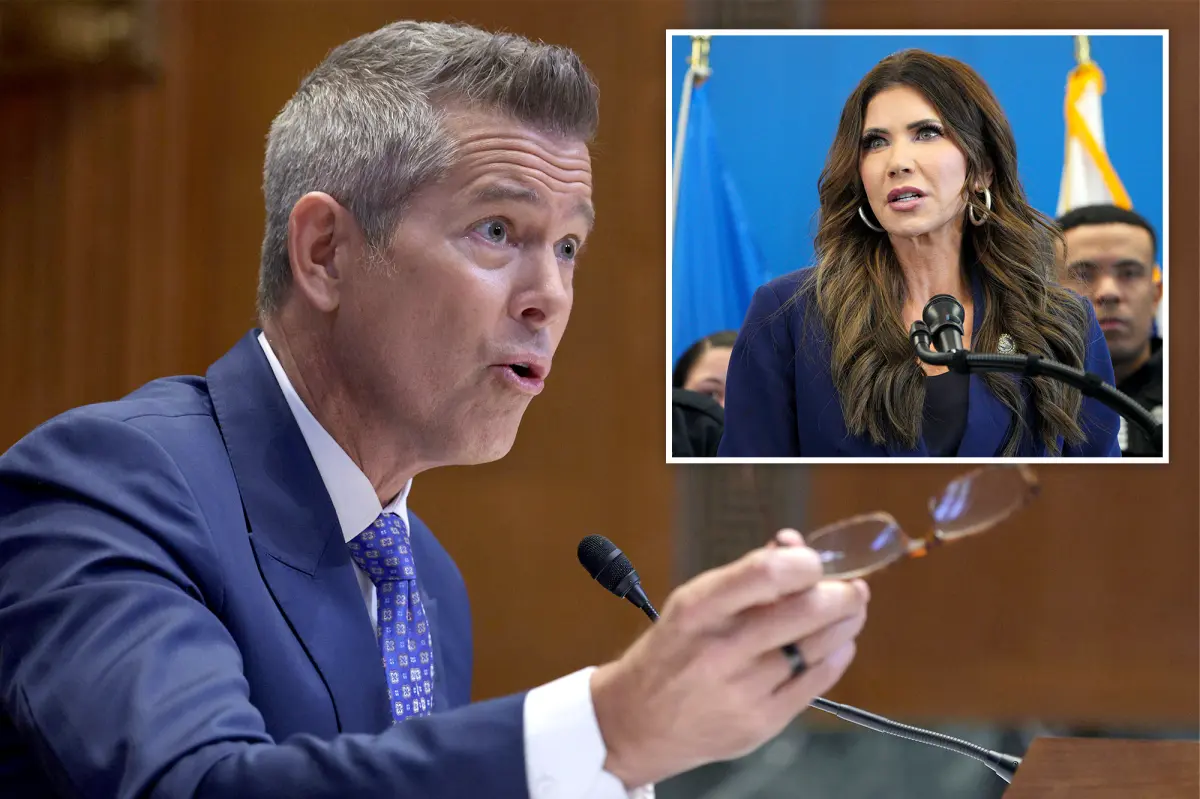
It was the kind of cryptic Sunday evening post that usually breaks through the quiet lull of a weekend news cycle, a digital flare launched into the ether of social media. Transportation Secretary Sean Duffy, never one for understated bureaucratic announcements, took to X (formerly Twitter) to drop a time bomb of a teaser: “TOMORROW: UNPRECEDENTED FRAUD CRACKDOWN.” The post was short, sharp, and almost theatrical in its brevity, yet it carried the weight of a government-wide signal flare. In the same breath, he tagged an impressive and intimidating list of federal heavyweights—Homeland Security Secretary Markwayne Mullin, the Department of Homeland Security (DHS), Immigration and Customs Enforcement (ICE), the Department of Justice (DOJ), and the White House Task Force to Eliminate Fraud. For the average American scrolling on their phone, it was a thrilling glimpse of government action; for the insiders in Washington, it was a promise of a coming storm. Duffy offered no details—no specific location, no exact time, no list of alleged perpetrators, and no confirmation of arrests. Instead, he allowed the word “unprecedented” to hang in the air, inviting speculation about the scope and severity of what the administration was about to unveil. The vagueness was deliberate, a tactic designed to maximize anticipation while keeping the targets of the investigation guessing, perhaps even sweating, through the night. It was the kind of message that bridges the gap between raw political messaging and the gritty, behind-the-scenes work of federal law enforcement, and it set the stage for what promises to be a major focal point of the Trump administration’s renewed war on waste, fraud, and abuse.
To truly grasp the significance of Duffy’s announcement, one must look back at the foundational pieces that were laid earlier in the year. In March, President Trump formally established the White House Task Force to Eliminate Fraud, a sweeping executive initiative designed to centralize and accelerate the government’s response to the systemic plundering of federal benefit programs. This was not merely a symbolic gesture; it was a coordinated command center tasked with rooting out the billions of dollars lost annually to fraudulent claims across Medicare, Medicaid, unemployment insurance, and pandemic-relief funds. The creation of this task force was a direct acknowledgment that the federal bureaucracy had grown too bloated and too slow to catch the sophisticated bad actors who had learned to game the system. Building on that foundation, the Department of Justice, under the direction of the Attorney General, established the National Fraud Enforcement Division—a specialized unit with the sole mandate to investigate and prosecute the theft or misuse of taxpayer dollars. This division was created to act as the legal sledgehammer for the task force’s intelligence gathering, giving prosecutors the dedicated resources and legal teeth to go after white-collar criminals, organized fraud rings, and even corrupt officials who enabled the schemes. The human element here is critical: behind every statistic is a story of a senior citizen whose Medicare benefits were billed for wheelchairs they never received, or a small business owner who was shut out of a loan while a shell company siphoned millions. The creation of these bodies was a promise to the American taxpayer that their hard-earned money would no longer be treated as a bottomless piggy bank for unscrupulous operators. Duffy’s “unprecedented” Monday announcement, therefore, is likely the operational unveiling of these structures—a public declaration that the analytical work is over, and the enforcement phase has begun.
While the broad strokes of the DOJ division focus on financial fraud and benefit scams, the specific collaboration that Duffy teased highlights a highly tangible and dangerous niche: the commercial trucking industry. The partnership between the Department of Transportation (DOT) and the DHS underscores a critical vulnerability in America’s supply chain—the issuance of Commercial Driver’s Licenses (CDLs). For years, there have been whispers and reports of a shadow market where unqualified individuals bypass the rigorous testing required to operate massive 18-wheelers. The DOT and DHS have been working in lockstep to dismantle these networks, and the announcement indicates that this quiet operation is about to yield very public results. The concern here is not just about fairness or lost fees; it is about public safety on a catastrophic scale. A fully loaded tractor-trailer weighs up to 80,000 pounds and requires split-second reflexes and an intimate knowledge of air brakes, weight distribution, and hazardous materials rules. When a fraud ring issues a CDL to an individual who has merely paid a bribe or memorized answers without ever driving a rig, they are effectively putting a weapon on the highway. The humanization of this effort comes through in the stories of the victims—families on a road trip, commuters on an interstate—who are sharing the road with a ticking time bomb driven by someone with no legitimate training. The administration’s focus on this sector reveals a profound understanding that “fraud” is not always a faceless crime; sometimes, it has a steering wheel, a diesel engine, and a horrifying potential for physical harm.
At the heart of this trucking investigation lies a joint operation that has already scrutinized approximately 75 commercial driving schools scattered across the country. These schools, which should be the gatekeepers of highway safety, have instead become the epicenter of the alleged fraud. Investigators suspect these institutions of systematically falsifying training records, signing off on behind-the-wheel hours that never occurred, and improperly certifying drivers who lack the basic skills to control a commercial vehicle. The scheme often works like this: a driving school, perhaps operating out of a strip mall with a few computers, charges exorbitant fees to individuals—often immigrants or those desperate for a job in the lucrative trucking industry—to “fast-track” their certifications. The students may sit through a rushed, substandard lecture, but the paperwork shows that they completed the full federal-mandated 160 hours of training. The network also extends to “unvetted foreign drivers,” a phrase that carries significant weight in the current political climate. These drivers may hold CDLs from foreign countries with less stringent standards, or they may have entered the country and been funneled into the system through corrupt brokers who connect them with lax testing facilities. The human tragedy here is multi-layered: the legitimate, honest truckers who log thousands of miles and attend rigorous training see their wages undercut by this illegal pipeline, while the fraudulent drivers themselves are often victims of exploitation, having paid thousands of dollars to criminals who promised them a path to a middle-class career. By targeting these 75 schools, the government is sending a clear message that they are choking off the supply line of unqualified drivers at its source, dismantling the infrastructure that allows this dangerous fraud to thrive.
Beyond the classroom and the paperwork, the enforcement arm of this crackdown has already begun to take to the asphalt. The collaboration between DOT and DHS has involved roadside enforcement operations designed to intercept these unqualified foreign commercial drivers before they can cause a tragedy. These operations are high-intensity, high-stakes checkpoints often staged at weigh stations, rest areas, or border crossings. Federal inspectors, armed with advanced scanning technology and the intelligence from the earlier investigations, pull over trucks to verify the authenticity of the CDL, cross-reference the driver’s identity with immigration databases, and inspect the electronic logging devices that track hours of service. For the honest trucker, this is an annoyance; for the fraudulent driver, it is the moment of reckoning. The roadside environment is a tense one—the air thick with diesel fumes and the hum of idling engines, inspectors moving methodically from cab to cab, checking documents that may be brilliantly forged or laughably amateur. The humanization of this scene is found in the faces of those involved: the inspector who has seen a fatal accident caused by a poorly trained driver and is determined to avoid another one, versus the shady driver sweating under the glare of the floodlights, realizing that his fraudulent journey has come to an abrupt end. These operations are the visible proof that the government is not just talking about fraud—they are actively hunting it down on the open road, ensuring that the next face that is pulled over is not just fined, but potentially deported, arrested, and held accountable for endangering public safety.
As the clock ticks toward Monday morning, the anticipation surrounding Duffy’s “unprecedented” announcement is palpable. Given the foundation laid by the White House Task Force, the DOJ’s new division, and the extensive groundwork done with the 75 driving schools and roadside operations, the announcement could entail a coordinated multi-state takedown—a morning of simultaneous raids, arrests, and asset seizures that would illustrate the reach of the federal government. It could also involve a sweeping new rulemaking or a policy directive that mandates stricter biometric testing for CDL applicants or harsher penalties for fraudulent certifiers. For Secretary Duffy, this moment is a chance to step out of the shadow of the broader administration and define his legacy as a protector of American infrastructure and public safety. He is framing this not just as an economic crime but as an act of moral and physical reckoning. The humanized bottom line is that this crackdown is not merely about punishing wrongdoers; it is about restoring faith in the systems that govern our daily lives. It is about the grandmother whose tax dollars are protected, the commuter who feels safer knowing the driver next to them is qualified, and the dedicated truck driver who can now compete on a level playing field. The sheer scope of the effort—spanning social media teasers, federal task forces, DOJ divisions, and roadside police work—shows a government attempting to move with the agility of a tech startup. Whether it will truly be “unprecedented” remains to be seen, but the preparation and the coordination suggest that the Trump administration is ready to throw the book at fraudsters, turning a bureaucratic concept into a very real, very human day of reckoning for those who have chosen to steal from the American people.