


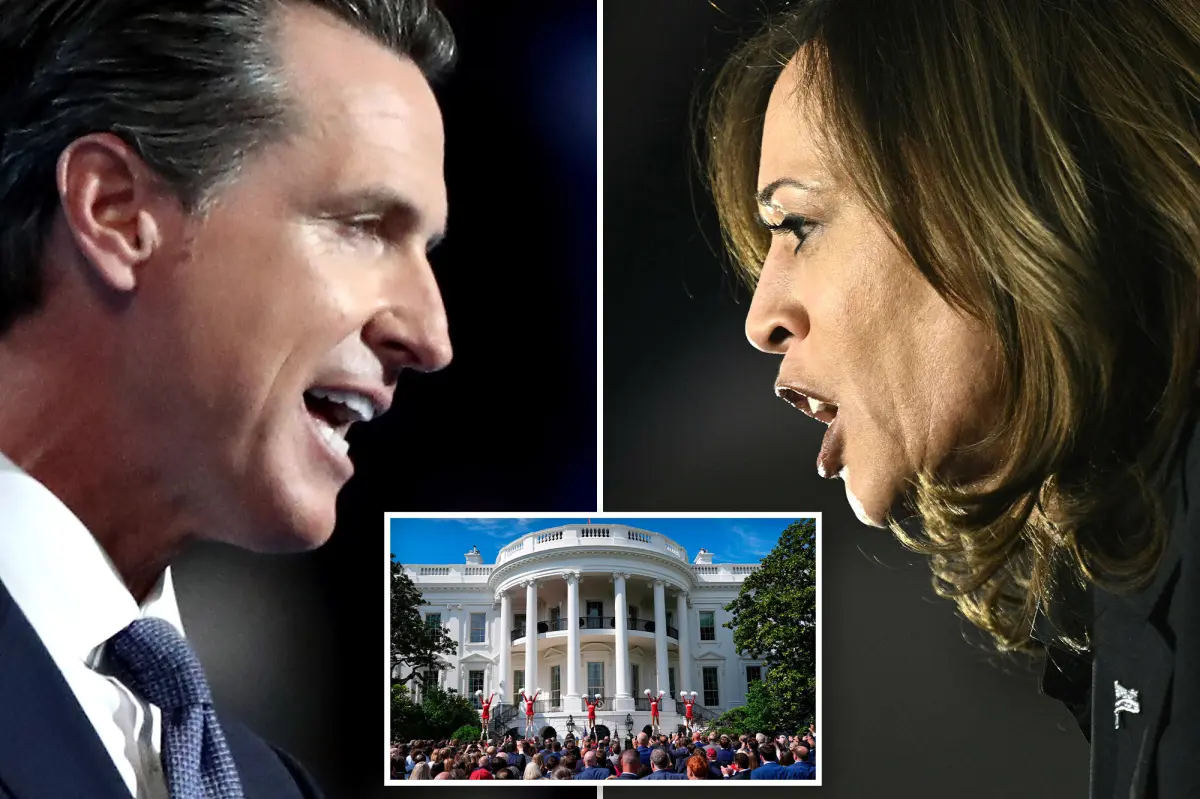
The story of Gavin Newsom and Kamala Harris is a decades-long psychological drama disguised as a partnership, rooted deeply in the distinct, hyper-competitive crucible of San Francisco politics. In the late 1990s and early 2000s, both were ambitious, polished, and exceptionally driven young leaders navigating the complex labyrinth of Northern California’s Democratic machine. Guided and championed by the legendary former San Francisco Mayor Willie Brown—who appointed Newsom to the Board of Supervisors in 1997 and previously dated Harris, helping her ascend to district attorney—they were the twin crown jewels of a new political era. To the public, they represented the vanguard of progressive California: charismatic, telegenic, and fiercely eloquent. But behind the scenes, their relationship was characterized by a quiet, watchful tension that one veteran Democratic strategist famously likened to “two cats, circling each other in an alley.” They did not just share a political home; they shared the same prestigious donor pools, the same ideological turf, and the exact same burning ambition to one day sit in the Oval Office. This shared trajectory created a strange, claustrophobic intimacy where every success of one was quietly measured as a relative regression of the other. For over twenty years, they maintained a delicate, performative truce, smiling warmly for the cameras, sharing stages in Sacramento and Washington, and offering glowing, highly rehearsed endorsements of each other’s public service. Yet, beneath this veneer of elite Northern California collegiality lay a profound, simmering rivalry that was bound to boil over the moment their parallel paths finally converged on the national stage. Now, as they both position themselves at the very top of early Democratic polls for the 2028 presidential nomination, that long-delayed collision is finally happening, transforming their superficial friendship into a bitter, highly personal duel where only one can survive.
This impending clash of titans has led political insiders to describe their relationship not as a healthy civic competition, but as an existential threat that could lead to a political “murder-suicide” if both decide to enter the 2028 primary season with equal ferocity. Because they draw water from the exact same well—appealing to West Coast progressives, suburban moderates, and wealthy coastal elites—they cannot easily co-exist in a national campaign without actively destroying each other’s viability. The fear among Democratic strategists is that an all-out war between Newsom and Harris would tear the party’s base apart, forcing donors, labor unions, and key activist groups to choose sides in a devastating civil war that would ultimately leave the nominee too wounded to win the general election. This high-stakes reality has turned every interaction between them into an exercise in paranoia, where every public gesture is analyzed for hidden slights and every private conversation is treated like state intelligence. It is an exhausting dynamic that humanizes the raw, vulnerable insecurity lying beneath all their polished public personas. Despite their immense power, national celebrity, and formidable legislative achievements, both leaders remain deeply sensitive to the other’s progress, constantly looking over their shoulders to see who is leading the pack. This relentless scrutiny has poisoned whatever genuine affection they once had for each other, turning their historical bond into an albatross. Instead of allies who conquered California together, they have become captives of their own ambitions, locked in a zero-sum game where one’s ultimate triumph requires the other’s complete public humiliation. As the shadow of 2028 looms larger, the polite masks are slipping, revealing a raw and naked battle for legacy where the stakes are nothing less than the presidency of the United States.
Nothing illustrates this latent hostility more vividly than the petty, deeply personal battle of the memoirs that erupted behind closed doors when both leaders released books within months of each other. In the high-stakes world of national politics, a campaign memoir is never just a book; it is a declaration of intent, a psychological profile, and a crucial metric of grassroots enthusiasm used to gauge a candidate’s viability. Sources close to both politicians reveal that their respective campaigns kept a hawkish, near-obsessive watch on each other’s sales figures, viewing retail success as a direct proxy for national popularity. When Harris released her book, “107 Days,” in September, it went on to sell a highly respectable 385,000 copies, establishing a solid baseline of interest among the Democratic electorate. By contrast, Newsom’s literary offering, “Young Man in a Hurry,” which was released in February, struggled to capture the same momentum, moving just over 100,000 copies. This numerical disparity reportedly rankled the California governor, who is known to be meticulous about his public image and deeply competitive regarding his national reach. For Newsom, the book sales were a stinging reminder of the built-in advantages Harris possessed as the sitting Vice President, whose structural prominence naturally granted her a wider megaphone and a more eager audience. Meanwhile, Harris’s camp quietly viewed the sales victory as validation of her superior national appeal and a rebuke to those who questioned her charisma. This literary proxy war laid bare the underlying insecurities of both camps, demonstrating how even the most mundane metrics of fame can become weaponized in their ongoing struggle for dominance, proving that no detail is too small to escape their competitive gaze.
However, the tension between them escalated beyond mere sales statistics and into open psychological warfare with the publication of a highly sensitive anecdote in Harris’s book that deeply damaged Newsom’s pride. In “107 Days,” Harris recounted the chaotic aftermath of Joe Biden’s historic decision to drop out of the 2024 presidential race, detailing how she immediately reached out to key Democratic allies to secure their quick endorsement. When she called Newsom, however, she was met not with immediate enthusiasm, but with a curt, dismissive text message that reportedly read: “Hiking. Will call back.” According to those in Newsom’s inner circle, the governor was absolutely livid and deeply hurt by the inclusion of this exchange, feeling that Harris had gone out of her way to paint him as an aloof, arrogant jerk who was indifferent to a crisis. Newsom felt this public portrayal was a betrayal, particularly given that he had spent the preceding months tirelessly stumping on her behalf across the country and had even delivered a highly praised, energetic introduction for her at the 2024 Democratic National Convention in Chicago. To Newsom, the anecdote was a calculated hit job designed to make him look self-absorbed and politically tone-deaf at a moment of national urgency, undermining his credentials as a loyal team player. While sources close to Harris insisted that the anecdote was merely an objective, unvarnished chronicle of a historic day rather than a deliberate editorial swipe, Newsom’s allies viewed it as a characteristic act of vindictiveness, illustrating how easily decades of shared history can be sacrificed for a fleeting political advantage.
The personal animosity between the two has been further compounded by strategic maneuvers surrounding California’s internal political landscape, particularly Harris’s conspicuous refusal to run for governor. Many influential Democrats believed that Harris, with her massive name recognition and established statewide network, could have easily coasted to victory in the gubernatorial race, providing a stable, high-profile platform for her political future. Newsom and his advisors were privately hoping she would take this sensible, traditional path, which would have conveniently kept her occupied with state affairs and effectively cleared the national runway for Newsom’s own presidential ambitions. Instead, Harris deliberately chose to bypass the governor’s mansion, keeping her options open for another presidential run by coyly stating that she “might” run in 2028, a move that Newsom’s camp viewed as a direct containment strategy. This refusal to exit the national stage has left Newsom in a difficult strategic bind, forcing him to delay his own definitive decision until after the upcoming midterm elections while constantly calculating her next move. The source close to Newsom noted that the governor felt Harris lacked the “common sense” to see how a gubernatorial run could benefit them both, viewing her stubborn focus on the presidency as a selfish choice that needlessly dragged out their cold war. This ongoing strategic standoff has transformed the entire state of California into a political chessboard, with both leaders positioning their allies, locking down donor commitments, and subtly undermining each other’s policy achievements in a desperate bid to force the other to blink first.
As this bitter rivalry accelerates toward an inevitable head-on collision, the political gravity in California is beginning to shift, and even their shared creator, Willie Brown, has made his preferences known. The former mayor, who has watched both of his protégés rise from local San Francisco officials to national icons, did not mince words when evaluating Harris’s political trajectory, bluntly labeling her vice-presidential ticket with Biden as an “ultimate disaster” that was not helped by her subsequent book. Brown’s harsh, unvarnished assessment reflects a growing sentiment among some party elders that Harris may lack the political instincts required to win a tough national general election, casting a favorable light on Newsom’s sharper executive style. Newsom’s allies have been quick to capitalize on this narrative, privately describing Harris as a “vindictive” operator whose grudge-holding tendencies date back to her days as San Francisco’s district attorney when Newsom was mayor. They warn that her polished national image conceals a ruthless, score-settling politician who is willing to “stick a pin in your ass” if she feels slighted, a characterization that her supporters strenuously deny as sexist and unfair. Ultimately, this escalating feud is about much more than books, hiking texts, or local grievances; it is a deeply human drama of two lifelong peers whose parallel ambitions have turned them into bitter adversaries. As they prepare to battle for the soul of the Democratic Party in 2028, the world will watch as these two master politicians, who rose from the same city streets, attempt to destroy each other in pursuit of the ultimate prize.