






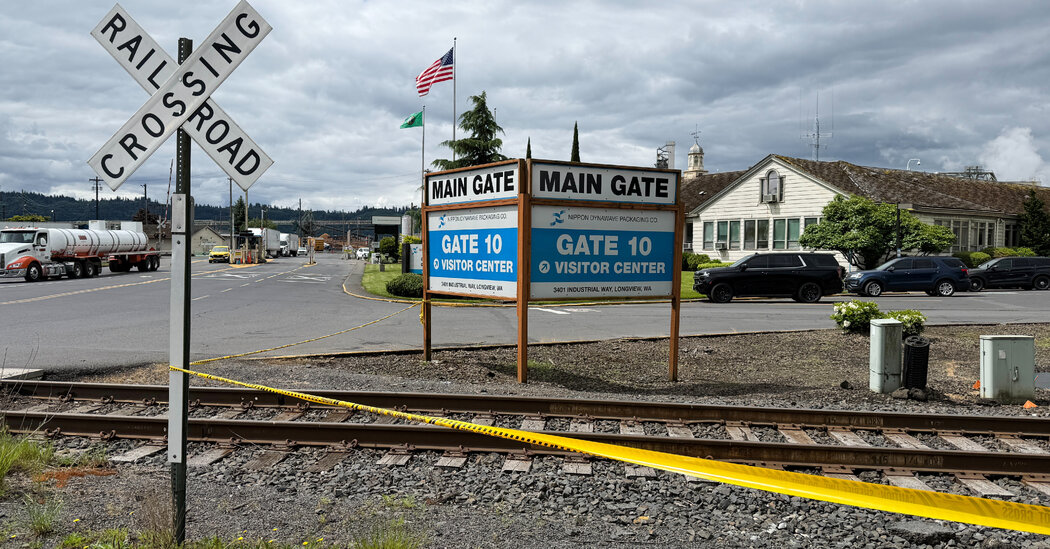
The damp, chilly air of a Tuesday morning in Longview, Washington, seemed like any other as early-shift workers made their familiar commute to the Nippon Dynawave Packaging Company mill. Sitting prominently near the banks of the winding Columbia River, the mill is a sprawling testament to the region’s deep-rooted industrial heritage—a place where the steady hum of machinery usually signals economic stability and honest, hard work. Families said their routine goodbyes at dawn, expecting the usual evening reunions. However, shortly before 7:15 a.m., that ordinary morning was violently shattered. A massive chemical tank, a quiet giant central to the mill’s operations, suddenly ruptured. In an instant, the routine was replaced by sheer terror as a localized disaster unfolded, catching workers completely off guard. The physical impact was immediate and devastating, leaving a trail of destruction that instantly claimed lives and left several others unaccounted for. In those first agonizing hours, the facility became a scene of profound grief and confusion, as authorities worked frantically through the wreckage, confirming fatalities while grappling with the heartbreaking reality that they could not yet provide an exact count of those who had perished. For the families waiting in suspense, the unfolding crisis transformed the mill from a symbol of livelihood into a site of unimaginable loss.
The response to the disaster was swift and massive, mobilizing the full force of regional emergency services as the gravity of the situation became clear. Cowlitz 2 Fire and Rescue, under the steady leadership of Chief Scott Goldstein, rushed to the scene alongside hazardous materials teams, navigating a chaotic environment filled with toxic vapors and unstable structures. Chief Goldstein’s voice carried the heavy weight of a community in crisis during his subsequent press conference, where he confirmed that lives had been lost and explained the immense difficulty of the ongoing recovery operation. The rescue workers faced extraordinary dangers, putting their own safety on the line as they searched for survivors among those still listed as unaccounted for. This courage came at a high cost, with one firefighter joining nine mill employees on the casualty list, suffering injuries that ranged from minor to critically severe. Initial reports had described the incident as a “major chemical explosion,” but emergency management later clarified that the destruction was caused by a sudden, violent implosion involving a massive vat of chemical treatment product. Whether an explosion or an implosion, the physical reality was the same: a sudden collapse of structural integrity that left rescuers to carefully sift through twisted metal and pooling chemicals in a race against time.
The source of the devastation was a highly hazardous substance known in the paper industry as “white liquor,” a highly alkaline mixture of sodium hydroxide and sodium sulfide. In the standard operations of a pulp mill, this chemical cocktail is used under intense heat and pressure to break down the lignin in wood chips, transforming raw timber into the strong pulp necessary for manufacturing paperboard and packaging cartons. However, when freed from its pressurized containment, white liquor becomes an incredibly destructive agent, capable of causing severe, deep-tissue chemical burns upon contact and releasing toxic fumes that ravage the respiratory system. The injured workers, many suffering from agonizing burns and inhalation trauma, were rushed to nearby medical facilities, including PeaceHealth St. John Medical Center in Longview and PeaceHealth Southwest Medical Center in Vancouver, Washington. Emergency room staff worked tirelessly to decontaminate and treat the victims, battling the unique and progressive damage that strong alkaline chemicals inflict on human flesh. The physical agony of these patients reflects a deeper, systemic trauma that will ripple outward for years, as the survivors and their families begin the long, difficult road to physical and emotional rehabilitation.
To fully understand the weight of this tragedy, one must look at the unique character of Longview, a city whose very existence and identity are historically bound to the timber and paper industries. Founded in the 1920s as a planned model industrial city, Longview has always been a place where the towering stacks of the mills are a familiar sight on the horizon, and the distinct smell of wood processing has long been viewed by locals as “the smell of money”—the scent of stable jobs and a thriving local economy. Generations of families have worked in these facilities, passing down a legacy of labor that requires immense grit, skill, and mutual trust. Because of these deep, intergenerational connections, a disaster at the Nippon Dynawave mill is not an isolated corporate event; it is a collective trauma that touches every corner of the community. On this tragic Tuesday, local schools, churches, and neighborhoods fell into a somber, anxious silence as residents waited for news about their friends and neighbors. The tragedy serves as a stark reminder of the underlying dangers that industrial workers accept as part of their daily lives, highlighting the profound human cost that sits behind the packaging products the rest of the world takes for granted.
In the shadow of the disaster, a frustrating silence emanated from the management of the Nippon Dynawave Packaging Company, with a representative declining to offer immediate comments or explanations for the tank failure. This lack of communication has only fueled the community’s search for answers and accountability, particularly given the facility’s troubled safety history in recent years. This was not the first time the plant had faced dangerous emergencies; in July 2023, a massive fire erupted in several football-field-sized wood chip piles, sending columns of toxic smoke into the atmosphere that compromised air quality across the region, extending all the way to Portland, Oregon. Although that fire was eventually ruled an accident, its exact cause was never determined, and it was followed by another blaze at an on-site locomotive repair shop in 2025. While those prior incidents miraculously resulted in no injuries, they paint a troubling picture of recurring safety challenges at the site. The catastrophic implosion of the white liquor tank represents a quantum leap in severity, forcing a critical examination of the mill’s maintenance practices, safety protocols, and the effectiveness of industrial regulatory oversight.
As the smoke clears and the investigations begin, the empty chairs at family dinner tables in Longview will remain a poignant symbol of the human cost of industrial negligence. The long process of healing will require more than just rebuilding the damaged infrastructure of the mill; it will demand a fundamental shift in how worker safety is valued over production speed and corporate profit. The brave individuals who clock in every day to perform hazardous labor deserve more than just thoughts and prayers in times of crisis; they deserve robust safety regulations, rigorous equipment inspections, and an unyielding commitment from employers to protect their lives at all costs. In the coming months, the people of Longview will undoubtedly band together, as working-class communities always do, to support the grieving families and help the injured recover. Yet, the memory of those lost in this horrific implosion must serve as a permanent catalyst for change, ensuring that no more lives are sacrificed on the altar of industrial output and that every worker who goes to earn a living can return home safely to the arms of their loved ones.