




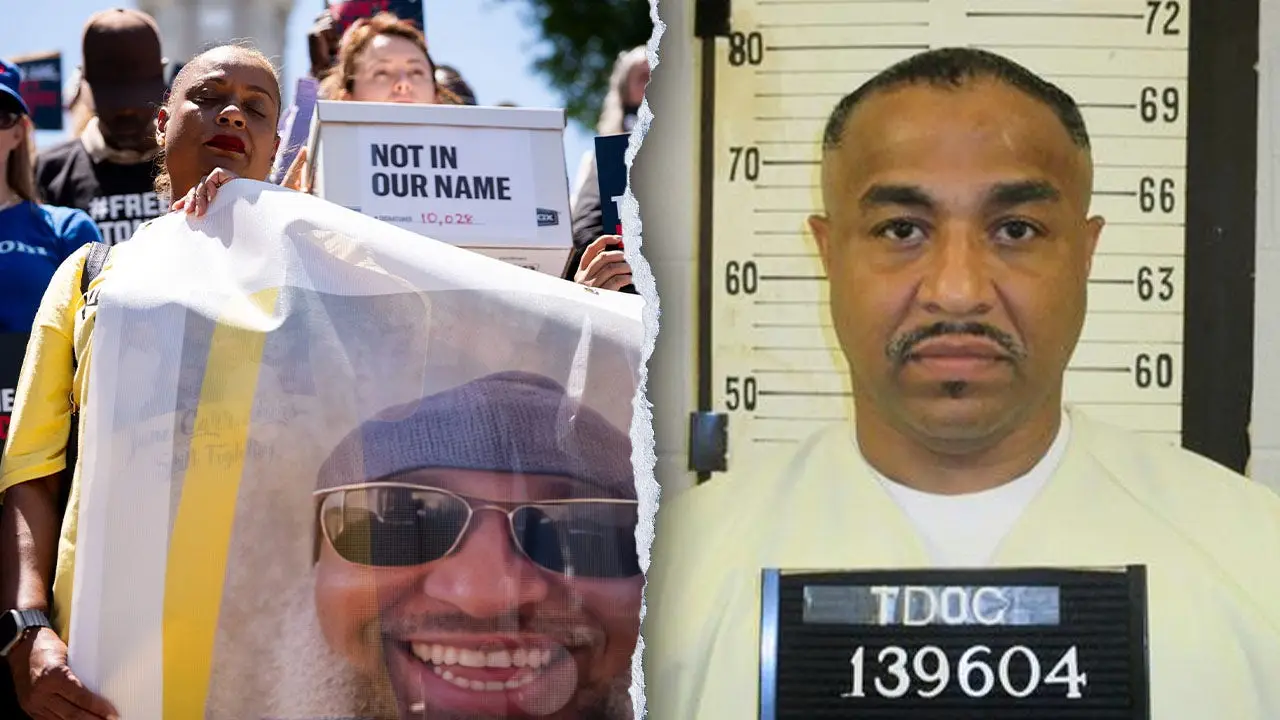
The sterile, glaringly lit execution chamber inside the Tennessee penitentiary became the stage for a grim and agonizing human drama on Thursday, exposing the deep friction between state-sponsored punishment and human biology. For over an hour, medical technicians struggled in vain to establish a viable intravenous path to administer lethal drugs to death-row inmate Tony Carruthers. Although the execution team managed to insert a primary IV line relatively quickly, the state’s absolute protocol demanded a secondary, backup line as a safety measure—a safeguard that proved impossible to secure. As the minutes ticked away, the atmosphere in the chamber grew increasingly tense as technicians shifted from peripheral veins to a highly invasive central venous line in his groin. Throughout this grueling ordeal, Carruthers’ attorney, Maria DeLiberato, watched the proceedings through a glass window, witnessing her client wincing and groaning in obvious, deep distress as the team repeatedly probed his body. The distressing sequence finally ended when prison officials conceded defeat and called off the execution. Shortly afterward, as DeLiberato was speaking to reporters outside the prison walls, news broke that Governor Bill Lee had granted a temporary reprieve, halting all execution efforts for at least a year. Overwhelmed by the sudden shift from impending death to an unexpected lease on life, DeLiberato broke down in tears of relief, exclaiming, “That’s amazing! I’m so grateful!” her raw emotion highlighting the immense burden carried by those operating on the front lines of capital punishment.
This failed execution marks yet another troubled chapter in a complex, decades-long saga that dates back to a horrific wave of violence in Memphis in 1994. Tony Carruthers was originally sentenced to death for the brutal kidnappings and murders of Marcellos Anderson, his mother Delois Anderson, and Frederick Tucker. The crimes devastated the local community, tearing a family apart and leaving a legacy of grief that persists to this day. However, the legal proceedings that followed were deeply troubled, characterized by chaos rather than a sober search for truth. During his initial trial, Carruthers, who was suffering from profound mental deterioration, exhibited extreme paranoia and hostility toward his court-appointed defense attorneys, accusing them of plotting his demise and threatening them with physical harm. Rather than recognizing these explosive outbursts as symptoms of severe psychological illness, the trial judge interpreted his behavior as a willful, manipulative attempt to delay the trial. Consequently, the court forced Carruthers to represent himself in a capital murder trial—a highly complex and high-stakes legal battle that he was entirely unequipped to navigate. Left completely defenseless in his fractured mental state, he was forced to fight for his life in a courtroom where his own delusions were mistaken for malice, casting a long shadow of doubt over the fairness of his ultimate conviction.
The structural integrity of the state’s case against Carruthers has faced severe criticism over the years, characterized by a near-complete lack of concrete, physical evidence linking him to the crime scenes. No fingerprints, DNA, or weapon-related forensics were ever presented to tie Carruthers to the violent deaths of the three victims; instead, the prosecution built its entire narrative on the subjective testimonies of jailhouse informants and local associates. Prosecutors asserted that Carruthers was a ruthless operator attempting to violently hijack the neighborhood drug trade from Marcellos Anderson. Yet, the reliability of the witnesses who claimed to have heard Carruthers confess to the crimes remains deeply suspect. In a telling revelation, one of the key witnesses who testified against him was later exposed as a paid police informant, who subsequently admitted to the news media that he had received financial compensation in exchange for his crucial courtroom testimony. This transactional approach to justice stands in stark contrast to the outcome of his co-defendant, James Montgomery. Though Montgomery was initially tried alongside Carruthers and also sentenced to die, his conviction was eventually overturned, leading to a resentencing and his ultimate release from prison in 2015. While Montgomery walked free, Carruthers remained isolated on death row, his life hanging in the balance based on testimonies that many legal experts believe were bought and paid for by the state.
Perhaps the most haunting and emotionally charged element of the prosecution’s case—and the one that almost certainly secured Carruthers’ death sentence—was the horrifying assertion that the three victims were buried alive. This terrifying image was presented to the jury with clinical authority by a medical examiner, leaving an indelible mark of cruelty and horror on the minds of the jurors who decided Carruthers’ fate. However, this sensational claim was later quietly withdrawn, and subsequent forensic experts who reviewed the case files thoroughly dismantled the original findings, declaring the “buried alive” theory to be entirely false. The retraction of this crucial piece of forensic science exposed a devastating reality: the jury’s decision to execute Carruthers was heavily influenced by a false, terrifying narrative of unimaginable physical torture. Despite the scientific community debunking this claim, the machinery of the justice system continued to roll forward, demonstrating how easily a false piece of evidence, once introduced into the emotional echo chamber of a trial, can become an unshakeable justification for state-sanctioned death, even after it has been proven wrong.
Beyond the flawed evidence and courtroom theater lies the profound tragedy of Carruthers’ mental state, which his current legal team argues renders him legally incompetent for execution. Humanizing Carruthers requires looking past the grim nature of his conviction to see a man lost in a labyrinth of severe psychiatric delusions, completely disconnected from the reality of his impending death. According to court filings, Carruthers did not believe the state of Tennessee actually intended to execute him; instead, he was convinced that the entire execution process was an elaborate, state-sponsored bluff designed to coerce him into accepting a fictional plea bargain. In his deeply fractured mind, this imaginary plea deal was the government’s way of avoiding paying him millions of dollars he believed he was legally owed. His paranoia extended directly to his own legal defense team, whom he viewed as active co-conspirators working with the state to steal his fictional fortune. Because of these deeply entrenched delusions, he completely refused to cooperate or speak with his attorneys, leaving him isolated in his own mind, unable to comprehend the true nature of the needle pointing toward his arm or the gravity of the punishment the state was attempting to carry out.
The abrupt halting of Thursday’s execution serves as an uneasy pause in Tennessee’s troubled journey with the death penalty, reflecting a broader national struggle with the ethics and mechanics of capital punishment. This incident is not an isolated event; it comes on the heels of a wholesale suspension of executions in Tennessee in 2022, which was triggered by systemic failures to properly test lethal injection drugs, forcing the state to scramble to overhaul its execution protocols. The painful hour Carruthers spent on the gurney, wincing in agony as technicians searched for a vein, highlights the disturbing reality that the search for a “humane” method of execution remains elusive. As Governor Lee’s one-year reprieve takes effect, it invites a deeper, necessary reflection on the human cost of a penal system that operates with life-and-death absolute finality. It forces us to confront uncomfortable questions about a legal system that allows a mentally incompetent man, convicted on questionable, paid testimony and retracted forensic science, to face the execution chamber. This temporary pause offers a moment of grace—not just for Tony Carruthers, but for a society that must continually examine whether its pursuit of retribution has compromised its commitment to truth, dignity, and basic human mercy.