





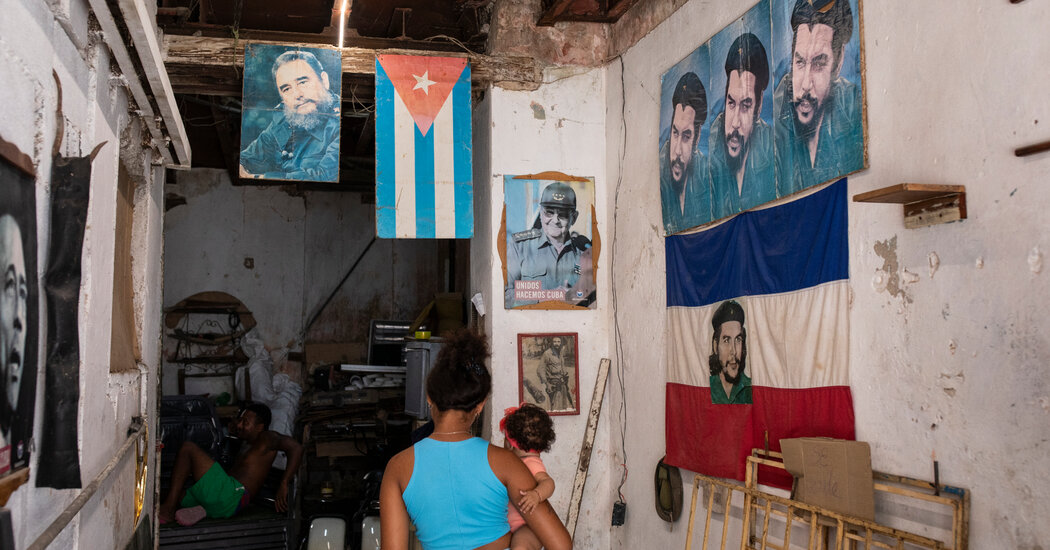
Summarize and humanize this content to 2000 words in 6 paragraphs in EnglishAs the news of the U.S. indictment of Raúl Castro, the former president of Cuba on charges of murder, spread across the world, many Cubans were kept in the dark.Widespread blackouts on the fuel-starved island and spotty phone signals meant word of the new, steep escalation in the U.S. pressure campaign on the Cuban government was slow to reach many of Cuba’s own residents.Trapped in the vise of a repressive regime and punishing American sanctions, Cubans who caught the news on their dimming smartphones and boxy TV sets split over the legitimacy of the U.S. charges — which accuse Mr. Castro of murder and conspiracy in the 1996 downing of two planes, which killed four people, including three Americans.But many shared a common exhaustion with the status quo.“This has to change,” said Yoandy Benítez Ramirez, 24, a tobacco factory worker in Havana.Cubans are facing blackouts, hunger and a health crisis, which worsened after the Trump administration all but cut off Cuba’s oil supplies in January, and many yearn for a breakthrough that might ease their suffering.The Trump administration used a federal indictment against Nicolás Maduro, the authoritarian leader of Venezuela, as the pretext to remove him with a raid in January. It is not known whether the U.S. military is moving toward a similar operation in Cuba. But many Cubans wondered whether the indictment was just another move in a painful, prolonged U.S. pressure campaign, or the catalyst for a more muscular U.S. intervention.“I don’t think a military intervention is the solution, but if that’s what it takes, well — what we need is for this to end once and for all, right now,” said Yasiel Lugones, 27, a delivery driver as he sat on his motorbike in Havana.He said that he hoped for a comprehensive dismantling of Cuba’s entire ruling class. “The whole leadership, the entire Castro family,” he said.“This is an endless cycle, we’ve been dealing with the same thing for over 60 years,” Mr. Lugones said. “They spend their time there acting as if we were a piece of property, passing it to you, to you, to you, and they have to leave now. We don’t want them.”The Cuban government immediately condemned the Justice Department’s indictment on Wednesday. Cuba’s president, Miguel Díaz-Canel, called the indictment “a political action, lacking any legal basis,” and said it was being used to build the case for potential military aggression against the island.Some Cubans called the accusations illegitimate, arguing that Cuba had acted in self-defense after its airspace was repeatedly violated by the aid group that organized the flights, Brothers to the Rescue.“Cuba took the right decision to shoot them down,” said Frank Alejandro Font, 24, a mechanical engineer in Havana.He also cautioned about the risk of a foreign military raid.“Many Cubans are asking for an intervention,” he said, but warned, “there is always collateral damage.”Rumors had spread in Cuba in the days preceding the announcement that something was going to happen on Wednesday. Would the U.S. conduct a military intervention? Would a large protest form in the country? Young Cubans grimly joked with older Cubans that they should be ready to pull out the old Soviet rifle they’ve got stashed away.The worsening of life conditions in Cuba have led to a growing number of protests, but experts say the demonstrations are unlikely to grow into a popular uprising that threatens the regime.Reliable polling is hard to find in Cuba. A recent survey by a Cuban news website, El Toque, which gathered over 40,000 answers, found that about 56 percent of Cubans who reside in the island, and nearly 70 percent of those abroad, would support a military intervention by the U.S.While the results of the survey — which gathered answers from voluntary participants — could not be considered as a representative poll, its findings likely did reflect the exhaustion of many Cubans, said Prof. Michael J. Bustamante, a professor of history and chair in Cuban and Cuban American Studies at the University of Miami.“I don’t think it means that Cubans relish the idea of a foreign power coming in and fixing their problems,” Professor Bustamante said. “But I think people are at such a level of exasperation, desperation, they’ll take help for from wherever they can get it.”Raúl Cardoso, a 70-year-old Cuban retiree, said whatever the U.S. decision, they should just hurry up and take it.“If they are going to go in, they should come in,” Mr. Cardoso said. “And if not, they should stop talking so much.”
In Blackout-Hit Cuba, Word of U.S. Castro Indictment Spreads Slowly
Keep Reading