




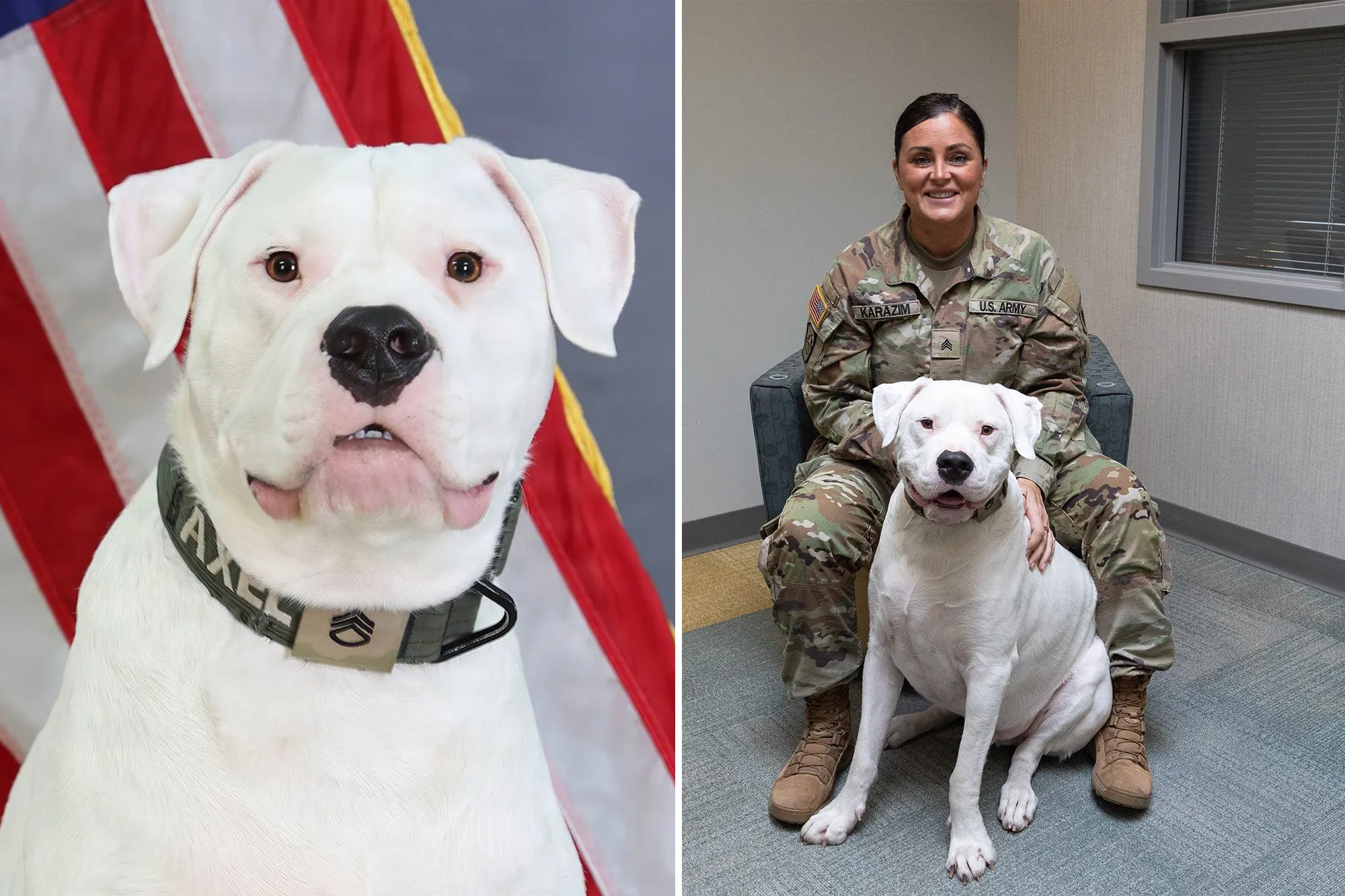
In the hazy predawn hours at Selfridge Air National Guard Base, the air hangs heavy with the gravity of departure. Soldiers in crisp camouflage exchange final, teary embraces with loved ones, their boots scuffing against the tarmac as they prepare to board a massive transport plane destined for an unspoken, likely volatile deployment. Amid the clatter of gear and the low rumble of engines, a striking, ghost-white figure moves with an almost ethereal calm—Axel, a three-year-old Dogo Argentino, his muscular frame carrying the weight of a lion and his coat the color of fresh snow. To a casual observer, Axel seems a fearsome relic of a bygone era, a breed bred to hunt wild boar and stand against formidable adversaries. But Axel’s battlefield is not the jungle or the desert; it is the human soul. He is a ministry dog, a certified emotional and spiritual companion, deploying alongside the Michigan National Guard. What makes his story utterly remarkable is that he is profoundly deaf—he has never heard a marching band, a shouted order, or the whimper of a soldier in distress. Yet, in the crushing silence of his world, Axel has discovered a lexicon far more profound than the spoken word. He does not need to hear the prayers of the faithful because he sees the hope in their eyes; he does not listen to the confessions of the broken because he feels the tremble in their chests. As he dons his custom vest—embossed with a small heart and a cross—he watches his handler, awaiting the silent hand signal that will guide him up the plane’s ramp. There is no bark, no whine, only a steady, deliberate gait. Axel is entering the fray, armed not with teeth and claws, but with an unending reservoir of patience and empathy. His mere presence challenges our definition of military might, suggesting that sometimes the most potent weapon in a soldier’s arsenal is the gentle touch of a soul that asks for nothing in return.
Axel’s journey to that tarmac was not forged in a single moment of inspiration but in thousands of tiny, patient interactions that built a bridge across an abyss of silence. Learning over fifty distinct commands is a monumental feat for any canine, but for a deaf dog, it requires a complete reimagining of obedience and understanding. There are no verbal cues like “sit,” “stay,” or “heel.” Instead, Axel responds to a rich tapestry of visual signals—dynamic hand gestures, precise finger snaps that create visible vibrations, deliberate shifts in his handler’s posture, and even the subtle beam of a flashlight pointed at the ground to redirect his focus. His training began when he was a puppy, and his handler, a dedicated volunteer with a background in service dog training, discovered that Axel’s disability was actually a hidden superpower. Without the distraction of auditory noise, Axel became hyper-observant, reading the micro-expressions on a human face—the clenching of a jaw, the welling of tears, the sudden tensing of shoulders—with a precision that hearing dogs rarely achieve. Each command is a dance between them; the handler signs, and Axel responds with a speed that borders on telepathy. This training required a level of trust so profound that it humbles all who witness it. Because Axel cannot hear praise or criticism, his rewards are purely tactile—a gentle rub behind the ears, a scratch under the chin, the taste of a favorite treat. He learned to associate his handler’s smile with safety and a furrowed brow with correction. Dogs are creatures of routine, but Axel’s routine is built on a silent, mutual respect, a partnership where sound is entirely irrelevant and heart-speak is the only language. The hours spent training were not just about teaching a dog tricks; they were about forging an unbreakable covenant. Every hand signal became a promise of safety; every completed task was a testament to their unwavering bond. Axel doesn’t just know commands; he understands purpose. When his handler gives the signal for “rest,” Axel knows he is being asked to settle the anxious energy of a nearby soldier; when he sees the signal for “visit,” he knows to move to a specific person and offer his head for comfort. This deep comprehension is what elevates him from a pet to a professional.
As a ministry dog, Axel’s role is distinct from that of a traditional service animal or a therapy dog. A therapy dog offers generalized comfort; a service dog performs specific tasks for a person with a disability. But a ministry dog operates in the spiritual and emotional domain, acting as an extension of the chaplaincy, designed to break down the walls that soldiers throw up around their trauma. Military culture is famously stoic, often equating emotional vulnerability with weakness. A soldier might sit silently through an entire counseling session, unwilling to vocalize the nightmares that plague them, fearing judgment, reprisal, or the simple inability to find words for the unspeakable. Axel changes the equation entirely. Because he is deaf, he is the ultimate embodiment of the confidential ear—he cannot repeat what he hears because he cannot hear at all. He sees everything, however. He sees the shame in a bowed head, the grief in a tired posture, the anxiety in a pacing body. He offers a non-judgmental presence that invites soldiers to unburden themselves in ways they never could with a human counselor. A soldier can kneel down, rest their forehead against Axel’s warm, solid shoulder, and whisper the darkest secrets of their deployment into his snow-white fur, knowing that their words will be swallowed by the silence and released into the air without consequence. The Michigan National Guard recognized an acute need for this kind of support; the mental health crisis among veterans is staggering, and spiritual resilience is often the bedrock of psychological survival in combat zones. Chaplains are invaluable, but they often remain linked to the command structure. Axel is neutral. He is a fellow traveler, a furry comrade who asks for nothing but gives everything. His presence is a conversation starter. Soldiers who have never prayed find themselves stroking his ears and muttering their hopes. Hardened sergeants sit on crates of ammunition and tell Axel about the photos in their helmets. He ministers not with scripture, but with empathy, walking alongside soldiers on patrols, flying with them in the holds of aircraft, and sleeping in the corner of the base chapel. Wherever there is pain, Axel positions himself as a silent sentinel, ready to absorb it, ready to lick the tear-laden hand that reaches for him.
The true measure of Axel’s impact cannot be quantified in official reports; it is written in the eyes of the troops he encounters. Imagine a muddy forward operating base. Soldiers have just returned from a tense patrol, adrenaline crashing into exhaustion. A young infantryman, barely old enough to shave, sits apart from his buddies, staring at nothing while holding a photo of his family. The chaplain approaches, but the soldier shakes his head—words are impossible right now. That’s when Axel appears. His handler gives the silent signal, and Axel pads over, pressing his heavy head against the man’s knee. It is a tactile offer of solidarity. The soldier flinches, looks down, and something breaks inside him. He wraps his arms around Axel’s neck, burying his face in the white fur. He talks—about the friend he lost last week, the guilt of surviving, the panic that grips his chest every time a door slams. He speaks because Axel’s silence is not empty; it is full of acceptance. In another corner, a female officer struggles with the crushing weight of command. She finds Axel during her off-hours, tracing the scars on his broad chest. She doesn’t speak in full sentences; she just exhales a long, shaky breath. “You don’t know how hard this is, buddy,” she whispers. Axel raises a paw and places it on her boot, a gesture of shared burden. He cannot offer operational advice, nor can he rewind time to fix what went wrong. What he offers is the rarest currency in a warzone: presence. In a world where the radio screams coordinates, where medics shout for supplies, and where sergeants bark orders, Axel provides a pocket of silence. That silence gives soldiers permission to feel. It is a safe space to rebuild the emotional armor they must wear in battle. He doesn’t judge the tears that stain his fur, nor does he flinch at the confessions of sin. He simply stays. He stays until the trembling stops. He stays until the breath evens out. He stays until the soldier is strong enough to stand, pat him once, and return to duty with a heart no longer carrying its burden alone.
The logistics of deploying a deaf dog into a combat environment are as meticulous as they are heartwarming. Axel is not a pet smuggled along for morale; he is an officially recognized member of the unit, complete with his own set of specialized gear. His custom-fitted tactical vest holds patches for the Michigan National Guard and a blue cross denoting his ministry role. He wears booties to protect his paws from scorching sand or freezing tundra, and he travels with a specialized harness that allows him to be safely lowered from aircraft or guided over obstacles. Because he cannot hear incoming danger, his handler must remain hyper-vigilant, teaching Axel to read changes in tension through the leash—a tightened lead means danger, a relaxed lead means the path is clear. This creates an unbreakable loop of mutual responsibility: Axel’s physical survival depends on his human, and the soldiers’ mental survival depends on Axel. On base, he is treated with the same respect as a decorated officer, given a designated sleeping area near the chapel. The soldiers affectionately call him “The General” because of his stoic, silent inspections of the troops. There is a profound irony at play. Military history celebrates German Shepherds as scouts and Labradors as bomb detectors, all prized for their acute hearing. Yet here is a deaf Dogo Argentino serving a role entirely separated from sensory input. The battlefield is a cacophony of destruction—artillery fire, rotor blades, and flashing explosions—yet the most comforting figure is one blissfully oblivious to the noise. Axel doesn’t flinch at the sound of a mortar, nor does he startle at a gunshot. His world is one of visual certainty and tactile connection, which gives the soldiers a profound sense of grounding. When the world is upside down, Axel is a constant, silent pillar. He is a living metaphor for resilience, proving that even when we cannot hear the world around us, we can still find our purpose, our mission, and our pack. He may not sniff out IEDs, but he defuses emotional bombs with every gentle wag of his tail, every wet nudge of his nose, and every loyal, steady step he takes beside his soldiers.
As the transport plane lifts off, carrying Axel and the brave men and women of the Michigan National Guard toward an uncertain horizon, his story offers a profound lesson to those of us left behind. We often view disabilities as limitations, as obstacles to be overcome. Axel flips that narrative with heartbreaking elegance. His deafness did not disqualify him from the highest calling; it qualified him for it, granting him a superpower of perception—an unclouded, compassionate view of the human heart. In a world that has become deafeningly loud, filled with 24/7 news cycles, relentless notifications, and the constant static of digital chatter, Axel teaches us the invaluable art of stillness. He shows us that we don’t need to hear to understand; we need to look, to feel, to offer our pure presence rather than just our unsolicited advice. He is a living witness that communication is far more than sound; it is intention, rhythm, and gaze. The soldiers he serves are receiving a masterclass in unconditional love. When they return home, they may forget the taste of rations or the color of the desert sky, but they will never forget the weight of Axel’s head on their lap when they were at their lowest. They will never forget that a creature who had never heard a single word of affection still knew exactly how to give it. That is the miracle of Axel: a tiny speck of light in the massive machinery of war, a reminder that reaching out requires no voice. As we wish him godspeed on his deployment, we are reminded of our own mission—to listen with our eyes, to comfort with our silence, and to be truly present for those who need us. In this extraordinary deaf dog, we see the very best of humanity reflected back at us: a silent, steadfast, unwavering hope that walks on four paws, straight into the storm, to sit beside a soldier and simply be there. God bless Axel, and God bless the troops who carry him into the fray.