

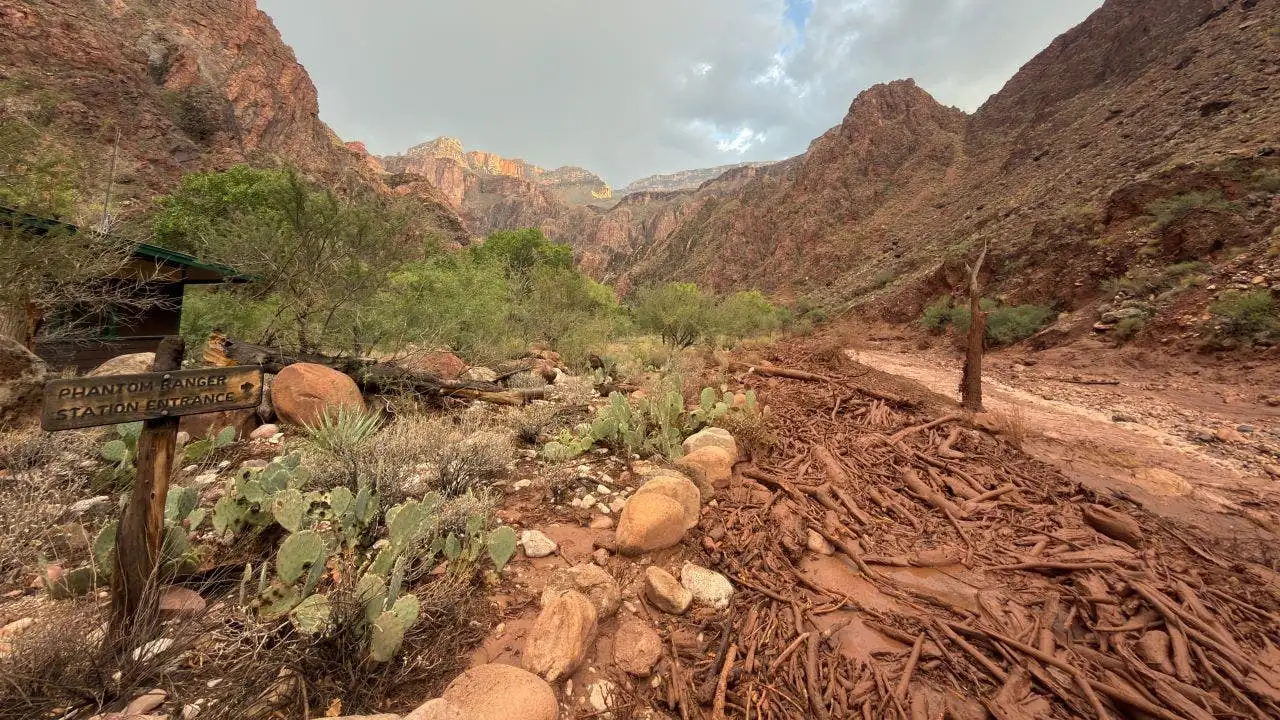
Even in a landscape as vast and durable as the Grand Canyon, water can rearrange the world in minutes. That truth hit home this past Saturday, when severe flash flooding tore through Bright Angel Canyon and the Phantom Ranch area, leaving an unforgettable path of destruction in its wake. The floodwater not only reshaped stretches of the canyon floor; it knocked out the central water line that supplies the entire park, forcing the National Park Service to do something it rarely must do: put the South Rim and inner canyon under severe water restrictions. Starting at 12:00 p.m. Monday, stage four water restrictions went into effect, meaning campgrounds are now dry camping only, overnight lodging is temporarily shut down, campfires are banned on the South Rim and in the inner canyon, and water spigots are off-limits to those who haven’t planned for them. These are practical, hard-edged rules that turn a normal Grand Canyon visit into a survival-minded expedition. They also underline how vulnerable one of America’s most iconic landmarks can be when the natural systems that keep it running break down. The timing makes it worse: dozens of hikers had been out on the trails, and the race to find missing people was just beginning. The park said the flash flooding had caused “extensive damage to infrastructure,” including the Transcanyon Waterline, the crucial pipeline that carries water through the inner canyon and supplies everything from ranger stations to visitor facilities. The flood struck on August 29, with the full force of the storm slamming the remote Bright Angel Creek corridor and the beloved Phantom Ranch area. Almost every footbridge spanning Bright Angel Creek was destroyed. For anyone who knows that trail, the image is staggering: a normally peaceful creek transformed into a roaring, debris-laden river, snapping wooden and steel bridges like twigs and washing out the very pathways that thousands of hikers use every summer.
The human toll is still coming into sharper focus, and it is the part of this story that lingers longest. Park officials confirmed that a 46-year-old man died in the flooding, his body recovered from the Colorado River on Sunday night. He has not been publicly identified, and his family is left to grieve in the middle of what should have been an ordinary trip to one of the world’s most beautiful places. The tragedy does not stop there. The National Park Service is operating on a grim and uncertain estimate that as many as 15 other people may be missing. On a normal weekend, Bright Angel Creek corridor is a ribbon of life—hikers descending into the canyon, backpackers setting up camp, mule riders heading toward Phantom Ranch, international travelers clutching their permits and daypacks. Now, rangers are pleading with anyone who knows hikers or backpackers who were in that corridor on August 29 to come forward. They also want anyone who had a campground reservation in the affected area to provide details. The whole situation feels strangely personal, because these are not just names on a roster; they are people who sought the same experience that draws millions to the Grand Canyon every year. They wanted to see the great carved red walls, listen to the quiet rush of the creek, and sleep under a sky so thick with stars that it feels like a blanket. Now their families are waiting by phones, searching for news, desperate for any sign that their loved ones are alive.
The rescue effort has been enormous, but it is also a battle against time and terrain. Park officials say at least 62 people have been evacuated since the flooding began, and every one of those evacuations represents a small miracle—a hiker plucked from a washed-out trail, a camper flown out of the canyon, a family reunited in the dusty safety zone above the rim. Yet the search is by no means over. The National Park Service Investigative Services Branch is actively asking the public for any information that could help identify the missing, which suggests that rangers are still dealing with more questions than answers. The number could change as people emerge from backcountry routes or make contact with worried loved ones. In the meantime, the canyon itself remains a dangerous, beautiful, and violently unpredictable place. Flash flooding in a place like Bright Angel Creek is especially terrifying because the water comes fast and with little warning, and the steep walls leave few routes to higher ground. Even experienced hikers can be caught completely off guard. The fact that search and rescue crews managed to evacuate dozens of people despite destroyed footbridges, damaged waterlines, and dangerous mud is a testament to their skill and courage. But every hour that passes makes it harder to hold out hope for those still unaccounted for, and the emotional weight of that uncertainty hangs heavy over the entire park.
The political and community response has been swift, and it reflects the seriousness of the moment. Arizona Governor Katie Hobbs said her heart is with the families and loved ones of every person unaccounted for after the flash flooding. She made it clear that state emergency officials are coordinating closely with federal and local authorities, including Coconino County Emergency Management, to support search and recovery efforts. That kind of cooperation matters, because the Grand Canyon is not a city street or a suburban neighborhood; it is a remote, rugged landscape where rescue operations require helicopters, trained technical teams, and a deep knowledge of the terrain. Arizona Secretary of State Adrian Fontes also spoke out, calling the flooding “devastating” and thanking the first responders who continue to search for those still missing and evacuate others from the affected area. He specifically mentioned the physical damage, which includes a historic lodge near the bottom of the site and untold environmental upheaval. When he offered prayers to the community, he was speaking for a lot of people who have been watching the news from afar, wondering what they can do. The destruction is not just infrastructure and statistics; it is the loss of a place where people have made memories for generations. The historic lodge at Phantom Ranch—reached only by foot, mule, or river—is one of the world’s most unique lodging experiences. To see that community and its surroundings battered by floodwaters is a kind of grief for everyone who loves the canyon.
What makes this disaster feel especially human is the reminder of how fragile life becomes when you step away from civilization and into the wild. The Grand Canyon is not a theme park. It is a raw, ancient landscape where the elements still rule, and where something as innocent as an afternoon thunderstorm far away can send a deadly wall of water rushing through a narrow side canyon. The Transcanyon Waterline, which was so badly damaged by this flood, has long been a symbol of the park’s delicate infrastructure; it crosses some of the most unforgiving terrain in North America, and when it breaks, everything changes. Visitors who came expecting a relaxing vacation now find themselves facing dry camping rules, closed lodging, and no open flame. They must carry every drop of water they need and treat every decision as a matter of safety, not convenience. For those who were evacuated, the experience will likely stay with them forever: the sound of the water, the sight of a trail disappearing before their eyes, the fear of being stranded in the dark with nowhere to go. The search crews are not just looking for people; they are piecing together the story of what happened on August 29, minute by minute, trying to understand how a place so full of wonder could become so dangerous so quickly. The park’s request for information is also an appeal to the larger hiking community, a quiet acknowledgment that sometimes the people who can help are the ones who were there on the trail, sharing a campsite, or passing a hiker on the way down.
As the days go on, the Grand Canyon will remain a landscape in crisis, but it will also be a landscape of resilience. The physical recovery will take time. Rebuilding footbridges, repairing the waterline, clearing trails, and restoring the historic lodge will not happen in days or even weeks. But the search for the missing is the immediate priority, and everyone from national park rangers to local emergency managers is operating with that urgent mission. In the meantime, the rest of us can do more than watch from afar. We can hold out hope for every missing hiker, reach out to anyone we know who may have been in the canyon, and trust the agencies that are working around the clock. We can also remember that the Grand Canyon is not just a tourist destination; it is a living place, full of history, wildness, and unpredictability. The flood that tore through Bright Angel Creek has changed it, but it has not erased its beauty. There will be quiet mornings again, with the sun rising over the rim and the Colorado River glinting far below. There will be trails rebuilt and footbridges replaced. But for now, the canyon is a place of waiting and searching, of grief and hope tangled together. The families of the missing, the evacuated hikers, the hard-working first responders, and the people who call the canyon home all deserve our deepest compassion as this story continues to unfold. What happened on August 29 is a powerful reminder that the natural world deserves our respect, our attention, and our humility—because even in the most familiar places, the earth can still surprise us, and the greatest adventures always carry an element of risk.