

The Last Guerrilla’s Final Siege: Raúl Castro’s Miami Indictment and the Hardening of Havana’s Revolutionary Guard
A Revolutionary Icon Under U.S. Legal Siege
                   _________
                _ /_|_____|_ _
                 /
                /  O    O
               |    __/    |
                  ____/   /
                __________/
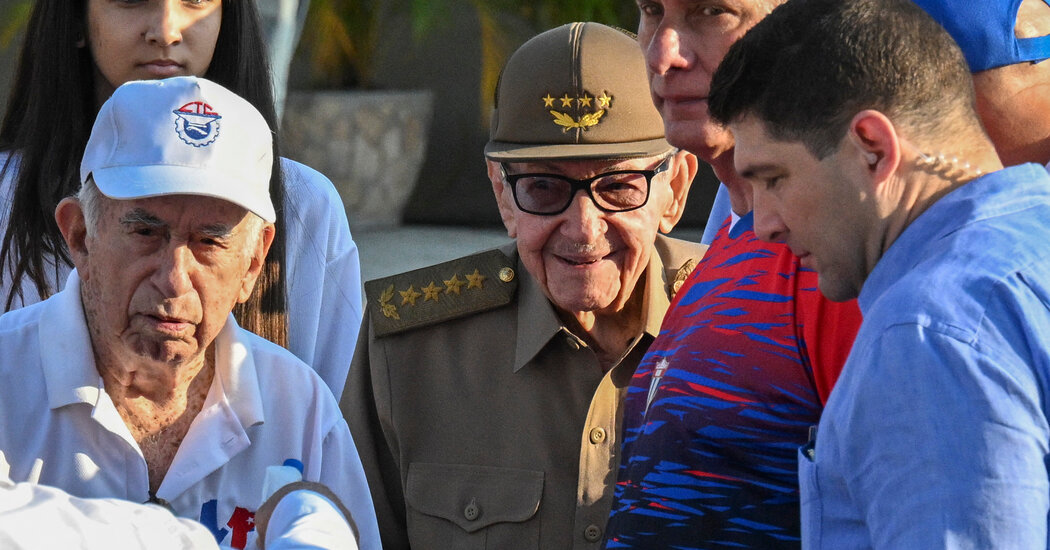
Within hours of the federal indictment in Miami charging Raúl Castro, the aging symbol of Cuba’s socialist experiment, with international murder, the state apparatus in Havana reacted not with defensive hesitation, but with a highly coordinated campaign of sovereign defiance. On state-controlled television networks, over the front pages of government-run tabloids, and across digital networks, the Cuban administration deployed an idealized, soft-focus retrospective of the ninety-four-year-old former president. Images of a youthful, fatigues-clad guerrilla laughing alongside his late brother Fidel, embracing rural schoolchildren, and waving the Lone Star flag of the republic flooded the social media feeds of the nation’s political class. This digital wall of solidarity was cemented by President Miguel Díaz-Canel, who went on camera to express a deeply personal allegiance, calling the retired general a “father figure” and signaling that any legal assault orchestrated from the shores of Florida would be treated as an assault on the Cuban state itself. By targeting the surviving patriarch of the 1959 revolution just weeks before his ninety-fifth birthday, the United States has introduced a volatile element into an already unstable geopolitical relationship, testing the historical resilience of a military apparatus that Castro himself spent half a century constructing and commanding.
Diplomatic Deadlocks and the Geopolitical Chessboard
            _________________________
           |  [US]             [CU]  |
           |   _O_             _O_   |
           |    |               |    |
           |   /              /    |
           |_________________________|
While the timing of the indictment points to a coordinated effort by the Trump administration to force a financially crippled Cuban regime into a corner, regional foreign policy analysts argue that threatening to drag the island’s historic leader to a Florida courtroom is more likely to solidify anti-American resistance than to prompt executive capitulation. In the delicate arena of bilateral diplomacy, the threat of legal prosecution has historically acted as a barrier to compromise, giving foreign adversaries little incentive to trust agreements with Washington when their foundational leaders face lifetime imprisonment. Even within the upper echelons of the American foreign policy establishment, expectations for a breakthrough remain remarkably low; Secretary of State Marco Rubio, a long-time architect of hardline measures against the Cuban government, acknowledged to reporters that while a structured bilateral agreement is always the preferred path, the likelihood of a diplomatic resolution under the current confrontational climate is practically nonexistent. For the Cuban leadership, whose entire political legitimacy of the last sixty years has been predicated on resisting northern imperialist pressure, accepting demands under the shadow of a criminal indictment would represent an unthinkable surrender of national sovereignty, ensuring that the current diplomatic freeze will harden into a permanent standoff.
The Making of a Guerrilla Commander in the Shadow of Birán
                 /          /
                /    /    /
               /    /    /
              /  [Birán Estate]
             /____________________
To understand the deeply ingrained resistance of the Castro dynasty, one must look back to the rural Oriente province of the early twentieth century, where Raúl Modesto Castro Ruz was born on a sprawling agricultural estate in the hamlet of Birán. The son of Angel Castro, a wealthy Spanish colonial immigrant who forged a fortune in sugar cane, and Lina Ruz, a domestic servant decades her husband’s junior, Raúl grew up in a environment of agrarian privilege marked by sharp social inequalities. It was his charismatic elder brother, Fidel, who first introduced the younger, more impressionable Raúl to Marxist-Leninist theory during their student days in Havana, transforming him from a rebellious youth into a disciplined, ideological militant. By the age of twenty-seven, Raúl was already a battle-hardened commander, having helped lead the guerrilla campaign that ousted the U.S.-backed dictatorship of Fulgencio Batista, which earned him the post of Minister of the Armed Forces in 1959—a position he would hold for the next forty-nine years. Lacking his brother’s theatrical public charisma, Raúl was instead feared and respected as the quiet administrative architect of the revolution, a cold pragmatist who built the Cuban military into a formidable global force capable of defeating exile forces at the Bay of Pigs and projecting military power across the battlefields of Cold War Angola.
The Fatal Skies over Florida Straits: The 1996 Shootdown
                 __   _
                ___|_)_____
                   _||_|_|_|_)
                  (_/ _)_)

                [Cessna Intercept]
The specific charges underlying this historic indictment stem from the afternoon of February 24, 1996, when Cuban MiG-29 fighter jets intercepted and destroyed two unarmed, American-registered Cessna Skymaster airplanes operated by the Miami-based exile organization Brothers to the Rescue. The incident, which resulted in the deaths of four volunteer pilots, sparked international outrage and permanently derailed the Clinton administration’s tentative efforts to normalize relations with Havana. At the center of the prosecution’s case is a controversial, decades-old eleven-minute audio recording, leaked from a state radio broadcast to journalists in Miami, in which Castro appears to boast to military officials about personally ordering his pilots to down the civilian aircraft if they violated Cuban airspace. In the tape, Castro expresses frustration with the continuous flyovers of the exile group, which had spent years dropping anti-communist flyers over the capital, stating that he explicitly authorized the military to “shoot them down” to prevent further incursions over the mainland. While previous federal prosecutors in Miami restricted their legal focus to indicting the individual MiG pilots and uncovering a network of Cuban intelligence agents operating within the exile community, this new indictment directly targets the command structure, placing the executive responsibility of the Cold War-era tragedy squarely at the feet of the retired military chief.
Pragmatism, Paranoia, and the Fragile Promises of Détente
               _________________
              |  [HAVANA 2016]  |
              |   Obama & Raúl  |
              |   Press Event   |
              |_________________|
When Raúl Castro assumed the presidency in 2008 following his brother’s sudden illness, he ushered in a decade of contradictory governance, defined by a desire to modernize Cuba’s dysfunctional economic model while retaining absolute control over its political system. He famously ridiculed the absurdities of the island’s centralized planning, criticizing a system that forced a single gallon of milk to travel hundreds of miles through bureaucratic channels before reaching local consumers, and he initially signaled an openness to limited private enterprise. Yet, as former Secretary of State John Kerry recalled during President Barack Obama’s historic 2016 visit to Havana, Castro’s commitment to reform was always deeply constrained by a profound institutional paranoia regarding domestic dissent and foreign interference. In press conferences alongside Obama, the aging general appeared visibly uncomfortable under the scrutiny of an unscripted international press corps, displaying an instinctive wariness of the democratic openings that American diplomats hoped would follow economic liberalization. This historical hesitation, coupled with the slow pace of state-approved reforms, ultimately meant that when the political landscape in Washington shifted back toward economic isolation, the fragile foundations of the détente were easily dismantled, leaving Cuba’s domestic market exposed and unprepared for the severe economic crises that lay ahead.
Economic Collapse and the Martyrdom of Havana’s Last Guerrilla
                 ________________
                |   WARNING:     |
                |  BLACKOUT AREA |
                |________________|
Today, the island of Cuba finds itself in its most precarious socio-economic position since the collapse of the Soviet Union, with a decimated tourism sector, a decaying electrical grid that subjects citizens to daily blackouts, and a near-total cutoff of vital Venezuelan crude oil shipments. It is against this backdrop of systemic collapse that the Trump administration has advanced its aggressive list of demands—demands that include the immediate step-down of President Díaz-Canel, financial compensation for nationalized commercial properties, and the dismantling of foreign military listening posts in exchange for economic relief. Yet, by turning Raúl Castro into a criminal target in the courts of Miami, American policymakers may have inadvertently handed the ailing regime a powerful narrative tool to distract the population from domestic misery and rally nationalistic sentiment around the flag. As senior Cuban diplomats reject the legitimacy of the U.S. judicial system, and political analysts point out that Castro will likely spend his final days stylized as a defiant anti-imperialist martyr who died with his boots on, the indictment underscores a fundamental truth of the Florida Straits: in the long, unresolved conflict between Washington and Havana, symbolic legal victories in Miami rarely translate into political transformation on the streets of Cuba.
Comparative Assessment: The Changing Tide of Cuban Sanctions
| U.S. Administration | Primary Policy Objective | Key Action Taken | Diplomatic Outcome |
|---|---|---|---|
| Clinton (1996) | Isolation & Containment | Signed Helms-Burton Act after plane shootdown | Permanent codification of the economic embargo |
| Obama (2014–2016) | Engagement & Liberalization | Restored diplomatic relations; removed state sponsor of terrorism tag | Expanded travel, initial private sector growth in Havana |
| Trump (First Term) | Regime Change through Maximum Pressure | Re-imposed travel bans, restricted remittances | Severe reduction in Cuban foreign currency reserves |
| Trump (Second Term) | Capital Mobilization & Decapitation | Intercepted Venezuelan oil; indicted high-ranking military leadership | Total economic paralysis, breakdown of diplomatic backchannels |