




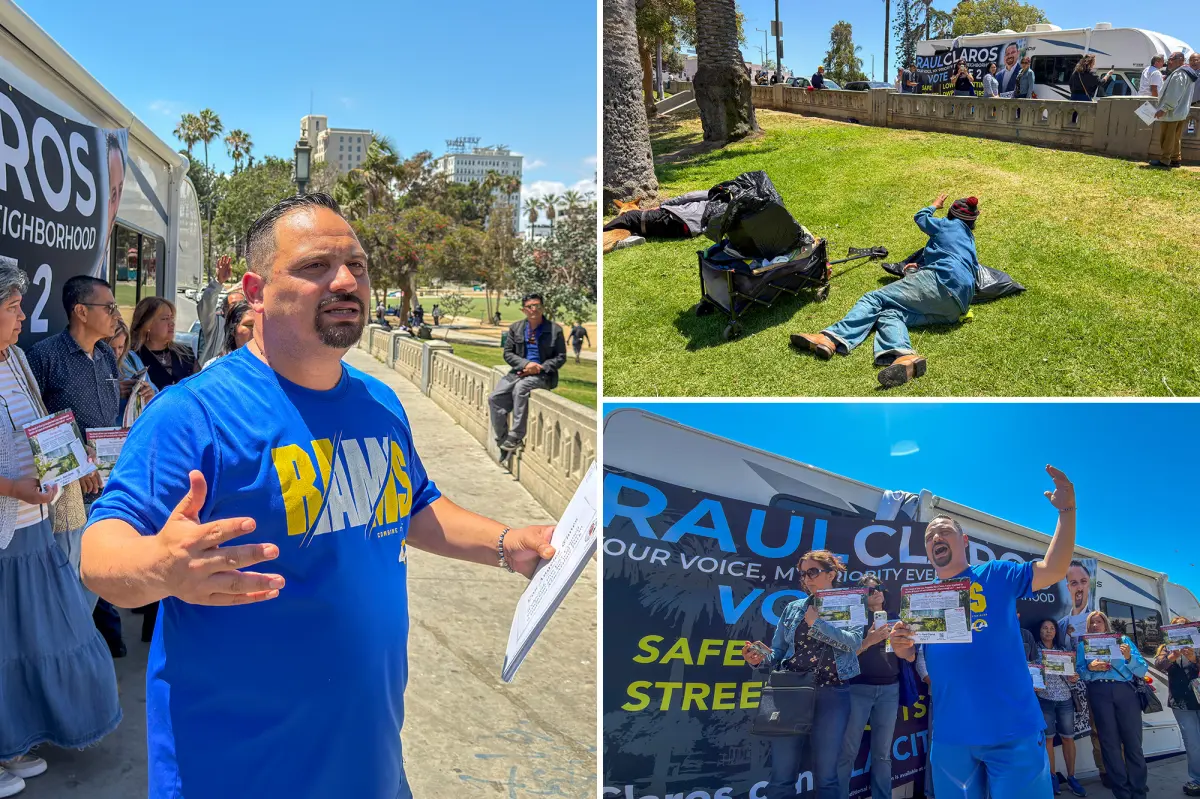
The sun-drenched, palm-lined expanse of MacArthur Park, once lovingly celebrated as the crown jewel of Los Angeles’s Westlake district and a vibrant oasis for generations of working-class immigrant families, has quietly transformed into the ultimate battleground for the political and moral soul of the city. On a dusty Friday morning, this striking juxtaposition of historical cultural splendor and modern urban crisis became the stage for a dramatic campaign maneuver when Raul Claros, a dynamic and fiercely determined candidate vying to represent City Council District 1, rolled a massive, thirty-foot recreational vehicle right into the heart of the park’s busiest corridor. Deciding to entirely bypass the polished, sterile podiums of City Hall and the exclusive, catered fundraisers of the affluent Westside, Claros chose to sleep, work, and campaign directly from the pavement of this deeply embattled green space, launching a five-day mobile tour engineered to confront one of the city’s most visible and painful leadership failures head-on. To Claros, this massive RV is not merely a clever publicity stunt or a temporary weekend photo opportunity; it is a literal and symbolic stake in the ground, representing a deep-seated, unwavering commitment to a community that has spent years pleading for help while feeling entirely abandoned by the politicians who govern them. As the rich, sensory aroma of local street food and heavy car exhaust mingled under the canopy of towering palms and historic statues, Claros made his mission clear to every passerby: he is willing to live within the trenches of MacArthur Park for as long as it takes to force the city’s power brokers to acknowledge the desperation, fear, and hopelessness felt by local residents. This unconventional occupation serves as a direct, physical challenge to the political status quo, signaling that the abstract debates of local government must finally yield to the visceral reality of a neighborhood in crisis, where the daily struggle for basic safety is lived out in the open air, just steps away from the doors of his temporary metal shelter.
The immediate physical and political urgency of Claros’s presence in the park was underscored almost immediately by the rapid, almost mechanical cadence of federal law enforcement operations happening simultaneously around him. On the very day the challenger parked his RV, a joint task force consisting of the Federal Bureau of Investigation, the Drug Enforcement Administration, and the Los Angeles Police Department executed yet another high-profile arrest, part of an ongoing, highly coordinated, multi-agency federal and local crackdown targeting a notorious, highly organized open-air drug market that has choked the life out of the neighborhood for several decades. For months, federal authorities have attempted to slice through the complex, violent criminal distribution networks that use the park’s historic lake, winding walkways, and crowded transit-adjacent streets to distribute deadly fentanyl, methamphetamine, and crack cocaine. Yet, as Claros pointedly observed while watching the blue and red emergency lights fade into the heavy traffic of Wilshire Boulevard, these dramatic law enforcement raids rarely yield lasting tranquility or peace of mind for the people who actually call the Westlake neighborhood home, who walk these streets constantly fearing for their physical safety. The morning after a massive sweep, when the tactical vehicles have cleared out and the news cameras have packed up their gear, the very same cycle of open-air drug consumption, gang turf wars, and intense human misery quietly reclaims the damp grass and cracked concrete paths. The deep-rooted societal issues do not simply vanish with a set of handcuffs and a court date; instead, they sink back into the shadows of the park, leaving local working-class shopkeepers to wash down their doorways and anxious parents to timidly navigate around discarded syringes and active overdoses on their children’s daily walks to the local elementary school. This endless loop of temporary enforcement and immediate civic relapse has bred a profound sense of exhaustion among the local immigrant community, who feel caught in an agonizing crossfire between systemic neglect and superficial government interventions that fail to address the heavy human tragedy nesting at the heart of their park.
At its deep human core, Claros’s unique, boots-on-the-ground campaign strategy is an emotional attempt to inject some deeply needed humanity back into a political landscape that has become increasingly cold, polarized, and paralyzed by administrative bureaucracy. By physically moving his campaign headquarters into the park, he seeks to bridge the immense trust gap that has widened between the resilient working-class families of District 1 and the comfortable, distant offices of City Hall, where high-level policy decisions are too often made by officials who have never had to look an anxious, struggling mother in the eye or step over an unresponsive human being on their morning commute. Claros’s message is simple but profoundly resonant: real, compassionate urban leadership requires showing up, standing with, and experiencing the discomfort of the people you aim to serve. Over the years, the surrounding neighborhood has lost its collective hope, sinking under the weight of empty political promises made by successive, highly performative, and detached municipal administrations that have treated Westlake as a theoretical case study to be analyzed rather than a community of real human beings suffering in real-time. By sitting on a simple folding chair outside his RV, Claros spent the weekend listening to the stories of street vendors who have been repeatedly robbed of their daily earnings, elderly residents who are terrified of stepping out of their apartment buildings after dusk, and parents who have watched their children grow up in the physical shadow of rampant, untreated addiction. This transformative grassroots campaign, he passionately insists, is not merely about accumulating votes; it is about restoring a basic sense of human dignity to a forgotten, hard-working population that has been forced to accept a substandard, dangerous quality of life as their inevitable reality simply because of their socio-economic status and geographic zip code.
This highly unconventional, grassroots campaign directly and aggressively challenges the controversial leadership of the District 1 incumbent, Councilwoman Eunisses Hernandez, a highly prominent progressive advocate whose term has been defined by a focus on systemic decarceration, harm reduction, and non-police community crisis interventions. While Hernandez’s idealistic social platform has been widely celebrated by national progressive organizations as a forward-thinking blueprint for social justice, it has come under intense, localized scrutiny from working-class residents who claim that her conceptual approach to public safety has allowed the physical conditions of MacArthur Park to spiral into absolute chaos. Critics argue that her administration’s ideological reluctance to aggressively enforce public space laws and her skepticism of traditional policing have created a dangerous power vacuum, one that has been rapidly filled by violent street gangs, predatory drug syndicates, and an uncontrolled surge in homelessness. This local political deadlock is indicative of a much larger national debate concerning modern urban governance, pitting progressive theorists who advocate for long-term social changes against pragmatic reformers who argue that immediate community safety, clean public spaces, and basic law enforcement are fundamental human rights that cannot wait for decades-long economic reforms to take root. Claros positions himself as a pragmatic, common-sense savior for these working-class families, arguing that while long-term social work and mental health services are critically important, they cannot serve as an excuse for ignoring the current, daily lawlessness that prevents a grandmother from safely walking through her own neighborhood park. The stark, high-stakes clash between these two fundamentally contrasting political philosophies represents a critical tipping point for District 1 voters, who must now decide whether to continue down a radical path of experimental progressivism or return to a model of governance that prioritizes physical order, visible accountability, and immediate public safety.
To transform this deep-seated communal frustration into a constructive, actionable path forward, Claros has laid out an ambitious, multi-layered blueprint aimed at fully reclaiming MacArthur Park and revitalizing the surrounding commercial corridors that form the economic heartbeat of the district. Rather than relying solely on sporadic, short-lived police raids or temporary sanitation sweeps that offer nothing more than a few days of cosmetic peace, his proposed strategy centers around the permanent establishment of a unified, on-site municipal command center located directly within the park’s geographic boundaries. This state-of-the-art command center would serve as an active, 24-hour nerve center, coordinating a massive, highly disciplined effort that unites local law enforcement, mental health specialists, compassionate addiction outreach workers, public sanitation crews, and park recreation staff into a singular, highly responsive operational force. Claros envisions a “full reset” that starts at the historic lake and slowly radiates outward into the adjacent residential streets, systematically clearing public hazards, offering meaningful shelter and rehabilitation pathways to those struggling on the margins of society, and creating a safe environment where local merchants can rebuild their small businesses without the constant threat of extortion or violence as they reclaim both the historic park and the surrounding merchant streets. By integrating compassionate human outreach with firm, consistent enforcement of city ordinances, his plan seeks to redefine what public safety looks like in a modern metropolis—not as an oppressive, hostile occupying force, but as an active, protective shield over public spaces where children can once again play on green fields and neighbors can gather under the sun. Claros insists that this comprehensive, hands-on administrative approach is the only way to break the endless, devastating cycle of neglect and criminality, ensuring that MacArthur Park can finally be restored to its historic role as a safe, beautiful sanctuary for all Angelenos.
As his thirty-foot RV winds its way through the diverse, dense, and energetic neighborhoods of Council District 1 over this crucial five-day campaign tour, Claros is carrying with him a message of profound urgency, fierce systemic resilience, and unyielding hope for the future. He knows that the hard-working people of Westlake and the surrounding neighborhoods are profoundly tired, frustrated with a political system that seems to eagerly demand their tax dollars and votes while offering nothing but empty platitudes and mounting decay in return. Yet, by choosing to lay his own head down in the very park that many of his political peers avoid at all costs, Claros is signaling a new dawn of political accountability, showing a disillusioned electorate that there are still leaders willing to step down from the ivory tower and physically fight alongside them for their community’s future. The thirty-foot RV stands as a mobile, welcoming sanctuary of democratic listening, a place where the overlooked, the hard-working, and the highly vulnerable can gather to share their dreams of a safer, cleaner, and more equitable Los Angeles. Ultimately, this hard-fought campaign is a poignant reminder that behind the dry statistics of crime rates, homelessness counts, and political polling numbers, there are real human lives, families, and businesses that deserve a city government capable of delivering basic decency, security, and respect. Whether Claros ultimately excels at the voting booth during the upcoming election or not, his bold demonstration in MacArthur Park has permanently shifted the municipal conversation, forcing Los Angeles to look into the mirror and confront the painful, agonizing reality of its most famous park, while offering a visionary blueprint of how a city can rebuild itself from the ground up, starting with a leader who is simply willing to show up, listen, and stay.