





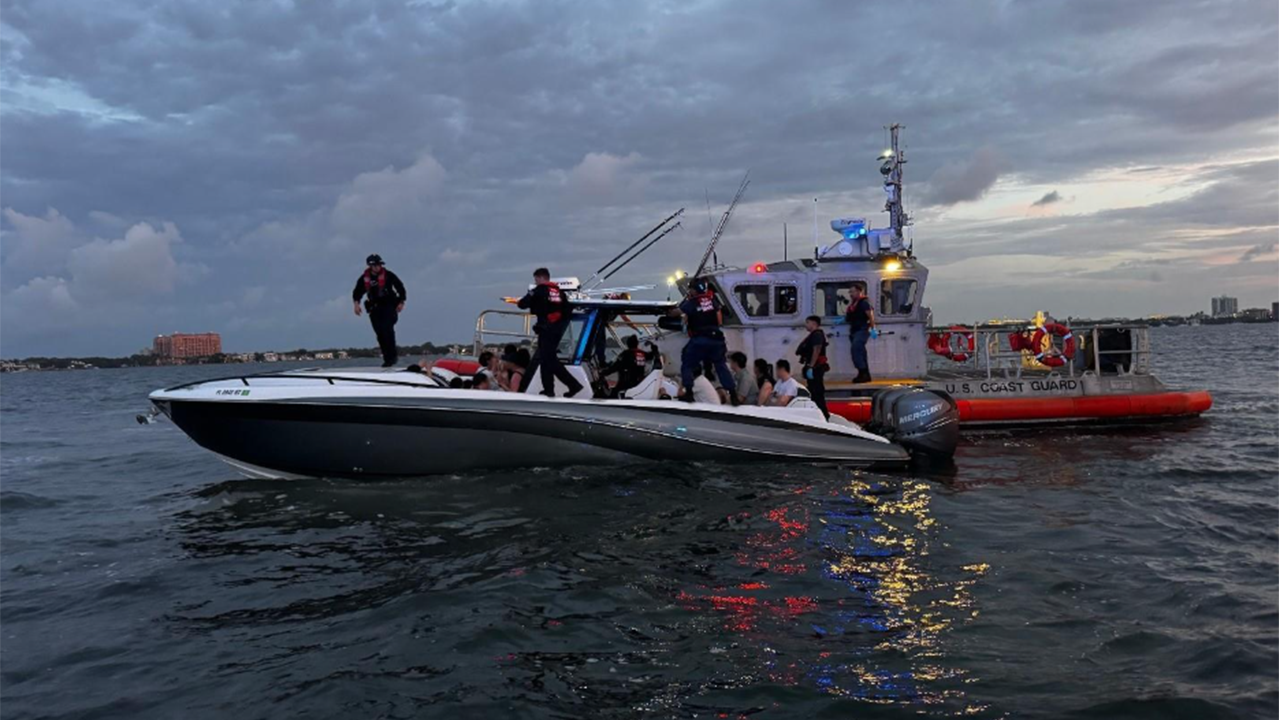
The azure waters drifting just a mile south of Key Biscayne, Florida, are typically associated with leisure, luxury yachts, and the serene beauty of the Atlantic Ocean. However, on the morning of June 10, this idyllic marine landscape became the stage for a heart-stopping, high-stakes maritime confrontation that underscored the harrowing, often hidden realities of the global migration crisis. A suspicious, overcrowded vessel carrying twenty-five Chinese nationals was spotted navigating toward the Florida coastline, triggering an immediate and urgent response from United States Coast Guard crews stationed at Miami Beach. As the patrol vessels converged on the target, commanding officers issued clear, unmistakable commands for the vessel to halt. Instead of complying with maritime law, the operator of the migrant boat throttled forward, initiating a dangerous game of evasion that threatened the lives of everyone crowded on board. Faced with a noncompliant vessel refusing to yield to standard law enforcement protocols, the Coast Guard crew had to make split-second, high-pressure tactical decisions amid the rushing wind and splashing ocean spray. They first deployed warning shots—deafening rounds fired into the water directly ahead of the fleeing vessel, meant to signal the absolute gravity of the situation and compel the operator to surrender. When these warning shots went completely unheeded, the tension escalated to a critical threshold, forcing the tactical team to employ “disabling fire.” This highly controlled, precise measure involves firing specialized munitions directly into the vessel’s outboard engines to destroy its physical propulsion systems and halt its forward momentum. It is an action of last resort, demanding immense skill, focus, and composure on a rolling deck. Miraculously, despite the inherent chaos and danger of firing live rounds at a moving target packed with people, the operation was executed flawlessly; the vessel’s engines were neutralized, the boat ground to a halt, and remarkably, not a single injury was reported among the passengers or crew, bringing a highly volatile, potentially tragic pursuit to a safe, controlled, and successful conclusion.
Beneath the clinical legal terminology of “maritime interdiction” and “noncompliant vessel” lies a deeply poignant, underreported human narrative of desperation, risk, and the pursuit of an elusive better life. The twenty-five Chinese nationals huddled aboard that disabled boat had embarked on a journey of unimaginable physical distance and psychological strain, navigating a complex, clandestine global underground to finally reach the shores of Florida. For many migrants from China, the painful decision to leave their homeland involves severing all ties with family, accumulating devastating debts to pay transnational human smuggling syndicates—often referred to as ‘snakeheads’—and enduring exhausting, multi-country journeys that frequently cross through South America, Central America, or the Caribbean. The final leg of this grueling odyssey, crammed onto a relatively small and open vessel subject to the violent, unpredictable whims of the ocean, is often the most terrifying segment of all. As the roaring Coast Guard cutters surrounded them and the sharp, deafening sound of gunfire shattered the sea air, the psychological terror experienced by these passengers must have been utterly paralyzing. Stranded in a foreign ocean, caught between the oppressive environments they fled and the impenetrable wall of American border enforcement, their dreams of reaching the United States evaporated in a plume of oil, engine smoke, and cold sea spray. By humanizing these individuals, we are forced to look beyond the polarized, frequently detached political debates surrounding immigration policy and recognize that they are not a faceless demographic; they are mothers, fathers, sons, and daughters who risked everything, placing their lives in the hands of unscrupulous smugglers who viewed them merely as profitable cargo rather than human beings, only to watch their perilous journey end in handcuffs and confinement just a short distance from the glittering, unreachable skyline of Miami.
From the perspective of the men and women wearing the Coast Guard uniform, the incident off Key Biscayne represents one of the most stressful, demanding, and high-stakes challenges in modern maritime law enforcement. Boarding officers and boat crews undergo continuous, rigorous training to prepare for intercept missions, but nothing can completely eliminate the intense rush of adrenaline and the heavy moral weight of a real-world scenario where kinetic force must be applied near living human beings. Utilizing disabling fire is an immense responsibility that requires absolute psychological discipline; even a minor miscalculation, an unexpected wave, or a split-second moment of hesitation could result in a catastrophic loss of life, turning a standard law enforcement operation into a tragedy that would haunt the crew forever. These service members are acutely aware of the duality of their mission—they are sworn guardians of national security, tasked with defending the maritime borders of the United States, yet they are also life-savers who operate under the sacred seafaring code of assisting those in distress at sea. When a smuggler refuses to capitulate, they intentionally force the Coast Guard into a dangerous tactical corner, demanding that the crew balance the necessity of border enforcement with the preservation of human life. The safe, successful resolution of the June 10 operation, culminating in zero casualties or injuries, stands as a testament to the profound discipline, technical proficiency, and emotional control of the Coast Guard Station Miami Beach personnel. Once the vessel was safely halted and secured, the crew immediately shifted from a tactical mindset to one of humanitarian care, transitioning from armed guardians into compassionate caregivers who distributed clean water, conducted initial medical checks, and offered warm clothing to the terrified, shivering, and exhausted passengers.
Following the successful neutralization and securing of the vessel, the focus of the operation shifted from the tactical hazards of the open ocean to the structured, administrative machinery of federal border enforcement. The twenty-five Chinese migrants were carefully, transitionally transferred from their disabled boat to the stable decks of the Coast Guard Cutter Margaret Norvell, a state-of-the-art Fast Response Cutter designed to handle mass migration processing, medical triage, and temporary transport. Meanwhile, their seized vessel was towed back to the secure docks of Station Miami Beach to be cataloged as physical evidence of a major smuggling event. Instantly, a powerful multi-agency operation swung into action to investigate the hidden network behind this smuggling attempt, recognizing that the boat crew was merely part of a larger, highly lucrative criminal enterprise. Special agents from Immigration and Customs Enforcement’s Homeland Security Investigations (HSI)—a branch specialized in dismantling transnational criminal organizations—initiated an exhaustive criminal inquiry, actively supported by Customs and Border Protection (CBP) Air and Marine Operations. This collaborative federal response highlights the government’s determination to target not just the migrants themselves, but the wealthy syndicates that profit from human smuggling. The incident also served as a highly visible platform for the Department of Homeland Security to project a message of strict deterrence. DHS Acting Assistant Secretary Lauren Bis delivered an uncompromising warning designed to echo far beyond the Florida coastline, stating unequivocally that the nation’s borders are closed by both land and sea, and advising anyone contemplating an unauthorized entry to abandon their plans entirely. This firm stance underscores the ongoing political and administrative tension between enforcing rigid statutory boundaries and managing the relentless pressure of global migration.
This dramatic confrontation near Key Biscayne did not occur in a vacuum, but rather within the framework of a highly organized, perpetual defense initiative known as Operation Vigilant Sentry. Established as a comprehensive, multi-agency operational plan, Vigilant Sentry integrates local, state, and federal assets to maintain a constant, highly visible presence throughout the Florida Straits, the Caribbean Sea, and the surrounding maritime corridors. The waters surrounding the Florida peninsula are deceptively beautiful, hiding treacherous currents, unpredictable tropical weather patterns, and vast expanses of open ocean that can quickly turn an unauthorized migration voyage into a horrific maritime disaster. Lieutenant Matthew Ross, the commanding officer of Coast Guard Station Miami Beach, emphasized the profound dangers inherent in these voyages, noting that individuals who entrust their lives to smugglers are frequently subjected to substandard vessels, lack of life jackets, inadequate fuel, and zero navigation equipment. In many cases, these vessels are entirely unseaworthy, leaving migrants vulnerable to extreme sun exposure, severe dehydration, and the catastrophic risk of capsizing in deep waters where rescue is highly unlikely. The Coast Guard’s regular patrols under Operation Vigilant Sentry are as much about search and rescue as they are about law enforcement; countless lives have been saved from sinking, overcrowded boats that were on the verge of tragedy. The blunt reminder from maritime authorities that unlawful voyages will result in interdiction and swift repatriation serves as a necessary, sobering counter-narrative to the false promises sold by human smugglers who downplay the mortal dangers of crossing the sea to maximize their profits. By maintaining this continuous, vigilant posture, law enforcement partners strive to disrupt the deadly trade of human smuggling before the vast and unforgiving Atlantic claims more victims.
Ultimately, the incident off the coast of Florida is a striking microcosm of a much broader, systemic global crisis that continues to challenge the political, ethical, and logistical structures of the modern world. The rising trend of Chinese nationals attempting to enter the United States through unconventional, highly dangerous maritime routes in the Caribbean highlights the deeply globalized, interconnected nature of modern migration, which is no longer confined to traditional land-bound pathways. Driven by economic uncertainty, political constriction, or the simple desire for personal liberty, individuals are willing to cross hemispheres and entrust their survival to criminal facilitators who exploit their vulnerabilities for financial gain. These human smuggling syndicates operate with a callous, predatory disregard for human life, treating people as disposable cargo to be discarded or run aground when law enforcement approaches. Until the root causes of global displacement and the financial incentives of transnational smuggling networks are comprehensively addressed, the cycle of desperate voyages and dramatic interdictions is bound to continue. The event of June 10 serves as a stark reminder of the delicate, complex balance that must be maintained on our waters: a balance between national security, humanitarian responsibility, and the rule of law. It shines a light on the brave Coast Guard crews who stand watch on the front lines, the desperate migrants caught in the middle, and the urgent need for a more comprehensive, secure, and humane approach to migration that prevents the open ocean from becoming a perilous battlefield for human survival.