



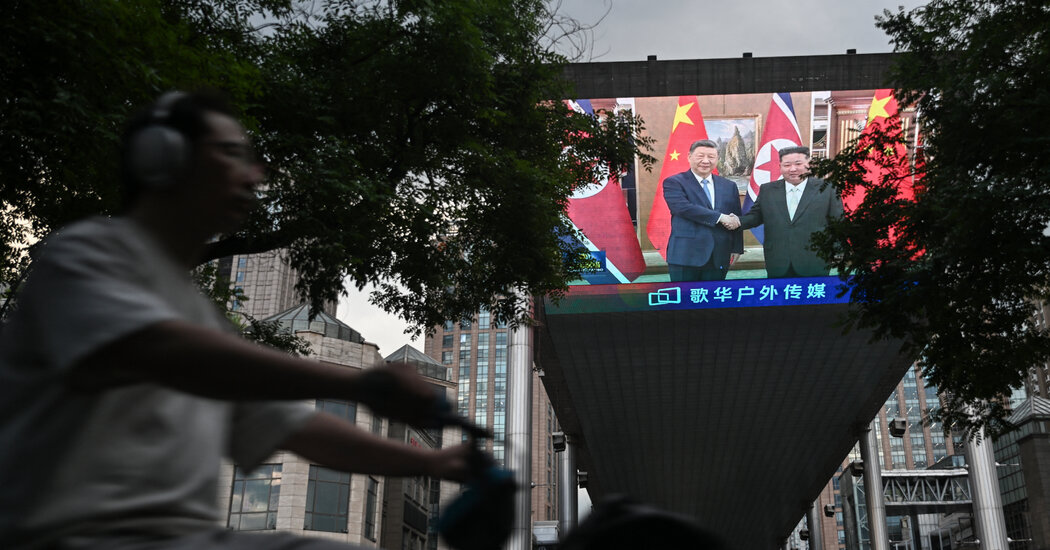
The grand avenues of Pyongyang were transformed on Monday into a carefully choreographed theater of solidarity and geopolitical theater. As China’s top leader, Xi Jinping, stepped onto the tarmac for his first visit to North Korea in seven years, he was met with a sensory blitz designed to project flawless unity to a watching world. Beside the newly emboldened dictator Kim Jong-un and his elegant wife, Ri Sol-ju, Mr. Xi looked out over a sea of fluttering national flags, military honor guards standing in rigid precision, and thousands of cheering, dancing children clutching vibrant balloons into the grey sky. Yet, beneath the booming brass bands, the meticulously rehearsed smiles, and the lavish state-sanctioned pageantry lay a subtle, razor-sharp message from Beijing: despite North Korea’s recent geopolitical maneuvers, China remains its ultimate lifeline, its primary economic patron, and its indispensable shield against the pressures of the United States. Through this highly publicized journey, Mr. Xi sought to remind his younger, increasingly assertive counterpart that while alliances may shift, the road to Pyongyang’s survival still runs directly through the corridors of power in Beijing.
The geopolitical landscape of Northeast Asia has grown increasingly complex, and Mr. Xi’s high-profile two-day visit serves as a calculated counterweight to the growing influence of Moscow in the region. Two years ago, North Korea and Russia signed a historic mutual defense pact, a milestone that revitalized the isolated state’s battered economy and infused Mr. Kim with a newfound sense of confidence. By supplying ammunition, missiles, and eventually tactical troops to support Vladimir Putin’s military campaign in Ukraine, Mr. Kim successfully traded military hardware for vital shipments of Russian oil, basic foodstuffs, and cutting-edge aerospace technology. This lucrative transaction with Moscow has gave the North Korean leader a much stronger hand, reducing his absolute dependence on Beijing and allowing him to negotiate with China from a position of relative strength. By arriving in Pyongyang with a massive delegation, Mr. Xi sought to subtly reassert China’s traditional dominance, ensuring that Beijing remains the primary arbiter of affairs on the Korean Peninsula and preventing Mr. Kim from drifting too far into the Kremlin’s orbit of influence.
Behind the closed doors of the Kumsusan Guest House, a lush and heavily guarded sanctuary reserved for the state’s most esteemed visitors, the two leaders engaged in deep discussions aimed at mapping out their shared future. According to official summaries released by Chinese state media, Mr. Xi repeatedly emphasized the critical necessity of “close strategic communication” and called for the rapid expansion of bilateral exchanges “at all levels and in all fields.” Framing their partnership in the loftier terms of his own global vision, the Chinese president expressed an eager willingness to deepen relations in what he frequently calls the “new era”—a signature phrase he employs to signal China’s rise as a dominant, self-assured superpower on the international stage. In practical terms, Mr. Xi offered a sweeping array of cooperative agreements spanning crucial domestic sectors including agricultural modernization, science, public healthcare, and state-vetted tourism. For the average North Korean civilian, who has long endured chronic food insecurity, erratic medical services, and severe economic isolation, these promises of structural cooperation hold deep, life-altering significance, even as they serve as powerful chips in the high-stakes game of global diplomacy.
Perhaps the most telling aspect of the summit was what remained unsaid, highlighting a profound shift in how Beijing views the threat of a nuclear-armed neighbor. In its official briefings, China made no mention whatsoever of North Korea’s controversial nuclear weapons program, choosing instead to focus on the vague, harmonious pursuit of “jointly safeguarding regional peace and development.” Historically, China has stood firmly against Pyongyang’s nuclear ambitions, deeply anxious that a nuclear-capable North Korea would provoke neighboring democracies like South Korea and Japan into pursuing their own nuclear arsenals or inviting more US military assets to the region. Yet, as relations between Washington and Beijing have deteriorated into a state of semi-permanent strategic competition, China’s calculus has shifted dramatically. Analysts note that Beijing now appears to view North Korea’s nuclear capabilities not just as a regional hazard, but as a useful pressure point and strategic leverage against American military encirclement, prompting a quiet transition from serving as an anxious mediator for denuclearization to acting as a powerful patron protecting a vital buffer state.
To cement this sense of shared destiny and appeal to the deep-seated patriotism of his host, Mr. Xi deliberately leaned into the emotional, conflict-spanning history shared by the two communist nations. He made repeated references to their joint struggle against United States forces during the Korean War, a grueling conflict that forged a “traditional friendship” that was, in his own evocative words, “forged in blood.” This historical appeal was amplified by a personal letter from Mr. Xi published on the front page of Rodong Sinmun, North Korea’s chief state-run newspaper, where he declared that their bilateral relations had arrived at a “new historical starting point.” In a series of thinly veiled broadsides, the Chinese leader urged both nations to stand shoulder-to-shoulder in opposition to “hegemonism and power politics”—a clear critique of American foreign policy—while also warning against unnamed regional actors attempting to “revive militarism,” a direct swipe at Japan’s expanding defense posture. By invoking these old ghosts of foreign intervention and colonial aggression, Mr. Xi successfully cast China and North Korea as natural, historical allies fighting against a common Western adversary.
Yet, this grand vision of a united front must ultimately contend with the harsh economic realities of a heavily sanctioned North Korea and the complicated machinery of global trade. Despite Mr. Kim’s desire to boost exchange with China to secure the foreign reserves required to prop up his regime, North Korea’s primary exports—including coal, textiles, seafood, and iron ore—remain strictly prohibited under sweeping United Nations Security Council resolutions. While China and Russia have grown increasingly bold in their reluctance to enforce these punitive measures, publicly denouncing the use of diplomatic isolation and economic pressure, any overt violations risk drawing further international condemnation and economic blowback. This protective embrace from two global superpowers has clearly emboldened the North Korean dictator; only days before Mr. Xi’s arrival, Mr. Kim toured key missile manufacturing plants and a newly operational uranium enrichment facility, boasting that he would expand his nuclear arsenal at an “exponential rate.” As the summit concluded and the state banners were folded away, it became clear that while North Korea remains a volatile and heavily armed actor, its destiny remains deeply tethered to China’s overarching strategic vision for a new, post-Western world order.