



The Dangerous Bluff: Prime Minister Mark Carney Warns Alberta’s October Referendum Echoes the Perils of Brexit
A Warning from the Highest Office: Carney Warns of a National Rift
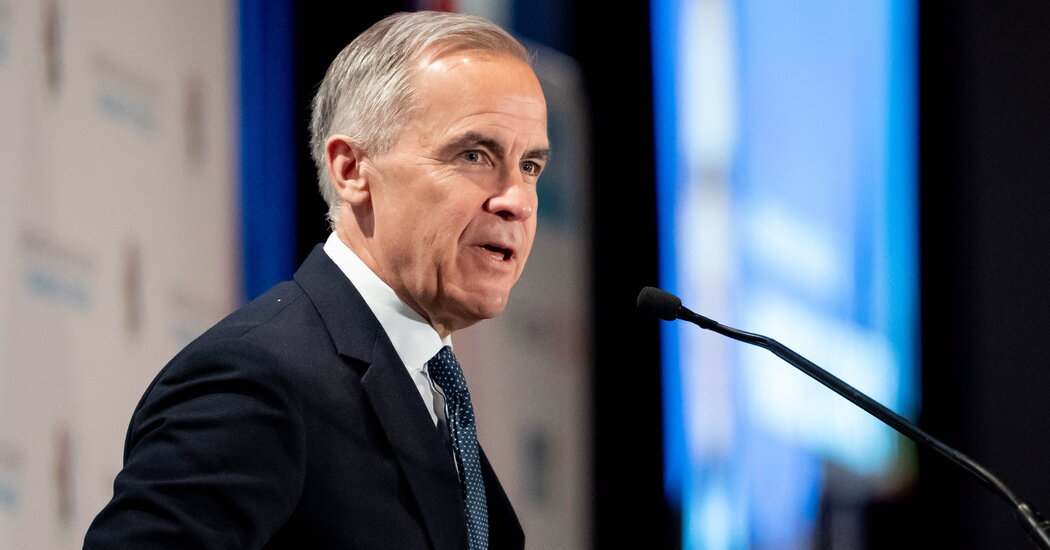
On Monday, Prime Minister Mark Carney of Canada delivered a sharp, historic warning to the nation, cautioning that Alberta’s upcoming referendum on a potential separation from Canada could spiral into a “dangerous bluff” with irreversible consequences. Drawing on his unique experience as the former Governor of the Bank of England during the United Kingdom’s turbulent 2016 Brexit vote, Carney urged both political leaders and everyday citizens to recognize the terrifying ease with which speculative political gambles can fracture a nation. He addressed a crowded press conference in Ottawa, expressing deep concern over Alberta Premier Danielle Smith’s sudden announcement that her government will push forward with a high-stakes provincial vote scheduled for October 19. The Prime Minister, who now leads a federal government tasked with keeping a diverse and economically polarized federation together, argued that using the threat of secession as a mere bargaining chip to extract concessions from the federal government is a path fraught with economic ruin and constitutional instability. Carney’s remarks represent a significant escalation in federal-provincial tensions, signaling that the federal government is no longer willing to treat Western separatist rhetoric as mere posturing, but rather as an active threat to the country’s macroeconomic stability and national unity. By linking Alberta’s current political trajectory directly to the systemic miscalculations that characterized the British exit from the European Union, Carney sought to inject a dose of grim economic realism into an increasingly emotional and polarized regional debate.
The Architecture of October’s Vote and the Fractured Response
The core of the burgeoning constitutional crisis lies in the specific and controversial design of the referendum scheduled for October 19, which has managed to anger both ardent federalists and passionate pro-independence activists alike. Under the framework devised by Premier Danielle Smith’s administration, Albertans will not be asked a simple, binary question about making an immediate exit from the Canadian federation; instead, the ballot will ask voters to decide whether they wish to remain in Canada or authorize the provincial government to hold a subsequent, legally binding referendum to secede. This dual-stage structure has drawn fierce criticism from all sides of the political spectrum, creating an unusual alliance of opponents who view the phrasing as either an act of political cowardice or a deceitful manipulation of democratic processes. Pro-independence activists argue that the provincial government is robbing Albertans of a genuine, direct opportunity to declare their desire for a sovereign state, reducing a historic movement to a multi-tiered bureaucratic negotiation tactic. Conversely, Canadian federalists and supporters of national unity are deeply incensed that the very concept of Canada’s territorial integrity is being put on a ballot at all, arguing that subjecting the nation’s borders to a provincial poll undermines the constitutional order. Premier Smith’s decision to pursue the referendum is seen by critics as a highly calculated maneuver to bypass traditional legal and legislative channels, especially after she intervened to keep the initiative alive following a lower court decision that had struck down an initial citizen-led petition for the vote. By rewriting the question and pushing forward despite judicial pushback, Smith has demonstrated a determination to force this existential question onto the provincial stage, framed under the guise of honoring the democratic rights of her constituents.
The Brexit Playbook: When Strategic Bluffs Turn Into Economic Reality
In invoking his years at the helm of the Bank of England, Prime Minister Mark Carney provided a vivid, firsthand account of how easily political leaders can lose control of populist movements once they are unleashed through referendums. Reflected in his warnings was the memory of the 2016 British vote, where many politicians and voters supported the “Leave” campaign not because they truly desired a hard break from the European Union, but because they believed the threat of departure would force Brussels to grant the United Kingdom unique structural and economic concessions. “I saw firsthand what happened in the United Kingdom when the view was, vote for this, it’ll be soft, and then we’ll negotiate,” Carney told reporters, pointing out that ten years later, British policymakers are still struggling to mitigate the structural damage of a decision that many voters did not fully comprehend at the time. As the head of Britain’s central bank during that era, Carney had faced intense political criticism for warning of the severe economic consequences of Brexit—a stance his detractors labeled as an inappropriate intrusion of an apolitical banker into partisan politics. However, the subsequent devaluation of the British pound, the disruption of established trade corridors, and the chronic productivity challenges that plagued the post-Brexit British economy ultimately validated his warnings, forcing him to deploy aggressive monetary policy measures to stabilize the financial system. By applying these hard-earned lessons to Canadian politics, Carney warned that Alberta’s leadership is playing a remarkably similar and reckless game, assuming they can negotiate a comfortable, “soft” separation from Canada without triggering a devastating flight of capital, currency destabilization, and the destruction of the province’s fiscal security.
Oil, Taxes, and the Deep Roots of Western Alienation
To understand why the threat of an Alberta separation referendum has gained such significant traction, one must examine the deep-seated structural grievances that have fueled Western alienation for generations. At the heart of Alberta’s frustration is the ongoing conflict over climate policy and the oil industry, which serves as the primary engine of the province’s affluent economy. For years, Albertans have watched with growing anger as federal environmental regulations put in place by the previous liberal administration led by Justin Trudeau placed increasingly stringent limits on carbon emissions, pipeline construction, and fossil fuel extraction. Many in the province’s energy sector view these policies not as necessary environmental protections, but as an existential threat designed to systematically stifle Alberta’s economic growth while ignoring the global demand for Canadian oil and gas. This regulatory frustration is compounded by a long-standing resentment over Canada’s federal equalization and taxation system, wherein Alberta’s immense natural resource wealth contributes disproportionately to the federal treasury. Many Albertans feel that their hard-earned provincial revenues are confiscated by Ottawa to subsidize public services in economically stagnant parts of Eastern and Central Canada, creating a profound sense of exploitation. This toxic mix of identity politics, economic anxiety, and regulatory fatigue has pushed separatist sentiment from the historical fringes of Alberta politics directly into the mainstream. A recent poll conducted by the Angus Reid Institute highlighted the severity of this shift, revealing that 35 percent of Albertans would currently vote “yes” to pursue secession in October—a dramatic increase from historical baselines that typically hovered between 25 and 30 percent, signaling a structural fracture in Canadian unity.
The Paradox of Trans-Provincial Pipeline Diplomacy
The public clash between Prime Minister Mark Carney and Premier Danielle Smith is made all the more compelling by the complex, cooperative relationship the two leaders have maintained when it comes to practical economic matters. Despite their diametrically opposed views on federalism and national sovereignty, Carney and Smith have worked closely over the past year to advance several ambitious industrial projects, finding common ground on the necessity of geting Alberta’s heavy crude to global energy markets. Specifically, the federal government under Carney has actively cooperated with Smith’s administration to facilitate the completion of a major pipeline corridor designed to carry Albertan oil across the Rocky Mountains to deepwater ports on the Pacific Coast of British Columbia, allowing Canadian producers to bypass the saturated market of the United States and sell directly to energy-hungry economies in Asia. This collaboration highlights the bizarre paradox of the current crisis: Smith has repeatedly stated that she personally hopes Alberta will remain a part of Canada and intends to campaign in favor of the union during the October vote, yet she has simultaneously built the legal and political infrastructure to make a separation possible. This dual-track strategy reveals a high-stakes legislative gamble where the threat of provincial secession is utilized as an extreme form of leveraging power. Carney’s willingness to publicly criticize Smith’s referendum while continuing to work with her on infrastructure development demonstrates a sophisticated approach to leadership, separating long-term national economic planning from the immediate necessity of defending the constitutional integrity of the Canadian federation.
The Search for Democratic Mandate and the Road Ahead
As Canada looks toward the pivotal October deadline, the fundamental debate centers on whether the scheduled referendum possesses genuine democratic legitimacy or is merely an artificial crisis manufactured for partisan benefit. Prime Minister Carney has explicitly rejected Premier Smith’s assertion that she is simply acting in accordance with her democratic duty to honor the wishes of those Albertans actively campaigning for self-determination. In a series of cutting rhetorical questions, Carney challenged the idea that this vote represents the authentic, expressed will of the electorate, noting that the issue of separation was never presenting itself on the ballot during the last provincial election, nor was it featured within the platform mandates of either the governing United Conservative Party or the official New Democratic opposition. “Is it helpful to ask these fundamental questions? No, it’s not helpful,” Carney observed, emphasizing that introducing a highly divisive constitutional question without a clear electoral mandate is an evasion of responsible governance that threatens to permanently polarize the country. With the October 19 vote rapidly approaching, the stakes for Canadian federalism, climate policy, and national cohesion have never been higher. Whether Albertans heed Carney’s warnings about the economic realities of a “dangerous bluff” or decide to double down on a high-stakes strategy of confrontation, the outcome of this referendum will undoubtedly redefine the relationship between Ottawa and the West, shaping the economic and political landscape of Canada for decades to come.