


On a seemingly ordinary Wednesday evening around 7:00 p.m., the familiar, comforting hum of Culver City, California, was abruptly and violently shattered by an act of sudden, intimate violence that no one in the neighborhood could have anticipated. For the vast majority of local residents, the night was supposed to be a quiet transition from the hectic workday—perhaps a time for preparing family dinners, winding down in front of the television, or taking casual walks along the tree-lined sidewalks of this vibrant, usually peaceful Los Angeles-area community. Instead, this peaceful evening routine was fractured when a normal moment turned into a living nightmare for one individual who was suddenly confronted by an aggressive suspect brandishing a knife. Under the terrifying and immediate threat of physical violence, the victim was forced to surrender their vehicle, watch helplessly as their personal safety and boundaries were deeply violated, and stand stranded in shock as the suspect sped off into the darkening streets. This initial carjacking was not merely a theft of property; it was the catalyst for a terrifying sequence of events that would soon put entire neighborhoods on high alert. The stolen vehicle, now in the hands of a deeply volatile and dangerous driver, ceased to be a simple mode of transportation and was instantly transformed into a deadly, multi-ton weapon of opportunity. As emergency police dispatchers began receiving the first frantic calls from the scene, a palpable sense of dread took hold of the first responders who rushed toward the area, realizing that an armed, desperate, and highly unpredictable individual was now loose on the heavily congested streets of Culver City. The psychological toll on the initial victim, left standing on the cold asphalt in a state of utter shock, was only the first chapter of a broader tragedy that would soon unfold, illustrating how quickly the fragile veneer of public safety can be pierced by a single individual’s reckless actions.
As the stolen vehicle surged through the arterial streets of Culver City, the suspect’s driving pattern shifted from desperate flight to an active, hostile, and seemingly targeted assault on the public. Witnesses on the sidewalks watched in absolute horror as the car began to swerve wildly across multiple lanes, completely disregarding basic traffic laws, running red lights with impunity, and aggressively mounting the curbs onto sidewalks where everyday citizens were walking. It became chillingly clear to those looking on that the driver was not merely attempting to evade capture; he appeared to be using the heavy vehicle as a blunt instrument to systematically target and strike innocent pedestrians. The sheer panic of that realization reverberated through the streets as people scrambled for cover behind light poles, steel utility boxes, parked cars, and storefront alcoves to escape the oncoming threat. Before a formal police pursuit could even be fully coordinated by local departments, the driver had already struck two unsuspecting pedestrians, leaving them severely injured and reeling on the asphalt as he continued his highly hazardous rampage. The sickening sound of screeching tires, crushing metal, and the terrified screams of onlookers filled the cool evening air, instantly transforming peaceful commercial corridors into active, chaotic emergency zones. For those individuals simply walking home or stepping out of local establishments, the sudden appearance of a car barreling directly toward them on a pedestrian walkway was a surreal, life-and-death ordeal where survival depended entirely on split-second human reflexes. The absolute vulnerability of the human body compared to a roaring machine of steel highlighted the terror of the attack, leaving the neighborhood in a state of profound shock and disbelief as the suspect fled, leaving a wake of trauma behind him.
The situation escalated rapidly from a localized emergency into a high-risk, multi-jurisdictional police pursuit as officers from the Culver City Police Department mobilized, spotted the stolen vehicle, and attempted to bring the unfolding nightmare to a swift end. The chase quickly spilled out of Culver City limits and entered the dense, bustling urban grid of Los Angeles proper, a transition that dramatically increased the statistical likelihood of further civilian tragedy. Inside their patrol cruisers, officers wrestled with the immense psychological and tactical burden of chasing a hostile suspect through highly populated corridors. They were forced to make split-second, high-stress decisions, constantly balancing the urgent necessity of stopping a violent felon against the agonizing potential for collateral damage that high-speed pursuits inherently carry in major metropolitan areas. Sirens wailed and emergency lights painted the glass facades of surrounding buildings in strobes of red and blue, screaming a warning to other motorists and pedestrians that a severe threat was rapidly approaching their location. Yet, despite the overwhelming and highly visible presence of law enforcement, the suspect remained totally undeterred, driving with a chaotic, almost suicidal recklessness that pushed the pursuit to its absolute physical limits. During this terrifying flight through Los Angeles, the suspect’s willingness to inflict harm showed no signs of abating; he collided with four additional pedestrians, further compounding the physical trauma inflicted on the community and leaving victims scattered across different intersections. In addition to the human targets, multiple innocent drivers in their own vehicles were sideswiped, rearended, and forced off the road, transforming a standard evening commute into a chaotic survival scenario for dozens of unsuspecting individuals trapped in the suspect’s destructive path.
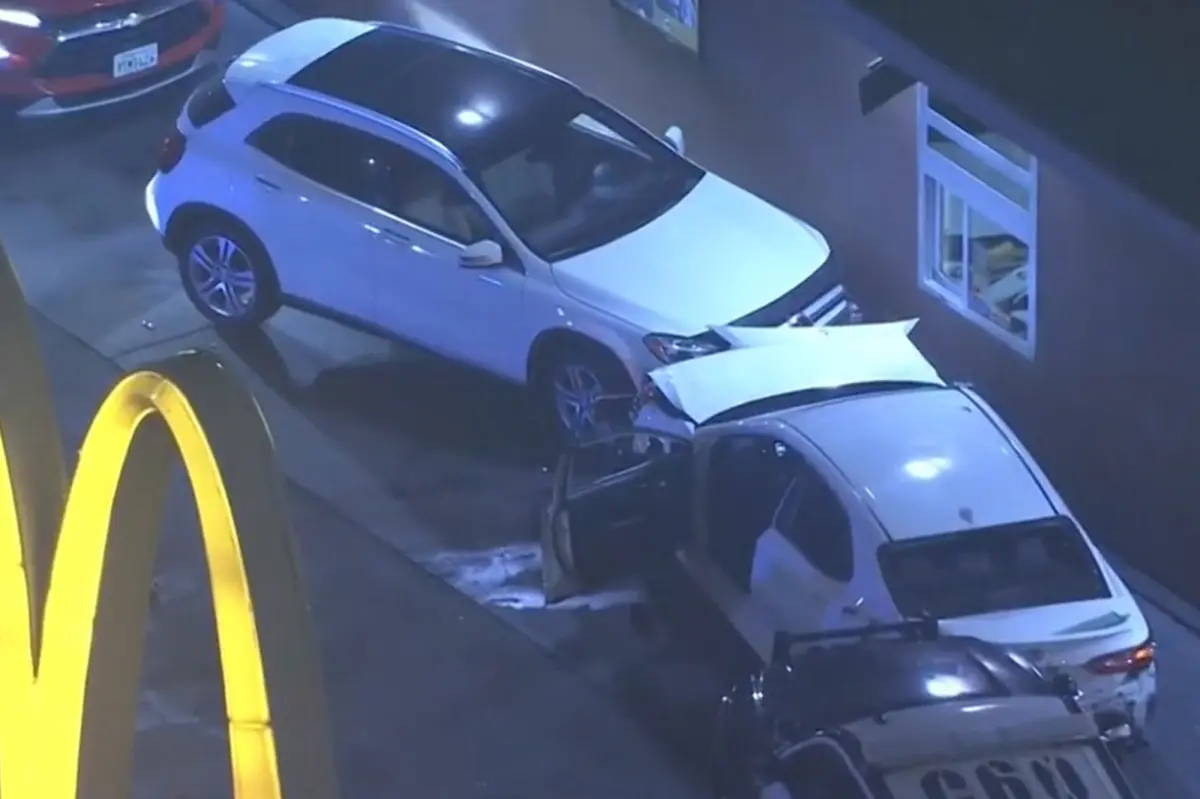
Every high-speed pursuit eventually reaches a physical breaking point, and for this terrifying ordeal, the dramatic climax occurred in one of the most mundane and unexpected locations imaginable: a local McDonald’s drive-thru lane. This spot, ordinarily associated with late-night convenience, familiar family routines, and comforting fast food, was suddenly transformed into the epicenter of a violent, high-stakes confrontation. Seeking a desperate escape route or perhaps utterly blinded by cascading panic, the suspect steered the battered, stolen vehicle directly into the narrow drive-thru lane, where unsuspecting families and individuals were trapped in their vehicles, waiting for their orders with absolutely no way to escape. The sudden intrusion of the suspect’s car, closely followed by a phalanx of police cruisers with guns drawn, shattered the calm of the restaurant workers and patrons, who looked out in absolute disbelief as their immediate surroundings were overrun by armed officers. With nowhere left to maneuver within the concrete confines of the lane, the suspect’s frantic bid for freedom culminated in a violent, metal-crunching crash, bringing the chaotic chase to a grinding halt. However, the danger did not instantly evaporate; during the high-stress struggle to secure the vehicle and apprehend the hostile occupant, a dedicated police officer was injured. This injury served as a stark, painful reminder of the physical jeopardy that first responders willingly encounter on a daily basis, placing their own safety on the line to bring a violent rampage to a conclusion. As handcuffs were finally secured and the suspect was extracted from the smoking wreckage, the immediate threat to the public ended, leaving the fast-food environment looking like a war zone littered with shattered glass, deployed airbags, and the stark glare of emergency lights.
With the suspect finally in custody, the immediate threat to human life was neutralized, but the long and arduous process of physical, mental, and legal recovery was only just beginning for the victims and the community at large. The suspect, who sustained only minor injuries during the final, crushing collision in the drive-thru, was transported to a local hospital under heavy police guard to be medically cleared before facing the full weight of the criminal justice system. The legal consequences currently awaiting him are exceptionally severe, featuring a long laundry list of felony charges that prominently includes attempted murder—a charge that speaks directly to the apparent intentionality and lethal nature of his actions throughout the evening. Meanwhile, both the community and law enforcement officials were left to grapple with the baffling and deeply unsettling question of what could have driven someone to commit such an atrocious act. Culver City Police Lieutenant Atenza perfectly captured this collective sense of bewilderment and anxiety during a subsequent press briefing, admitting that investigators remained entirely in the dark regarding what could have possibly motivated the suspect to launch such a targeted and destructive assault on random citizens. Atenza emphasized that while the suspect’s internal thought process remains a mystery, the objective reality of his actions was undeniably clear: he acted with a reckless, terrifying disregard for human life, systematically putting countless innocent people in extreme jeopardy. For the victims who were struck down on the streets, whose medical conditions remained frustratingly undisclosed, and for the traumatized witnesses who watched the horror unfold, the lack of an obvious motive only added to the psychological difficulty of processing this senseless tragedy.
In the sobering days following this terrifying incident, the narrative within the region began to touchingly shift from the chaotic details of the crime itself to the resilient recovery of the affected community. Culver City and the broader Los Angeles metropolitan area are sadly familiar with the hazards of urban traffic, but the targeted and violent nature of this vehicular assault struck a raw nerve, forcing a collective conversation about pedestrian safety, mental health crises, and the inherent vulnerability of shared public spaces. Neighbors quickly rallied around one another, organizing support systems for the injured pedestrians whose lives were so abruptly upended, and expressing a profound sense of gratitude for the rapid, decisive actions of first responders and paramedics who prevented an even greater tragedy from unfolding. The injury sustained by the arresting officer during the final confrontation highlighted the profound daily sacrifices made by law enforcement, fostering a deeper sense of community connection and mutual respect between the public and those sworn to protect them. As the formal investigation continues to meticulously compile evidence, analyze surveillance footage, and interview traumatized eyewitnesses, the physical debris on the city’s streets has been cleared, but the emotional echoes of that fateful Wednesday will undoubtedly linger. Ultimately, this frightening event serves as a stark, humanizing reminder of the fragility of our daily routines and the vital importance of solidarity in the wake of senseless violence. Through their shared resilience and determination to reclaim their streets, the residents of Culver City are showing that while a single destructive act can temporarily shatter the peace, the enduring strength of a community bound by care, empathy, and collective courage can never be truly defeated.