



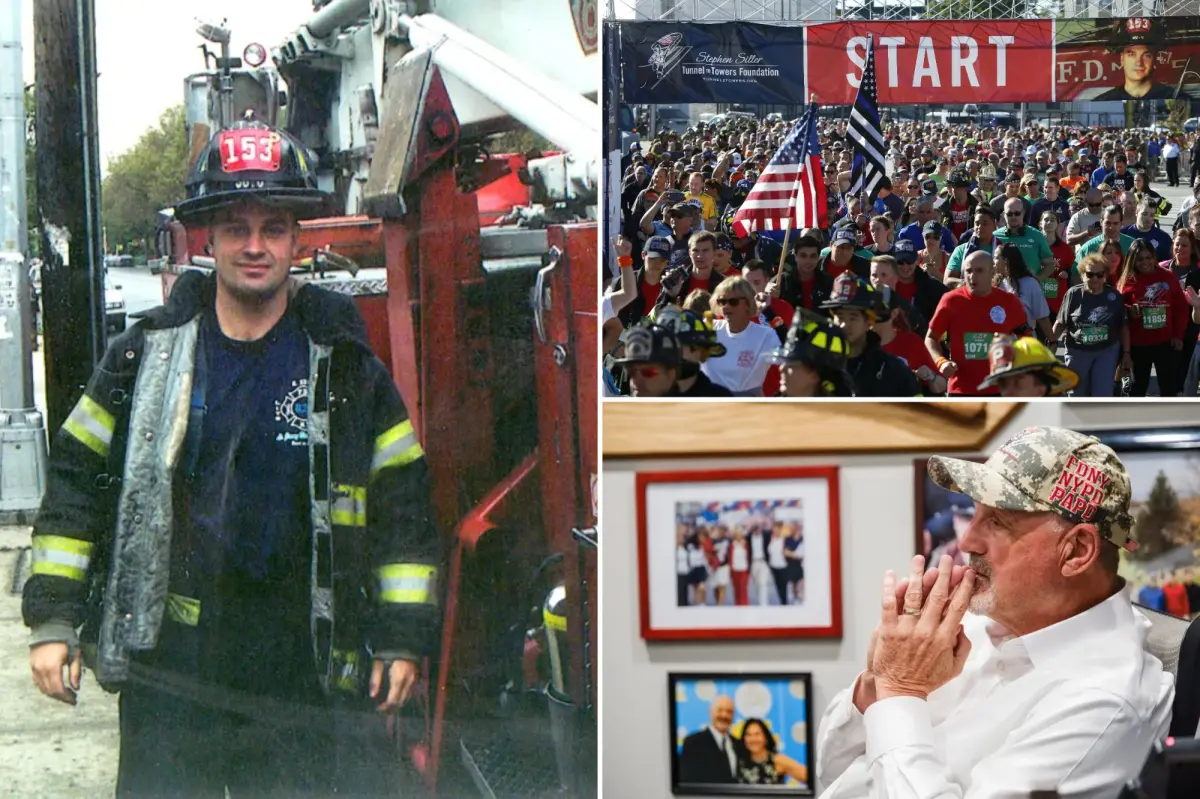
The morning of September 11, 2001 began like any other, but Frank Siller woke into a nightmare he somehow felt before it was confirmed. He remembers turning to his mother-in-law and saying, “I think I just lost my brother,” the words coming out before his mind could catch up. The sickness in his stomach told him everything. His brother Stephen, a New York City firefighter, had just finished his shift and was heading home to Staten Island when news broke that a plane had struck the North Tower of the World Trade Center. Stephen didn’t hesitate. He turned his truck around, drove to the Brooklyn Battery Tunnel, strapped on sixty pounds of equipment, and ran through the darkness toward the smoke and chaos. That image—a man in full bunker gear sprinting through a tunnel while others were fleeing—would become one of the defining symbols of that terrible day. Frank spent hours in agony, waiting for word. The confirmation came from Stephen’s friend and fellow firefighter Richie Obermeyer, who called from Ground Zero. The words were as brutal as they were final: “No one is coming home, Frank. No one.” Stephen, a married father of five, never came home. But in that moment of devastation, something else was born: a family’s refusal to let his sacrifice be wasted. Frank later said the news was brutal, but it was also when their faith kicked in. The Sillers, a devout Catholic family, were faced with an agonizing choice—let the grief consume them, or take the love and courage Stephen had shown and turn it into something that would help others. They chose the latter, and that choice would eventually touch thousands of lives.
To understand that choice, you need to know the Siller family, and Frank’s book “Let Us Do Good” is partly an introduction to the people who shaped them. Stephen was the youngest of seven children, born to George and Mae Siller, who raised their big, raucous brood in a small Staten Island home full of noise, faith, and love. They didn’t have money, but Frank remembers that they had each other, and they had great friends. Stephen was a “larger than life” boy, a passionate fan of the Knicks and Royals legend George Brett, and his childhood seemed bright. Then, when he was just ten years old, everything changed. Their father died of a heart embolism, and a year and a half later, their mother died too. Stephen was suddenly an orphan, but he was not alone. His much older siblings—Frank is fourteen years older—took him in and made sure he was raised in the Siller way. It wasn’t easy. Frank recalls taking his little brother to a park one day, and Stephen broke down crying, telling him he wished he had never been born. Frank held him and said, “I know God put you on this Earth for a reason, and I know someday you are going to do something very special.” Those words proved prophetic. But Stephen himself had an eerie sense of his fate. Years later, he admitted to his wife Sally that he felt compelled to make the most of every single day because he had a deeply held premonition that he would die young. That urgency was part of what made him so alive, so loving, and so fearless. It also made his final run toward the burning tower not a random act of heroism, but the last expression of a life that had always been aimed at service. Frank writes about all of this with aching honesty, including his own complicated feelings: in a very selfish way, he’d rather have his brother back. He would happily be helping someone else’s foundation if Stephen were still here. That admission makes his work more human, more real, and more powerful.
After Stephen’s death, the six surviving Siller siblings had to decide what to do with their grief. They were devout, and their faith didn’t offer easy answers; it offered a direction. As Frank put it, they could let the tragedy define everything, or they could take what Stephen did and thank him for his sacrifice by doing good in his name. They launched the Tunnel to Towers Foundation, originally intended to help children who had lost parents in the attacks. In 2002, they organized a 5k run that retraced Stephen’s route through the Brooklyn Battery Tunnel. It was a way for people to feel, even for a few minutes, what Stephen had felt—the weight of the gear, the echo of footsteps, the pull of duty. The first run drew 1,500 participants. This year, there will be 30,000. That growth reflects something deep in the American spirit: people are hungry for stories of selflessness, especially when the world feels divided and cynical. But the foundation didn’t stop at that annual run. It has expanded far beyond 9/11 families, because the Sillers recognized that the same spirit of service lives in every first responder and veteran who puts their life on the line. They build “smart homes” for injured veterans, homes designed around their specific disabilities so they can live with dignity and independence. They provide housing for homeless veterans, pay off mortgages for Gold Star families so that those who lost a loved one don’t also lose their home, and offer scholarships to children of the fallen. The mission, Frank says, was inspired by Stephen’s selfless action, but also by St. Francis of Assisi, who said, “While we are here, let us do good.” That simple phrase became a kind of family motto. It’s not about grand gestures or political statements. It’s about showing up for people in their worst moments, the way Stephen showed up for strangers he would never meet.
Frank’s book is also a love letter to his parents and to the ordinary, beautiful world of his childhood. He wanted to introduce people to George and Mae Siller, who raised seven children in that raucous Staten Island home. They had very little in material terms, but they gave their children an inheritance of faith, loyalty, and humor. Frank describes his own childhood as glorious, and even though Stephen’s was marked by loss, the older siblings worked hard to make sure he never felt abandoned. That foundation of family is why Tunnel to Towers has been able to grow into a nationwide force. By the end of 2026, the foundation will have delivered more than 2,000 mortgage-free homes to veterans and first responders’ families. That’s not just a statistic; it’s 2,000 front doors, 2,000 families who can breathe a little easier, 2,000 communities where a hero’s sacrifice is honored in bricks and mortar. Along the way, the foundation has drawn support from celebrities like Sylvester Stallone, Mark Wahlberg, and Dave Portnoy, who have lent their names and voices to raise money. But Frank is quick to say that the boldface names aren’t the real story. The real story is in the faces of the families he has sat with in the raw aftermath of loss, when the shock is still fresh and the reality hasn’t yet set in. He writes about those moments with a tenderness that can only come from personal experience. He knows what it’s like to get that phone call. He knows what it’s like to live with the “what ifs.” And he knows that the only way through the darkness is to keep moving, keep serving, keep doing good. That’s why the foundation keeps adding new initiatives, from disaster relief to programs for veterans suffering from PTSD. Every program is an answer to a simple question: What would Stephen do? And the answer is always the same: run toward the need.
One of the most striking things about Frank Siller is his honesty about the cost of this calling. He admits that, in a selfish way, he would trade every home, every ceremony, every headline to have his brother back. That’s hard to say, and harder to feel. But it’s also what makes him trustworthy. He isn’t running a charity to feel good about himself; he’s running it because he made a promise to his brother’s memory. And he has kept that promise in ways that go far beyond what anyone could have imagined in 2001. The foundation now works with thousands of families every year, and Frank has made it his personal mission to be present for them. He sits in their living rooms, listens to their stories, holds their hands, and lets them know that their loved one’s sacrifice will not be forgotten. He writes about these encounters with a reporter’s eye and a brother’s heart, capturing moments of grace in the middle of grief. There is the widow who doesn’t know how she’ll pay the mortgage, the child who will grow up without a father, the veteran whose injuries have left him feeling like a burden. In every case, Tunnel to Towers tries to be the answer. The foundation’s growth has been remarkable, but its soul remains the same. It’s still about that run through the tunnel, that stubborn refusal to let fear win. It’s about taking the worst day in America’s history and turning it into a source of light. Frank knows that he can’t bring Stephen back, and he knows that nothing he does will ever fully heal the wound. But he also knows that the wound can be a doorway. Stephen’s children have grown up knowing that their father was a hero, not just because he died on 9/11, but because he lived every day with purpose and love. That legacy is what the foundation tries to pass on to every family it serves.
After nearly a quarter of a century, Tunnel to Towers is still fighting the battle to “never forget.” But that battle has become harder in a culture that sometimes seems allergic to heroism. Frank Siller doesn’t like to get political, but when someone like leftist streamer Hasan Piker says “America deserved 9/11,” Frank can’t stay silent. He calls it what it is: disturbing, brainwashed nonsense. He points out that America, for all its flaws, is the greatest country in the world, and the proof is in the way ordinary people ran toward danger that day. The young men and women who attack America’s ideals, he says, are naive kids who have been fed a false story. When asked how he would respond to someone who said such a thing, Frank laughed and admitted that the 25-year-old version of himself would have punched them in the face. But the 73-year-old version knows that violence doesn’t settle anything. The best response is to keep doing good, to keep building homes, to keep honoring the dead, and to keep telling the truth about what happened. And so he does. He still replays Stephen’s last day in his mind, wondering what his brother thought as he raced through the tunnel toward the unknown. Frank imagines Stephen was torn—thinking of his wife Sally and his five kids, knowing he might never see them again, and yet unable to stop. That tension, that choice between love and duty, is what makes a hero. It’s not the absence of fear; it’s the decision to move forward anyway. Stephen Siller didn’t set out to become a symbol. He set out to do his job, to help the people he could, to be one more pair of hands in the smoke. But in that final run, he embodied everything the Siller family believes: that we are here for a short time, and the only thing that matters is what we do for each other. Frank has spent the last two decades trying to live up to that. “Let Us Do Good” is not just a book title; it’s a way of being. And as long as there are people like Frank Siller, the memory of Stephen Siller—and the best of America—will never fade.