



Royal Couple Dives into New York’s Vibrant Mosaic: From Chicken Coops to Pooh Bears
A Day of Contrasts: Escaping Washington’s Shadows for Manhattan’s Spotlight
After navigating the intricate web of diplomacy and politics in Washington, D.C., where King Charles III and Queen Camilla faced the persistent echoes of international tensions and past grievances, Wednesday marked a refreshing shift for the British royals. Their three-day visit to the United States, timed to coincide with America’s semiquincentennial—the 250th anniversary of the nation’s founding—took them to New York City, a bustling metropolis that offered a palette of cultural escapism. Far from the Capitol’s scrutiny, where awkward moments in parliamentary halls had tested the king’s deft touch and Camilla’s poised grace, the couple embraced the city’s carefully orchestrated itinerary. Reporters were kept at a distance, allowing for photo ops that showcased smiles and spontaneity rather than stage-managed standoffs. It was a day dripping with the essence of New York: a mix of historic reverence, youthful energy, artistic whimsy, and elite hobnobbing. From the earthy enclaves of Harlem to the gilded heights of Rockefeller Center, their journey underscored the enduring ties between the United Kingdom and the United States—bonds forged in shared histories of war, innovation, and creativity. In a world still recalibrating post-pandemic, this royal outing not only celebrated America’s birthday but also highlighted the quiet power of cultural diplomacy to mend and unite.
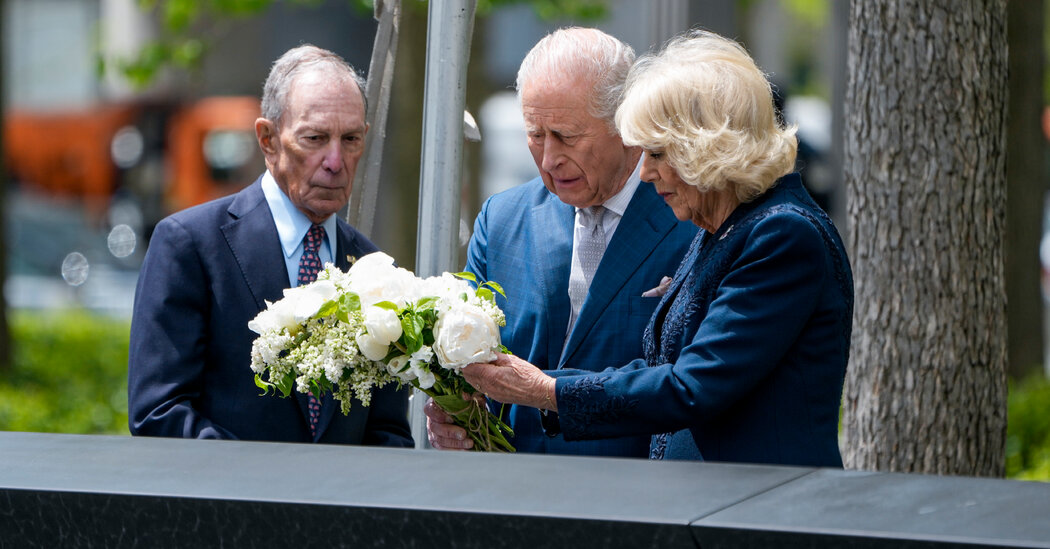
The itinerary began early, with a poignant stop at the 9/11 Memorial in Lower Manhattan, a solemn nod to the dark chapters shared between the two nations. Here, amidst the reflective pools etching the names of nearly 3,000 victims, King Charles III laid a bouquet of white lilacs, sweet peas, peonies, and daffodils—a floral tribute symbolic of memory and renewal. Accompanied by former Mayor Michael Bloomberg, the chairman of the memorial foundation, the king and queen greeted families of the fallen and first responders in crisp uniforms. It was the first such visit by a British monarch since the site’s 2014 opening, a gesture that paid homage to the 67 Britons lost in the attacks. Standing before the cascading waterfalls, visitors felt the gravity of that September morning in 2001, when jets shattered the sky and the world watched in horror. For Charles, who had called upon NATO allies to stand together then, it was a moment of profound resonance. Afterward, the couple dispersed to their separate engagements, the king heading uptown to Harlem’s verdant spaces, while Camilla ventured to Midtown’s literary heart. This structured yet fluid schedule mirrored the broader themes of their U.S. trip: balancing solemnity with joy, tradition with innovation. As they moved through New York’s diverse neighborhoods, it became evident that this was more than tourism; it was a narrative of reconnection, a reminder that even in an era of geopolitical fractures, shared values could foster harmony. The day’s activities, free from the political skirmishes of D.C., allowed the royals to engage authentically—feeding chickens, reading to children, mingling with elites—painting a picture of a monarchy attuned to the pulse of modernity.
In Harlem’s Gardens: King Charles’s Hands-On Lesson in Sustainability
Uptown in Harlem, where the rhythms of jazz and the spirit of resilience define the neighborhood, King Charles III stepped into a world far removed from Buckingham Palace’s gilded chambers. At Harlem Grown, a nonprofit urban farm pulsing with life, he met a group of eager schoolchildren who greeted him outside the chicken coops with infectious enthusiasm. “I like your hair,” one child piped up, drawing a warm chuckle from the 74-year-old monarch. “Do you? Good,” he replied with characteristic charm, his eyes twinkling behind his glasses. When offered the chance to feed the broiler chickens, he seized it eagerly, scattering greens into the coop with the eagerness of a seasoned farmer. This wasn’t mere photo fodder; it was a reflection of the king’s lifelong passion for the environment—a man who, at his Gloucestershire estate, tends an organic garden and champions sustainable practices. In speeches across the globe, he’s warned of climate change’s grim toll, urging generations to seek harmony with nature. Just a day prior, addressing Congress, he’d invoked “our shared responsibility to safeguard nature, our most precious and irreplaceable asset.” Facing lawmakers, he decried the “collapse of critical natural systems,” a clarion call that resonated amid global debates on ecological peril.
Harlem Grown’s farm, nestled in a converted brownstone lot, is a testament to urban renewal—a little oasis amid the city’s concrete jungle. Raised bed gardens burst with vegetables, a greenhouse hums with warmth, beehives attract pollinators, and a composting station transforms waste into bounty. Under a covered patio, the children nibbled snacks, their laughter mingling with the clucks of hens and the buzz of bees. For the king, this visit was deeply personal; his advocacy stems from years of witnessing deforestation and biodiversity loss. At Highgrove House, his family home, he experiments with regenerative agriculture, proving that royalty can be green. Before departing, he presented a gift—a box of honey from his own Highgrove bees—to the farm’s founder, a gesture that bridged continents through shared stewardship. In a time when cities grapple with food insecurity and environmental degradation, initiatives like Harlem Grown offer hope, empowering youth through hands-on education. King Charles’s presence wasn’t symbolic; it amplified the farm’s mission, showing how royal influence could spotlight grassroots efforts. The children, oblivious to protocol, saw a king who shared their love for simple joys—like tossing feed to poultry. It was a moment of unguarded connection, where hierarchies dissolved, and the future stewards of the planet, both young and seasoned, mingled in harmony.
Queen Camilla’s Literary Enchantment: A Rendezvous with Winnie-the-Pooh
While her husband tended to hens and hopes in Harlem, Queen Camilla, with her sharp wit and literary flair, ventured to the New York Public Library on Fifth Avenue—a bastion of knowledge towering over Midtown Manhattan. There, she promoted her beloved charity, the Queen’s Reading Room, and indulged in a whimsical encounter with one of literature’s most enduring icons: Winnie-the-Pooh. The stuffed bear, a relic from the 1920s, had once belonged to A.A. Milne’s son, Christopher Robin, and now resided in a climate-controlled case alongside its plush companions—Kanga, Piglet, Eeyore, and Tigger. Notably absent was Roo, lost decades ago in an English orchard; Camilla remedied this with a bespoke replica, presented on a Union Jack cushion, a thoughtful nod to the tale’s British roots.
Gathered around the exhibit were schoolchildren, their faces alight with wonder. “Hello, children,” the queen addressed them warmly. “Hello, Your Majesty,” they chorused back, their voices a unified wave of politeness. Seated amidst the group’s innocent awe, she shared the magic of reading, joined by Jim Cummings, the actor who has voiced Pooh in films since the 1980s. Together, they unfolded pages from Milne’s stories, weaving enchantment with playful narration. “Reading has the power to change its visitors,” Camilla remarked, her words carrying the weight of personal conviction. She recounted how childhood novels introduced her to America long before her feet touched its soil, calling books “best friends in good times and bad.” Her initiative, the Queen’s Reading Room, has blossomed beyond expectations, fostering literacy worldwide—a testament to her role as a patron of the arts and education. In an age of digital distractions, this library visit served as a gentle plea for the timeless allure of paper and ink. Pooh, the bear of “little brain” fame, embodied comfort and community, much like the royals’ own outreach. Camilla’s engagement wasn’t scripted; it flowed with genuine affection, connecting generations through stories that transcend borders. As the children departed with new inspirations, the queen’s presence illuminated the library’s role as a sanctuary of imagination—a far cry from her diplomatic duties, yet equally essential.
Reflections at the 9/11 Memorial: A Monarch’s Tribute to Shared Sorrow
The day’s solemn anchor came early at the 9/11 Memorial and Museum, where King Charles III and Queen Camilla paid respects in Lower Manhattan—a site etched in collective memory as the wound of a world forever altered. For the king, it was his inaugural visit as a monarch to this hallowed ground, inaugurated nine years prior amid healing rituals. Accompanied by Bloomberg and flanked by uniformed firefighters from the NYPD, Port Authority PD, and FDNY, the couple laid their fragrant bouquet beside one of the twin reflecting pools, where waterfalls plunge into abyssal voids inscribed with victims’ names. The air hung heavy with reverence, a reminder of that fateful Tuesday when terrorists hijacked planes, toppling towers and shattering lives. Sixty-seven Britons perished, their deaths a poignant thread linking London’s stoicism to New York’s grief.
Mayor Zohran Mamdani, New York’s progressive leader and first South Asian heritage mayor, attended briefly, exchanging words with the king but forgoing a private tete-a-tete. Mamdani had previously voiced his desire to address colonial blemishes, hinting at returning the Koh-i-Noor diamond—stolen from an Indian prince and gifted to Queen Victoria—to its ancestral land. This subtle tension underscored the visit’s political undercurrents, echoing lingering debates over the British Empire’s legacy. Yet, amid the sorrow, the royals extended empathy, greeting survivors and families with quiet dignity. Charles, in his Congressional address the day before, had evoked 9/11, pledging, “We stood with you then, and we stand with you now in solemn remembrance.” The memorial’s design, by Michael Arad and Peter Walker, transforms tragedy into tranquility—water mirroring sky, names forming an intimate narrative. For the couple, racing past protocol to honor this historic alliance, it was a bridge across oceans: NATO’s Article 5 invoked, pulling allies into Afghanistan and Iraq’s quagmires. In New York, this act of remembrance reaffirmed transatlantic solidarity, a counterpoint to divisions wrought by time and ideology. As the morning sun dappled the bronze parapets, the royals’ presence humanized history, showing how monarchy could serve as a vessel for reconciliation in an unpredictable world.
Evening Elevation: King Charles Rubs Shoulders with Titans of Industry
By twilight, King Charles III ascended to the 65th floor of Rockefeller Center, where the iconic building’s Art Deco splendor provided a grand stage for mingling with American enterprise’s titans. The reception, a curated affair, saw the king engaging with about 15 corporate luminaries over an array of canapés—crispy vegetable spring rolls glazed in balsamic, pea empanadas, conical fish and chips with herb-kissed tartar, and bite-sized beef Wellingtons drizzled in Béarnaise. It was a far cry from Harlem’s earthy simplicity, here the air charged with the energy of innovation and influence. Charles, ever the conversationalist, navigated discussions that spanned business moguls and million-dollar deals, his environmental ethos finding common ground in sustainable ventures. Rockefeller Center, born from John D. Rockefeller Jr.’s vision and now a hub for media and finance, symbolized the skyline’s ambition, much like the king’s own push for green enterprises.
This evening blend of opulence and opportunity highlighted the U.S. visit’s thematic core: celebrating shared creativity and values. From the farm’s future farmers to corporate visionaries, the day wove threads of inspiration, despite D.C.’s jagged edges. As night deepened, the couple proceeded to Christie’s Auction House, where a star-studded gala co-chaired by Lionel Richie glittered with celebrities—Anna Wintour’s elegance, Iman’s iconic poise, Martha Stewart’s domestic finesse, Donatella Versace’s flamboyance, Karlie Kloss’s youth, Meghann Fahy’s silver-screen glow, and Leo Woodall’s charm. Here, Charles thanked Richie, quipping about his voice—perhaps “gargling port”—a light-hearted jibe that drew laughter from the elite crowd. Reflecting on the King’s Trust, a UK charity aiding youth, he spoke of “enduring cultural bonds,” rooted in “creativity, enterprise, and values,” proclaiming America and Britain “greater together.” It was a crescendo of diplomacy, where laughter mingled with legacy, proving that royalty could bridge worlds amidst cocktails and canapés.
Echoes of a Royal Odyssey: Bonds Forged in Diversity and Resilience
As their New York sojourn concluded, King Charles III and Queen Camilla had traversed the city’s tapestry—from grief’s quiet pools to culture’s joyous peaks—embodying the visit’s promise of unity. This four-day American pilgrimage, amid the 250th anniversary festivities, transcended mere protocol; it was a tapestry of humanity, where a monarch fed chickens in the shadow of skyscrapers and a queen enchanted children with tales of bears and books. Despite undercurrents of historical discord, such as the Koh-i-Noor’s shadow or 9/11’s enduring ache, the day underscored resilience and rapport. Charles’s eco-advocacy resonated in Harlem’s soil, Camilla’s literary heart warmed Midtown’s halls, and their collective presence honored sacrifices past while envisioning futures shared. In a globe divided by politics and pandemics, this royal dance through New York’s veins reminded us of enduring alliances—transatlantic threads of creativity and citizenship. As they departed for further horizons, the couple left echoes of harmony: a testament that, even in complexity, connections could flourish, one handshake, one story, one shared moment at a time. Remy Tumin contributed reporting.