





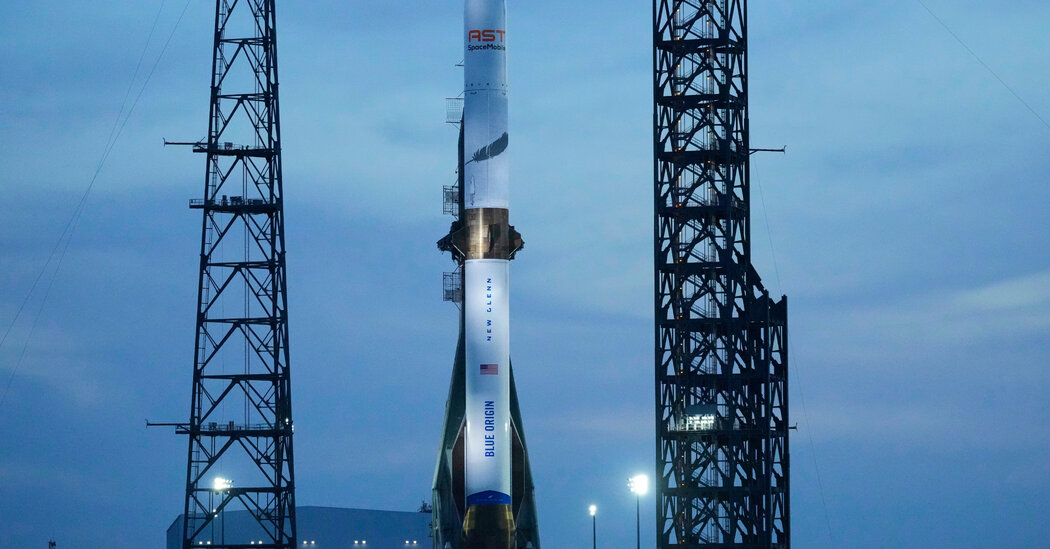
Space exploration has always been a high-stakes endeavor where triumph and disaster exist on a razor’s edge, a stark reality that hit home violently on a Thursday evening in Florida. Under the dark, humid canopy of the Space Coast, the hum of quiet anticipation turned into a deafening roar and a blinding flash of light as a massive rocket built by Jeff Bezos’s Blue Origin exploded on its launchpad. The incident occurred at approximately 9 p.m. during a critical pre-launch operation known as a “hotfire” test, designed to push the limits of the vehicle’s propulsion systems while keeping it securely tethered to Earth. The goal was to fire the New Glenn rocket’s seven powerful main engines simultaneously, simulating the immense forces of liftoff. Instead, a sudden, catastrophic anomaly occurred. Witnesses watched in horror as bright orange flames began to lick up the pristine white sides of the 322-foot-tall booster, culminating in a colossal fireball that completely enveloped the launch area and sent shockwaves through the surrounding night air. In the agonizing moments that followed, the immediate anxiety was not for the millions of dollars of hardware, but for the human lives stationed nearby. Word quickly spread through the aerospace community, and a wave of profound relief washed over everyone when Blue Origin released a statement confirming that all personnel were safe and accounted for. This simple phrase—”All personnel have been accounted for”—served as a powerful reminder of the human cost that underpins every launch. Behind the steel, fire, and fuel are the hundreds of engineers, technicians, and safety officers who put their hearts and lives into these monumental machines. While the destruction of the rocket was a severe blow, the preservation of human life remained the ultimate victory of the night, leaving the physical wreckage as something that could be repaired, even if the road ahead would be long and arduous.
The physical devastation left in the wake of the fireball is immense, dealing a crippling blow to the infrastructure of Cape Canaveral Space Force Station. The explosion severely damaged Launch Complex 36, the only pad Blue Origin possesses capable of hosting the massive New Glenn booster, a towering marvel of engineering named in honor of John Glenn, the legendary first American to orbit our planet. Repairing this highly specialized facility, which is packed with intricate plumbing, high-voltage electrical systems, and cryogenic fueling lines, will not be a matter of weeks, but likely many months of grueling, painstaking labor. The disaster also reverberates through the commercial satellite sector. This particular rocket had been slated to carry forty-eight satellites into low-Earth orbit for Amazon’s highly anticipated Leo constellation, a direct competitor to Elon Musk’s SpaceX Starlink network. By a stroke of immense good fortune, these invaluable pieces of technology were not yet loaded onto the vehicle, saving Amazon from a double catastrophe. Nonetheless, the loss of the launchpad effectively freezes the rollout of Amazon’s internet constellation, leaving teams of engineers in limbo as they wait for a place to fly. For the hundreds of workers who spent years designing, assembling, and testing this specific rocket, seeing their hard work reduced to ashes in a matter of seconds is an emotionally exhausting experience. The launchpad was more than just concrete and steel; it was a harbor of dreams, a physical gateway to the future that must now be entirely rebuilt from the ground up by a workforce already exhausted by the relentless demands of the modern space race. It requires a unique psychological resilience to sweep away the scorched metal of your own creation, roll up your sleeves, and begin again, knowing that the eyes of the entire world are watching and judging your every step.
In the immediate aftermath of such a public failure, the spotlight inevitably turned to the leaders at the helm of these multi-billion-dollar endeavors, revealing the deeply human side of a fierce industry. Jeff Bezos took to social media with a message that struck a balance between vulnerability and defiance, acknowledging the pain of the moment while reaffirming his commitment to the grand vision of space travel. “It’s too early to know the root cause but we’re already working to find it,” Bezos shared, adding, “Very rough day, but we’ll rebuild whatever needs rebuilding and get back to flying. It’s worth it.” This raw acknowledgment of a “very rough day” resonated deeply with space enthusiasts and industry veterans alike, reminding the public that behind the gargantuan wealth of these tech barons lies a genuine, fragile human passion for exploration that is severely tested by moments of profound failure. In an unexpected and heartwarming display of solidarity, Bezos’s chief rival, Elon Musk, put aside their long-standing corporate feuds and legal battles to offer a hand of digital comfort. Musk, who has experienced his own dramatic share of explosive setbacks on the launchpads of Texas and Florida, wrote on X, “Sorry to see this, I hope you recover quickly.” This simple gesture highlighted an unspoken bond shared by those who try to conquer the heavens: they know that rocket science is an incredibly unforgiving beast, and that a failure for one is a sobering reminder of the difficulties they all face daily. It demonstrated that at the highest levels of cosmic ambition, empathy often overrides commercial rivalry, as both men recognize that the path to the stars is paved with the wreckage of hard-learned lessons.
Beyond the immediate corporate and financial fallout, the destruction of the Blue Origin launchpad sends a distressing shockwave through NASA’s ambitious timeline to return humans to the lunar surface. The American space agency is currently operating on an incredibly tight schedule with almost zero margin for error, and they have relied heavily on a dual-provider strategy involving both SpaceX and Blue Origin to ferry astronauts from lunar orbit down to the dusty ground of the Moon. This ambitious lunar architecture is highly complex and depends on a series of flawless, successful New Glenn launches to place the massive Blue Moon lander into position. With the Artemis III mission scheduled to launch as early as next year, astronauts were prepared to practice critical docking maneuvers with these landers while remaining in Earth’s orbit inside their Orion capsule. Now, with Blue Origin’s sole launchpad in ruins, the company’s ability to actively participate in these historical training missions is in serious jeopardy, threatening to delay a return to the Moon that has been decades in the making. The disappointment is deeply personal for the astronauts themselves, who train for years, simulating every possible outcome and sacrificing family time, only to find their real-world timelines subject to the unpredictable whims of fuel and steel. NASA’s leadership summarized this collective anxiety and determination on social media, noting that “spaceflight is unforgiving, and developing new heavy-lift launch capability is extraordinarily difficult.” The agency now faces the daunting task of working alongside Blue Origin to investigate the anomaly, recalculating the delicate timelines of the Artemis and Moon Base programs, and trying to salvage a dream of human spaceflight that suddenly feels a little further out of reach, reminding us that the road to the stars is never guaranteed.
This latest catastrophe is a stark reminder of the tumultuous history that New Glenn has experienced throughout its lifetime, painting a vivid picture of the relentless trial-and-error nature of modern rocketry. Prior to this explosion, the rocket had completed three official launches, showcasing a bittersweet, mixed record of soaring triumphs and sudden, heartbreaking failures. The initial debut mission back in January 2025 felt like a triumphant milestone when it successfully carried a test satellite into orbit, though the celebration was cut short when the booster failed to safely land on its designated recovery barge waiting in the turbulent waters of the Atlantic Ocean. The second flight brought a wave of much-needed hope, executing a flawless launch that hurled NASA’s ESCAPADE mission toward Mars and successfully landing the massive booster back on Earth to the cheers of ecstatic engineers. However, the high-stakes gamble of reusing components proved costly during the third launch; while the reused booster once again landed safely, a critical second-stage malfunction ultimately stranded its payload—a sophisticated satellite for AST SpaceMobile—in an unsustainably low orbit where it eventually burned up in the atmosphere. This roller coaster of emotions is the daily reality for the workforce at Blue Origin, who must constantly navigate the psychological highs of successful liftoffs and the crushing lows of orbital failures. The fiery setback on the launchpad is just the latest, and perhaps most physically damaging, chapter in this ongoing saga of trying to tame the extreme physics required to escape Earth’s gravity. It illustrates that even the most advanced technology, backed by billions of dollars and the world’s finest minds, can be humbled in an instant, proving that the margin between a historic breakthrough and a smoldering ruin is often just a fraction of a second.
As the smoke clears over the Florida coastline, a profound sense of community resilience has taken hold of Cape Canaveral, proving that the human spirit cannot be easily dampened by a momentary catastrophe. Local leaders, including Republican Congressman Mike Haridopolos, immediately voiced their solidarity with the hardworking men and women of the Space Coast, expressing deep gratitude to the first responders, engineers, and launch crews whose rapid action prevented a bad situation from becoming a human tragedy. The local economy and identity of this region are deeply intertwined with the fortunes of the space industry; when a rocket fails, the entire community feels the tremor, yet they also share in the collective determination to rebuild. The road ahead for Blue Origin will be intensely difficult, requiring an exhaustive forensic investigation to locate the very root cause of the anomaly, followed by months of grueling physical labor to reconstruct their sole launchpad. Yet, the history of space exploration is defined not by how often we fall, but by how we stand back up, wipe the soot from our faces, and keep looking toward the sky. The dream of landing rovers on the moon in 2028 for the Artemis IV and V missions and eventually establishing a permanent human presence on the lunar surface remains alive, fueled by the passion of thousands of people who refuse to let fear of failure ground their ultimate ambitions. As Blue Origin prepares to rebuild, the world is reminded that every explosion on a launchpad is not just a commercial setback or a mechanical failure, but a deeply human lesson in patience, courage, and the unyielding drive to explore the great unknown. This setback, while painful, is merely a detour on a long journey that humanity has committed to walk, proving that the stars are always worth the struggle.